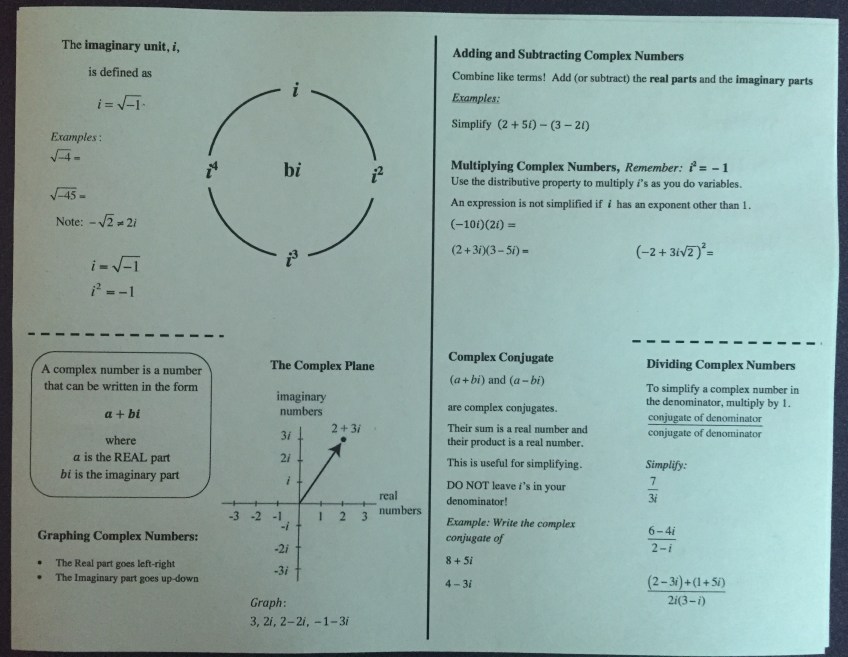
I have a few quibbles with the foldable:
page 1 line 1 : i is not a unit. 1 is the unit, algebraically speaking
page 1 line 3 : It is better to define i with “i squared = -1”, as strictly we do not know which root of -1 is the negative one !!!
page 1 the circle : It goes the other way round, and with some lines drawn they can see that multiplying something by i rotates the something through an anticlockwise right angle.
page 2 dividing : I think it is better to say “multiply the numerator and the denominator by the conjugate of the denominator”
Have you told them about 3-phase electric systems, where each phase can be represented by a complex number, which deals with amplitude and offset in one number.? This perhaps is a bit heavy for the introduction !!
Complex numbers are real fun, especially with the kids who still cling to the idea of truth in math.
Oh! I love the idea of turning the circle around, so that it matches with the graph. I have seen both, but this idea puts them together!
The articles I had the kids read before we started were all about who uses complex numbers in real life and included electric systems. I don’t know how much they absorbed but it was interesting!
 I Speak Math

I have a few quibbles with the foldable:
page 1 line 1 : i is not a unit. 1 is the unit, algebraically speaking
page 1 line 3 : It is better to define i with “i squared = -1”, as strictly we do not know which root of -1 is the negative one !!!
page 1 the circle : It goes the other way round, and with some lines drawn they can see that multiplying something by i rotates the something through an anticlockwise right angle.
page 2 dividing : I think it is better to say “multiply the numerator and the denominator by the conjugate of the denominator”
Have you told them about 3-phase electric systems, where each phase can be represented by a complex number, which deals with amplitude and offset in one number.? This perhaps is a bit heavy for the introduction !!
Complex numbers are real fun, especially with the kids who still cling to the idea of truth in math.
Oh! I love the idea of turning the circle around, so that it matches with the graph. I have seen both, but this idea puts them together!
The articles I had the kids read before we started were all about who uses complex numbers in real life and included electric systems. I don’t know how much they absorbed but it was interesting!
Thanks, as always, for the excellent feedback! 🙂