Favorite Math Class Website – MS Sunday Funday

Click here to submit your MS Sunday Funday post!

#msSunFun

Student Thoughts about the Khan Academy

I went to a “Technology Meets the Brain” conference on Wednesday.  It was a full house of energized teachers who love technology and are striving to make their teaching better through research by attending a conference.  Two teachers next to me started grumbling when the Khan Academy was mentioned.  Upon saying, “Not a big fan of the Khan Academy?”, the teacher next to me opened up.  Their two middle school aged children were required to do Khan Academy at their school.  When I asked them if their children liked it, “NO!” was their emphatic answer.  They told me that their children were not only required to become proficient in EVERY topic, but they also had to watch all the videos.  The Khan Academy software can track if the students watch the videos, so their children now hit the play button and then go and do other homework, then come back to work on the problem sets.  But the worst part, they told me, were the problem sets.  Some problem sets take a very long time to become proficient in.  And, if you accidentally type in something wrong you have to do many more problems.  Their children have been doing this since August, and they are sick of it.  They said that they and their children hated the Khan Academy.  Both of these friendly, engaging women are teachers.  And both of them are working to change things for their children.  They want their children to love math, especially in middle school where they know many students are lose interest in math forever.

They were looking for research to enlighten their children’s teachers.  When I started telling them about some of the criticism I had heard, they asked for links and sent me their email.  I emailed them links to some of these criticisms, which included:

I rarely use the Khan Academy, and only as a tool.  I do not use it to “flip” my class and I never assign the videos.  There are much better videos out there if you are willing to spend the time looking for them.  Like any other homework I assign, I only to ask them work for a maximum of 20 minutes.  Mostly, I have students use it for remediation and extra help or extra practice if they want it.

I should love the Khan Academy problem sets because kids get immediate feedback and I get tons of data.  But I don’t love it, so I don’t use it very often.  And after one really bad Khan experience, I do not require my students to become proficient in any topic.  Just like Fawn, my students really hate the fraction sets (and a few others), but they seem to like the new “Intuition Sets” (thanks to all the MTT2K’s for bringing this about).  I also dislike that I don’t have a place on their site where I keep the sets I want to use for easy assignment.

I was very surprised by my encounter with the two teachers and their strong reactions, especially since their children were such frequent users.  So, I decided to survey my students about their thoughts on Khan.  Since I am pretty ambivalent about it, I expect them to feel the same way.  I was surprised at the results.  Overall 6th graders ranged between liking and loving it, while 7th graders ranged from not liking it to hating it.  All of my students become frustrated when it takes “forever” to become proficient in a topic on Khan, especially if it is due to their frequent typing errors during solution entry.  “I had a negative on my paper but didn’t type it in!” or “I hit enter too soon!”  And even students that like the problems sets rarely watch the videos.  When asked how often they watched the videos, 75% of my students said rarely or never, 25% said occasionally and none of my students said often.

6th Grade Results

My 6th graders are first time computer owners, so they love anything technology.  As I very infrequently assign Khan sets, and never require proficiency, they have not really had a bad experience with it (where they were required to become proficient for class and it took them hours).  When I surveyed them about Khan I was surprised to see that several of them actually love it.  They said that it was fun and love earning points, even doing simple addition and multiplication sets just to earn extra points.

7th Grade Results

On the other hand, with the exception of only one student, most of my 7th graders HATE it.  I was actually quite surprised at this result as well.  I had never asked them if they liked it or not, and was not aware they felt so strongly against it.  I’m not sure what the big difference is between 6th and 7th grade.  ONCE I required that the 7th graders become proficient in one fraction topic.  They had a terrible time with it.  As soon as some of them told me how much they had been working on one set I told them that they did not have to become proficient.  Maybe this experience is what did them in.  I plan to look into this further with them.

What my students said they like about the Khan Academy:

  • “It’s a fun, new way of learning.”
  • “I like that it helps you through the steps”
  • “its fun and you do it for points too, not just work”
  • “Good practice”
  • “i like it because you can practice without worksheets.”
  • “I like how it helps with math.”
  • “It inspires me!”
  • “I like that it gives you points that you have to work up to”
  • “we can earn badges and unlock new characters”

What my students said they do not like about the Khan Academy

  • “It’s boring.” (70% of 7th graders said this).
  • “I don’t like how you have to do several more sets if you miss one problem by a careless mistake.”
  • “I do not like how if you get one problem wrong to are not in the blue section.”
  • “Because if i do not understand something I need 1 on 1 help not a computer.”
  • “It is hard to figure out equation bars, like the fraction, and if you do not do the right bar you get it wrong when the answer is right.”
  • “They do work a little different than we do in class.”
  • “They are worded weirdly.”
  • “More work less game.”
  • “I don’t like how it will just give you the answers.”
  • “the *help me* button is usually a different method than what we learn”
  • “When you mess up barely on one problem you have to do a whole other set”
  • “If you don’t have a link, it can sometimes be hard to find the problem sets and then you are looking at videos instead of problem sets.”
  • “It is confusing”
  • “Hard to use”

I recently stumbled upon the Khan sets for graphing systems of equations with slider bars that I would like to try out with my 7th grade.  It seems to be a fast, neat way to check your graphs of linear equations and see if you are getting the correct answer.  But only time will tell if it is a success, as my 7th grade students are Khan’s toughest critics.

The software I am dying to try out with my students is Ten Marks.  I just haven’t had the time to get organized.

Do you use Khan Academy with your students?  If so, how do you use it and do they like it?


Barbie Bungee Follow Up – Be Careful When Using “The Recipe”

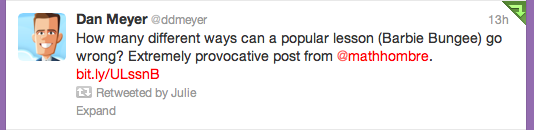
Last night, I saw this tweet from Dan,

Screen Shot 2013-02-02 at 12.14.39 PM

that led me to John’s post about his recent experience with the Barbie Bungee activity.  This is a great post, and there is a great discussion going on in the comments right now about how some activities can feel like a recipe and what we can do as teachers to change that.  Most of my projects for my first two years were recipes, and I have been trying desperately this year to change that!

Until this year, I had no idea how engaging student wondering, student questions, and student creativity would be for the actual students.  I had been reading about it via Dan’s blog any questions (#anyqs) and 3-acts.  As a teacher, I know that every lesson needs a great hook to fully engage students.  It was not until this summer however, that I actually got to experience this myself, as a student would, through Max’s “Wonderings” session at TMC12.  Now, for me “the hook” is not only the hook I would have used before (something interesting to them via an article, multimedia,…), but it also involves student wonderings and questions.  Since then I have observed that when students have time to wonder and develop their own questions, they become not only engaged but immersed in the activity.  Just by me talking (and instructing) less, and letting them wonder more, my students have naturally become more engaged and interested in the math.  They discover that they need to know more math to get to the next step, and this is when I give them instruction.  It is instruction during the project as they need it, not before.  Activities are projects are not afterthoughts, they are the lesson.  When they need the math to figure out their own questions, they work harder and longer, and they actually care about what they are doing.  When they create it, they own, and this is where I have seen them grow and learn the most!

I wanted to post this response on my my blog because I have touted the glory of the Barbie Bungee lesson.  I posted just the facts, my “recipe”, but I now realize that I left the most important part of my lesson – emphasizing the wondering.  With any activity, you have to be careful or it can end up just like a recipe.  Looking back, the projects that I have done for the past two years in my classes have been mostly recipes.  Since I experienced “wonderings” this summer, I work very hard to NOT let my activities develop as recipes.  Sometimes I am successful and sometimes I am not.  There is still so much I need to learn, and never enough time!

For Barbie Bungee,  I spent almost the entire first class period on “the hook”, “wonderings”, and student questions and creativity.  For the hook I showed them the Bungee Videos that they loved.  I had them create their own Barbie Bungee Companies but gave them very little directions other than, “Brainstorm things a successful company needs.”  From this they came up with company names, company slogans, and company goals.  Their goals were like the “any questions” I was hoping that they would come up with, similar to what I have seen come from a “First Act”.

Only after they decided to give Barbie the biggest drop without killing her and started talking about how to estimate the number of rubber bands did I give them the instructions worksheet.  I probably could have done this without the worksheet.  But, I like that it had the Barbie Bungee slipknot instructions on it.  I love to give middle school students opportunities to read and follow directions and knew that consistent results (from consistent rubber band knotting) would help us draw better generalizations in the end.  Fawn is considering going without the worksheet next time around.  I’ll see how that goes before I jump.

After collecting the data on the jumps, I did not have my students analyze the chart at all.  Instead, I had them plot their data.  When they did this, they noticed that it correlated and asked me how they could use this to make a better prediction.  I instructionally guided them and reminded them of the line of best fit.  This led them to their predictions for the test jump.

Another instructional opportunity came after the test jump.  When their Barbies hit the ground or fell short, they wanted to know why, and where they had gone wrong.  I encouraged them to put this new “test jump” on the data chart and on their graph.  This is when many noticed that they needed to adjust their line.  Almost every students second test jump was successful.  In all of this we did not calculate, we just predicted.

The “BIG JUMP” (13 feet), was more like the beginning of an “Act 3”.  Was their math correct?  It was exciting because the students loved seeing the Barbies jump – and loved to see their math work!  The finale was putting their data into the linear regression calculator, to see how many rubber bands they should have used and how close their predictions had come to the actual math.

I did not end this project with any giant math lesson.  In fact, this entire project for me was to create more wondering about linear relationships for our NEXT project where we would need to learn how to do the calculations.  Their wonderings were amazing.  They wanted to know things like, if they could predict Barbie’s fall with a linear equation, what else out there could they predict?  Does this work with anything else?  Does this work with everything else?  When does this not work?  It has led to three subsequent projects and we are starting a fourth in the next week.  In this, Barbie Bungee was not an activity in itself for my class, but the hook for all future linear equation work.

In a recent survey I gave my students, they said that they had the most fun with the Barbie Bungee activity, but that they learned the most “math” from our nutrition project (two projects later).  That, to me, is progress.