Index Card Flip Charts

I have the students make index cards in class each day in place of taking notes on paper.  They keep these index cards on a ring and refer to them for their nightly homework and to study for tests.   My previous post on index cards.

The only problem with this system is that the cards add up rather quickly, especially as you cover more chapters.  I used to have my students “file” these cards by chapter in an index card box after we completed the chapter.  But, there were many problems with this.  The boxes were large so it was difficult to keep them with them and they were left at home or in the locker.  But, the biggest problem was that once they were “filed” the index cards were never to be seen again (we all know how that goes right)?  And, if they did need to refer to one, they had to make an effort to look it up (which meant it never happened).

Brainstorming about this system with some wonderful math teachers on Twitter gave me the idea to put all of the index cards on one sheet of paper after the chapter is finished.  Then druinok took it one step further and came up with the fabulous suggestion of making a “flip chart” of the finished cards.  I loved this idea and ran with it!

Now, once the chapter is complete I have them take the index cards off of the ring and tape them to a piece of card stock.  They keep this sheet in the “permanent” section of their notebooks the entire year.   I have them do this so that they can quickly and easily refer back to concepts that we covered in past chapters.  After the flip chart is made, they can clean all of the paper from the past chapter out of their notebooks (additional notes, warm-ups, and homework they have completed).  This replaces many pages in their notebooks with one page.  So, they will have ONE index card flip chart per chapter that they keep in their notebooks.  This will hopefully help when we are using a concept that we learn (like simplifying algebraic expressions on a new concept like solving equations that involve algebraic expressions that they have to first simplify).

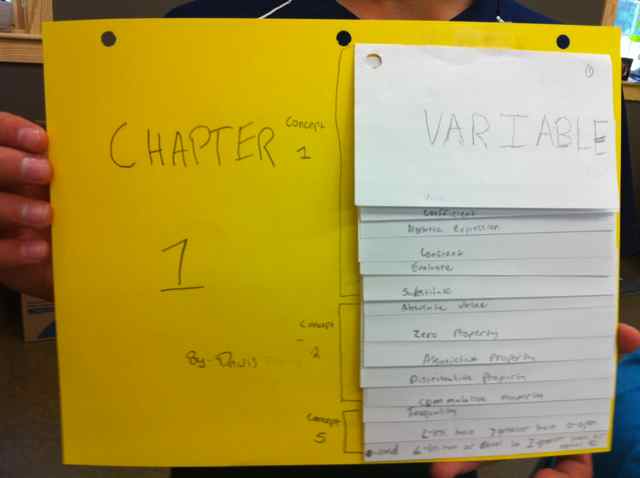
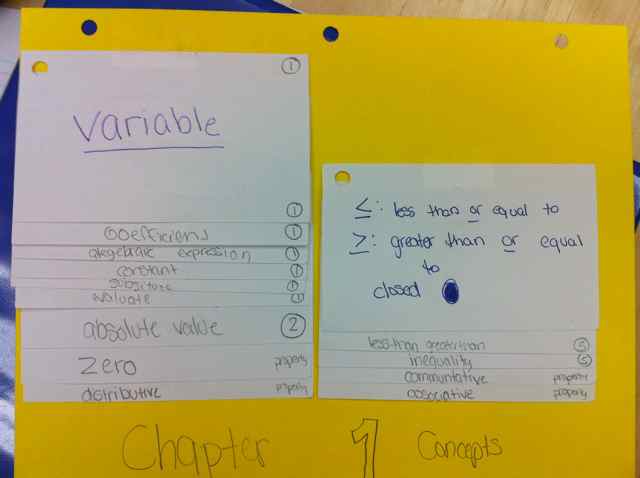
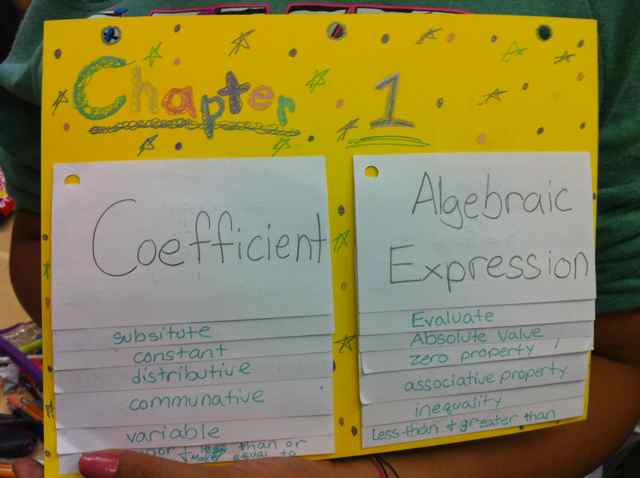
Here are some pictures of the student flip charts for chapter one, concepts 1 – 5.

To make the flip chart work, you need to ensure that the students flip the cards up when writing on the back so that the notes won’t be upside down.   Once the students started taping the cards to the charts, the magic started happening.  Students are fabulously intelligent and creative and always give me my best ideas.  They came up with three things that I LOVE.

  • Writing the title of the card at the bottom so you can see what cards are underneath
  • Writing and circling the concept number right next to the title so that you can easily go to a concept you love.
  • Writing the concept name on the card stock next to the cards so you can see where each concept is.

Suggestions and comments are always welcome!   : )

First Two Weeks in Middle School!

6th
Week 1

  • Measured each other!
  • Exponents, including negative exponents and scientific notation (Powers of 10 Video was a big hit)
  • Learned how to submit onto a Google Form for my Homework Data survey

Week 2

  • Order of Operations (GEMS)
  • Properties (they loved THE CLAW)
  • Turning WORDS into MATH

7th

Week 1

  • Growth – measured each other
  • Evaluating Algebraic expressions
  • Evaluating Algebraic expressions
  • Properties

Week 2

  • Integer Operations
  • One and Two step equations (showed them Hands On Equations)
  • Population Density

Uh-oh! I’m Forgetting What They Mess Up!

I love that I am a HS teacher teaching 6th and 7th grade. I am their first stop in Algebra. And, I know what they really need to remember. However, I am afraid that I may forget what they mess up on a regular basis! Some things are obvious – like canceling out individual terms in expressions. But, some are more forgettable.

Tonight on Twitter, druinok posted
how to fix kids from doing 3|x+4| = 3x+12??

Ok, totally forgot about that one!

Yes, I did teach them the distributive property last week using, “THE CLAW!!!” and then two days later taught them absolute value and told them that they could not distribute into the | |. Give it one day, take it from them the next. The question is, are they EVER going to remember that random bit of miscellany until they do it for a few years? Doubtful. So, what do we do as teachers? Make it memorable! How am I going to do that? Well, since we aren’t graphing yet I can’t make them believe that. However, I can tell them that the BARS keep out the CLAW. I am going to tell them this ALOT and we are going to do ALOT of problems. Hopefully it will stick!

So, all of you Algebra teachers out there, if you want to comment to me what drives you CRAZY as you come to it so I won’t forget, I would really appreciate it! Hopefully, I can find a way to permanently imprint the correct way into their heads! : )

Wiki’s, Google Docs, and Population Density in Math!

** All links I refer to are listed at the end. **

On Friday I did an integration unit with social studies.  They are studying Japan and population density.  We got wifi in our building late Wednesday night, so I decided it was time to “break out” the laptops on Friday!

I used a fabulous lesson that I found on NCTM Illuminations called “Five’s A Crowd”.  It was a great activity so I only had to modify it slightly.  It covered population density, ratios, and even estimation!  And, it had a game element so it was very fun! I used their grid worksheet but modified their game sheet.  Of course it was my first time doing anything like this so we had some bumps in the road, but next year it will be so much better!

1)  First the students distributed rice onto grids to visually compare population density of two communities, and to create a definition of population density.  The only thing I had at home that was small enough for the grids was arborio rice.  So, I used colored paper so the rice would show up better.  The kids loved the rice (apparently it was tasty and of course I let them eat it after the activity was over).  But, it was very hard to move around because it was so small.  Next year I am going to enlarge the grids and use a small dried bean – like black beans.

2)  Then we talked about the density of the United States.  We wrote down the exact population and area of the US and then I had them estimate the population density without using a calculator using the definition that we found in number 1.

3)  Next, I gave them the “game sheets” and they had 5 minutes to try to estimate the 5 densest countries in the world using lists I had compiled and put on the wiki.
**Big Bumps Here:

  • I used Box to put the files on the wiki and some kids could not download the files (it was freezing).  NEXT year I will just put the PDF on the wiki.
  • My kids needed longer than 5 minutes.  I had them write down the exact population and area of the places we picked and THEN estimate (not calculate).  So, it took them longer than I thought.  10 minutes next year!

4)  When I finally made them stop (and they didn’t want to), we were seriously running out of time.  So, even though I had planned to have them enter all five countries into a Google Document spreadsheet that I had created, I only asked them to enter their MOST dense country.  They were to enter their country, their exact data, and their estimate.  Then, I had a column that calculated the exact density so we could see how close their estimate was.  Then, I was going to sort their list and pull in the top 20 most densely populated countries to see how good their estimates were.

This is when my lesson went HAYWIRE.

First of all, I didn’t even know if the Google Docs were going to work.  I didn’t want to spend time having students sign up for accounts or sign-in so I made my document editable by everyone.  If they couldn’t enter the info, we would have skipped this part.  But, voila!  It worked!!

Since I didn’t know if it was going to work, and this was our first time using it (including MY first time), I did NOT prepare them for what would happen.  And to be honest, I didn’t even anticipate the snafu’s that we would encounter.  The kids were simply AMAZED that what they entered showed up on the projector and everyone else’s computer.  They had never seen or used this sort of interactivity.  They were very new at this and very excited, and this caused several problems:

  1. They entered the data in crazy places (ie – they deleted my title column “Countries” with their county’s name).
  2. Since they were doing it all at the same time, everyone clicked on ROW 1 to enter their data -at the same time.  Thus, one kid would start typing and then another kid would accidentally erase it.
  3. I saw this quickly and told kids to go on different lines
  4. Some students thought the deleting thing was too hilarious to resist and started deleting each others entries, it really became a “deleting war” at the end.  They thought it was funny – I (and some students) did not appreciate that.

With all of the craziness that ensued I barely got to throw up all of the amazing population density graphs I had found AND play with the SORTABLE wikipedia population density by country data that I found.  I would have liked to spend so much more time on this stuff!

Overall, though I still think the lesson was a smashing success because it was interesting, fun, and even exciting!  It was very enriching to add real life statistics and integrate their current social studies lessons into pre-algebra!  I NOW know what to expect when using Google Docs with a whole class of students at once and can prepare them, in advance!  ALL of these snafu’s were completely my fault and could have been easily prevented with proper instruction on HOW to use Google Docs to the students.  Too bad for me I just didn’t know those instructions in advance.  But, I think that we all learn best by doing it ourselves and I learned so much from this lesson!

I can’t wait to use Google Docs again in the future!

LINKS:

My Mini-SBG Experiment

The thing that I love the most about SBG (Standards Based Grading) is that both I AND the student will always know exactly what they need help with.  As soon as I realized this – I was hooked!  And, as much as I would love to jump head first into the SBG waters, I have a few obstacles in my path this year.  First, I am at a new school.  The other teachers and administrators do not know me yet, so I can’t go changing up their entire grading scheme before I even teach a day there.  Second, I am teaching a whole new grade level.  I have not even begun to plan all that I need to for this year, much less add SBG to the workload.  And third, I am a perfectionist.  So, no matter how much I read, until I really figure out this SBG for myself I just can’t commit.

But, I could not stay away either!  So, I decided to do a little mini-SBG experimenting this year.  That way, I can figure as much of it out as possible, ask lots of questions, and have so much more time to really get ready to launch!  What’s a mini-SBG look like you might ask?  Read on to see what I am implementing in my classes.

1)  I came up with my concepts list for each class.  I have approximately 50 concepts.

2)  I created (copied) a blank Concepts Checksheet for the students.  I took Dan’s and tweeked it some to work for me.

3)  I give them a pre-test on each chapter to see where they are.  This helps me condense sections they already  know large parts of and helps me focus on what I need to really work on with them.

4)  I score them from 1 (Beginning) to 4 (Exemplary).  This goes along with our rubric grades.  I only used 1 – 4 initally, but my fabulous middle school director suggested the B – E.  I like that so much better than the numbers 1 – 4 because I am VERY stingy with 4’s.  I give a 3 if you do not have the concept done perfectly.  For me, a 3 is almost got it!  But I am afraid they see a 3 as 3/4 (75%) and I don’t want that.

5) For each quiz and test I give them a concept grade for each concept covered on the assessment AND a number grade (95%).  The concept grade does NOT go into the “gradebook”.  It is just for my files and for their files to see what they know.

Yes, it is double the work because I am recording the concept grades AND the numerical grades.  However, I have already gleaned such valuable information out of this in just the first week that I feel it really is worth it.

Where My SBG is Different:

  • We make notecards as we take notes in class on key concepts.  I have them put the concept numbers on each of the notecards that they make so if they have a low score on a concept they know what to study.
  • I am using B, D, P, E instead of 1 – 4.  Still, I love it!
  • I am not re-testing.  But, I am including the concepts on each quiz and test several times so each concept will have at least 2 entries.

Kids loved seeing an improvement in the Concept Checksheet – even if they didn’t get as high of a score on a test as they would have liked.

Progressive concept questions are progressively harder.  So sometimes students go from a P down to a D.  They don’t like that.  But I tell them it is only temporary.

HELP NEEDED!
I need to organize extra work for the students (with answers) so that they may do additional work on the concepts they need help with independently.  Any idea?   Yes, I will help them.  But, then they need to know what to go and practice without me having to make up a million new practice sheets.  My MS director suggested the teacher’s edition practice workbook that goes along with the book.  I like that idea!  But, would love more!

My students are just figuring out the concept thing but so am I!  Plus, there is so much new stuff thrown at them at the beginning of the year that I doubt they have had time to absorb it.  After the first chapter I think everything will make so much more sense to them – and me!

3-2-1, Math is FUN! or HELP! My transition time is killing me!

So I have three classes of amazing, brilliant and enthusiastic students.  I have been doing many activities and group work, so it gets a bit loud for my one class that is especially enthusiastic.  My solution thus far is that I say 3-2-1, and then they say, MATH IS FUN!  Then, silence.  and wow – this does work wonders!  However, I am having to say it a couple times each period to get their attention so that I may talk to the entire class about the activity.  This is wasting time.  In addition, it takes time to hand out (and collect) all of these activities and grouping materials.  Basically, transition time is killing me!  I feel like I am not utilizing my class time to the fullest.  Yes, I am going to go back and look over Lemov and Fred Jones when I get a spare moment (unlikely), I will have to MAKE a spare moment.

But in the meantime, if you are an activity, group loving teacher I would love some tips on keeping it quick, simple, and quiet when we are so very active!

** Note – I float from room to room so I cannot leave materials out for the next class – I must collect and distribute each period.

I Just Wish I Had More TIME…

This is my first year teaching middle school.  I have two preps, 6th grade math and Pre-algebra.  The material is so much easier than anything I have ever taught in high school before.  So, why am I working so hard?

It is because when you switch subject areas or grade, it is like starting all over again.  The workload is like being a first-year teacher all over again!  Thank goodness I am NOT a first year teacher and do not have the stress of figuring out how to manage a classroom.  Whew.

As a teacher, when you change subjects or grade areas it is a mountain of work.  You have no lessons on file for every day of the 180 day school year.  You have no activities, no tests, not a thing.  Yes, we are usually left files from former teachers, and of course we have a book.  But, that isn’t really that helpful.  Even if you get a million ideas from the book, past teachers, the internet and Twitter Tweeps, that still isn’t teaching.  And, there is so much more work to be done.

Teaching is planning at least three different activities for each different subject that you have, every day.  For example, today in 7th grade we:

1)  Did a warm-up

2)  Taught a lesson

3)  Did an activity pertaining to the lesson

Tomorrow I will:

1) Give a quiz (that I had to make, and then copy)

2) Teach a short lesson

3) Teach them how to play a game that I created (and wrote the instructions for in a Word document, and then made copies of).

4)  Plan a short lesson for several students that need extra help instead of playing the game.

5)  Send them home with a worksheet that I (thankfully) found, but still have to make the answer key for and them make the copies.

And that is just in one class.  I still have 6th grade to do all of the same things for, everyday.  Please don’t get me wrong.  I am not complaining.  In fact, I LOVE what I do!  I love creating fun games and coming up with great activities that the students will not only (hopefully) love, but will learn a lot from as well.  When all of this work is done I am so happy.  Because when I am in the classroom and I see the results I know it is all worth it.  I love teaching math.

I just wish I had more time.  And, I can’t wait until NEXT year when I have the time to make it all so much better!

Marvelous Middle Schoolers!

My entire career I have only taught high school or college students.  When I told people I was going to be teaching middle school I heard all sorts of crazy stories – most of them were not good. Almost everyone would say, “Middle school?!?” and look at me like I was crazy.  So, I became a bit nervous about what I was getting into.  Thankfully, some of my favorite middle school teachers on Twitter keep me encouraged.

So, after finishing my first week of teaching middle school students I found that…

I LOVE THEM!

Before I met them, I just expected them to be smaller versions of high school students.  However, upon seeing them, I quickly realized that they were actually larger versions of elementary school students!  They seemed so young!

This youthfulness is what I am enjoying the most because here is freshness in their youth.  Best of all, they don’t hate math yet!  In high school, I usually spent as least my first month trying to win my students over.  I worked so hard trying to convince them that math is not big, bad, and boring.  Many times I was not entirely successful.  Even students I was able to convince would suspiciously look at me like I was trying to “pull one over” on them.

In middle school I have an accepting audience everyday.  They have an open attitude and unformed ideas about their math feelings.  They also love to participate and just can’t WAIT to tell me the correct answer.  They are openly excited when they know the right answer and when they first figure out a new concept.  I find this immensely pleasing as their teacher!

The only thing that I didn’t expect was how sensitive they are.  They really are larger versions of elementary school students.  A low grade on a test, a forgot homework assignment, or a lost worksheet can wreck them.  I need to remember this and try to keep my tone light and positive, even when I am disappointed.  I don’t want math to be a negative experience for them.

My favorite thing about middle school students is their boundless energy!  They are all fired up and so excited about everything!  I have always had a ton of extra energy – so this is a good match for me!  Just being around them energizes me even more though (I think we are feeding off of each other).  Together – I feel like we are just going to make magic this year!

I end this week as the best week that I have had in my entire teaching career.  And I owe it all to those magical, marvelous, middle school students.  They are just so much fun!

Teaching as a Parent

Just like Clark Kent in Superman, I take off my glasses to change my persona.  Except I’m not a superhero, I’m a Mom.  When I take off my reading glasses, I switch from teacher-mode to mommy-mode.  Just like Clark, it is not that easy to separate it all that cleanly.  Most days, I am teacher and mommy to both my children and my students.  And, I wouldn’t have it any other way.

I taught for several years before I had children, I left for 8 years, and now I am finally back and doing what I love.  But now I am older, and have an entire family at home.  This does not come without a few minor complications.  Teaching when you have children has it’s ups and downs.  I have found that doing both has made my life so much richer.  I am a much happier Mom when I get to teach.  And, I am a much better teacher now that I am a Mom.

Reasons why I am a better teacher now that I am a Mom:

  • EVERY student is somebody’s child.  They all have family at home that love them dearly and want the best for them.  They all have people who are proud of their accomplishments (or hurt when they mess up).  A dear “mommy” teacher friend told me this before I had kids.  I listened, but now I really understand.
  • Class discipline?  Get serious.  Nothing can touch 3 children under four screaming – alot.  Nothing that happens in the classroom can really “ruffle my feathers” after surviving the antics of three little BOYS under one roof – for several years.  (And, this is coming from someone who taught in the inner city the first few years of teaching.)
  • I don’t take it personally.  Living with small children has really taught me that kids usually don’t mean the bad things they say and do, they are just angry or hurt.  Kids can have crazy tempers that they just let fly because they haven’t learned to control that yet.  Plus, they get over it quickly.
  • It is usually not about YOU, it is about THEM – too little sleep? bad fight with the sibling?  not enough breakfast?  Your brother just poked you in the eye?  Yes – you are upset now, but it isn’t about ME, it is about something else.  And, it will be forgotten in five minutes.
  • I don’t care if I’m cool now.  I’m older, I have kids.  I’m over it.  It is so much easier this way.  Don’t know how (or when) this happened to me but I’m so glad it did.  I guess I just grew up!
  • Organization – This is do or die when you have kids.  You must organize or you drown in a complete time suck cycle.
  • Almost everything can be made better with food or rest.  If it can’t then…
  • ABOVE ALL you have to make time to listen to kids.  Almost everything that is left over can be made better by just letting them talk to you and telling you what is wrong.  You don’t even have to solve it.  You don’t have to even talk, you just have to listen.  Then, once again, don’t try to solve it.  Just tell them that you are sorry.  It lets them know you care.

    Why I Assign the Odds

    Assigning odds allows the students to check to see if they have the correct answer to every single problem that they attempt.  This is important because I do not want them practicing 10 homework problems incorrectly.

    Scenario One –  Student gets a correct answer
    If they do the first problem and see that they have it correct, they gain encouragement and confidently move on to the next problem.

    Scenario Two –  Student gets an incorrect answer
    If they do the first problem and then see that it is incorrect, they know they did something wrong.  Hopefully they will not continue to do the remainder of the homework incorrectly.  A student that does an entire homework assignment incorrectly has not only gained nothing, but they have committed incorrect practices to memory.

    My hope is that once they discover a problem is done incorrectly, they will research how to do it right.  They can read their book, look back into notes, search the net, call a friend, ask a parent, or email me.   I would rather a student not do the homework than do 10 problems incorrectly.

    I will look at the students’ homework each day.  I am not looking for the correct answers because they already have these.  I am looking for the correct procedures.  I want to make sure they each know how to get the correct answer.

    I believe that homework should be practice.  But for homework to be productive practice, students need to do homework correctly.  This means having the answers to all of their homework problems while they are working them.