Solving Equations – MONSTER MATH!

Solving equations is one of the MOST important things that I do with middle school students (other than fractions, of course).  I want them to learn the “process” of solving equations with simple, one-step equations.  Hopefully when we get to multiple step equations they will have a process to fall back on.

I always start with Hands On Equations.  I do not use their “number dice” because I want students to physically move EACH unit from each side.  So, I use integer counters instead.  I also made my own worksheet to go with it because it matches many online equation solving (virtual manipulative) websites.  I link to these sites on my Concept Help Pages and don’t want students to be confused.

This year, I also had students do the Khan Academy’s equation solving intuition problem set before we even started the Hands On Equations.  (Here is the explanation video – but none of my students needed it).  They understood the concept of the balance AND really got a kick out of the little characters (representing the variable) on the Khan site.  That also gave me an idea!  Khan called the guys “Pants” or “Old Spice Man” but I decided that WE would call them MONSTERS!

I used the Hands On Equation manipulates (which I called TOYS so they loved them before they even saw them) and my own worksheet (below) which they LOVED because I let them draw MONSTERS on it.  Of course we needed to get the MONSTER (x) by itself before it gobbled up the poor little integer circles.  Seriously. Gold.

OH MY!  How 6th graders LOVE monsters.  They have begged and begged to do more equation solving – just so they could draw more monsters!

This slideshow requires JavaScript.

  Day 2 we did not get out the “toys” but did do a pass-it equation solving unit where each student got to make up their own one-step equation (and thus their own monster) and then pass it to a friend for the second step.  Really, you would have thought that we were playing a game instead of just writing down and solving equations.  Day 3 we will work with on one-step equations involving multiplication and division.  I made that one a foldable for their notebooks!

I still can’t believe what the right “spin” can do to a lesson with 6th graders!  Have I said how much I LOVE 6th graders?  My worksheets are shared below.  🙂

Foldable for one step equations with multiplication and division.

Sub Plans – MS Sunday Funday

 #msSunFun

This week’s theme is Sub Plans.  Next week, the theme will be “Math Club”.

Click here to submit your MS Sunday Funday post!

Click here to submit your MS Sunday Funday post!

No Sub Plans! MS Sunday Funday

#msSunFun I’m not going to lie.  I DON’T HAVE SUB PLANS!  This is not good because I’m going to miss 3 days in October / November for school trips and the NCAIS conference (I’m presenting, yeah!).

I do have a substitute binder with overall instructions, my class lists, and two manilla folders with my seating charts in them.  But right now, that is about it!

I usually have my students work on their math wiki pages or chose topics that they need help on from the Concept Help Pages.  There, they can watch videos, do extra example problems, and even play math games!  However, even though it is FIXED now, our internet has been iffy this year, so I would love to have a paper and pencil back up plan.  My students LOVE those coordinate graph sheets that make a picture when you are done, but I can’t find any good ones.  I am thinking of assigning them the task of creating their own coordinate graph picture (for their friend to solve).  Has anyone done this?

My director suggested that I let my students play my math center games when I am absent.  That is a fabulous idea and it IS my goal, but I don’t have enough games – and it is not yet organized in a way that students can just go and pick out a game.  Also, I need an in-class “trial run” once everything is all organized and labeled so that I can help students pick out games (and put them back), the first time.  I don’t want them picking games that are too difficult for them and causing stress for the sub.  I can’t wait to have this in place for my students, but it is not going to happen by October 18th!

I am excited to read about other middle school teachers sub plans – so please post today and help me out.  🙂

Writing Word Problem Equations – Help!

Please help me make this lesson better.  The main problem was that the students did not get to practice enough problems (the rotation and the checking slowed us down).

My students need help writing equations for word problems.  Most often, they read the problem and scratch out an answer – with nary an equation in site!  To help fix this, I wanted to practice writing equations to simple, one and two step equation word problems.  I did not want it to be boring AND I wanted students to work together.  With the help of the wonderful Twitterverse, I decided to do a “Pass the Problem” activity.  (Thanks so much to @wahedahbug, @approx_normal, and @cgramatges for the idea and inspiration!)

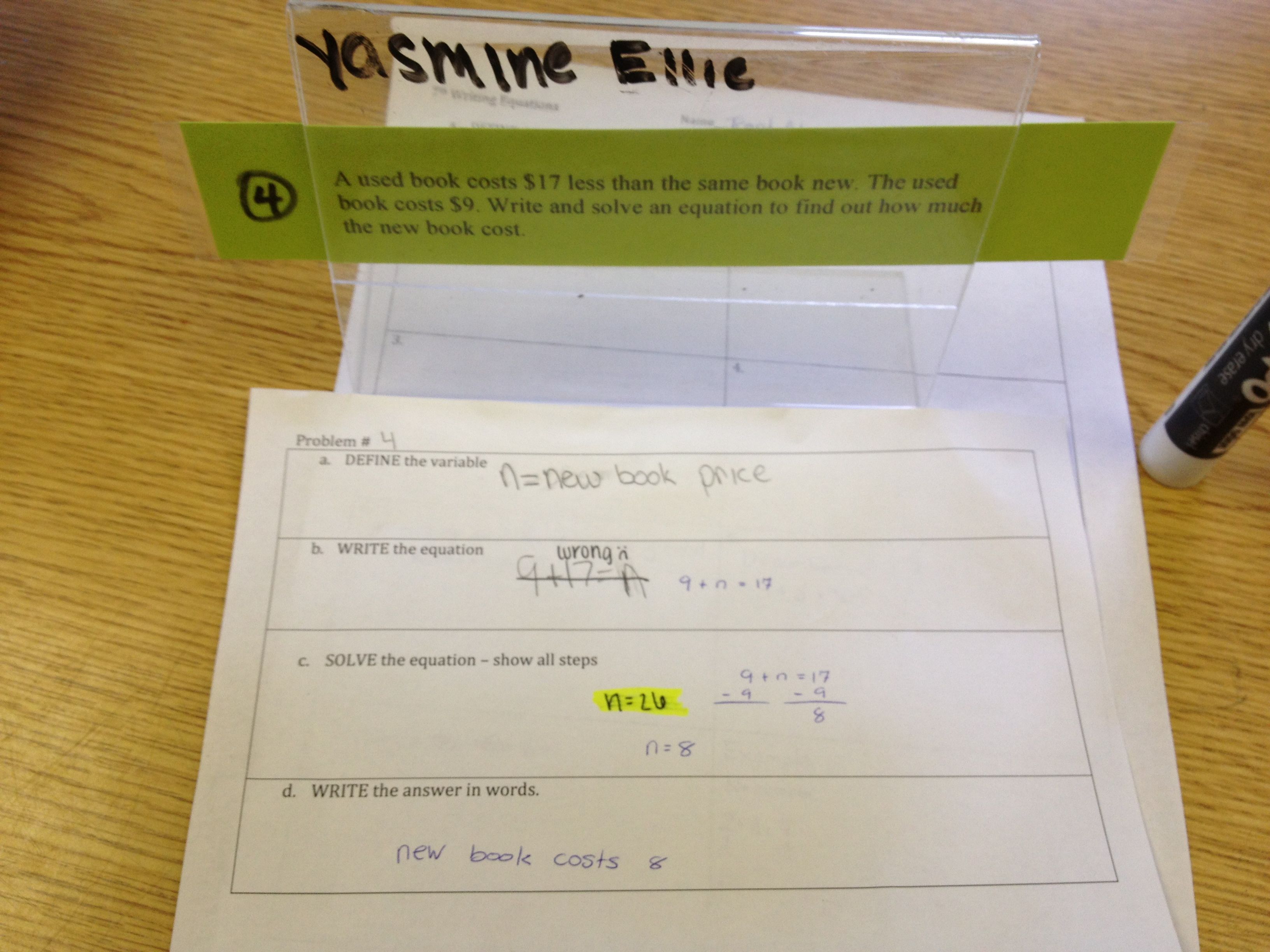
Each student received their own answer sheet to record their work.  Each partner group received a word problem and a small answer sheet that went with the word problem.

For each problem, the students had to do the work individually on their own answer sheet, compare their answer with their partner, come up with the best joint answer, and then write that answer on the small answer sheet.  We did one step at a time, and then passed the word problem with it’s answer sheet, to the next pair of partners.  The steps were

  1. Define the variable
  2. Write an equation
  3. Solve the problem
  4. Write the solution in words to see if it makes sense.

I had color coded word problems (by level of difficulty) and used my table top dry erase frames to put them in.  This made reading the problem and passing it easier.  Also, at each step the new partners checked the past work, and made corrections when a problem was incorrect (as well as noting it on the sheet).

I liked the thought of this idea.  But, all of the passing seemed confusing.  I also felt that the students did not receive “closure” with any one problem.  And, we only were able to get through three sets of word problems, so I don’t think that the students got enough practice.  Plus, it was too “teacher directed” and high maintenance.  I like it when the activity runs itself so I am more available to walk around and help students.  I would love to make this activity better.  Help!

Come to The Global Math Departments “My Favorites” Presentation Tonight at 9pm EST

Tonight at 9pm EST, FIVE math teachers will be presenting some of their favorite math class activities!  Please tune in to watch!  https://www.bigmarker.com/globalmathdept/oct2

I will be presenting my Dry-Erase Index Card Necklaces.  Also presenting are Kristin Fouss, Elissa Miller and Leigh Nataro.  We hope to see you there!

Simplifying Algebraic Expressions Activity

Dry-erase necklaces are at it again!  I cannot tell you how much I LOVE these things!

Today, I had my students choose a term (x, y, xy, x², 5, -1, 4) and write it on their dry-erase necklace.  THEN, if they chose x, y, xy, x², they had to add a coefficient to their term.  This was great because students had to look up exactly how to write a coefficient if they forgot – and several did.

After a discussion and a couple of examples of “like” terms…

  1. I went around the room and wrote everyone’s individual term on the board (16 terms total).
  2. I told my students to get up and find other people that were “like” themselves.
  3. After they were in groups with their like terms, they had to add write all of their terms on a small whiteboard and add them up.
  4. Then, they had to “arrange” the entire room (all of the final terms) into standard form.
  5. I then wrote the final terms on the board.

This slideshow requires JavaScript.

There were GREAT discussions going on today:

  • First, does -1 go with 4 and 5?  YES – they are all constants, so they are “like”.
  • Who goes first around the room?  x² was largest so it goes first, constants went last.  It was fun watching them rearrange themselves, and each other!
  • They were really impressed with their gigantic algebraic expression, and the resulting smaller expression.

After this, they all grabbed white boards and we simplified many more algebraic equations.  My students usually get that 5a + 2b cannot be combined (apples and bananas), but have trouble with x and x².  Today was no different, and even after the activity they still wanted to make 9x + 2x² = 11x².  But, it was very helpful to be able to say, “When you got into groups, did the x’s go with the x²’s?”  They really seemed to get it better after that.

Zero! Game for Integer Operations and Absolute Value

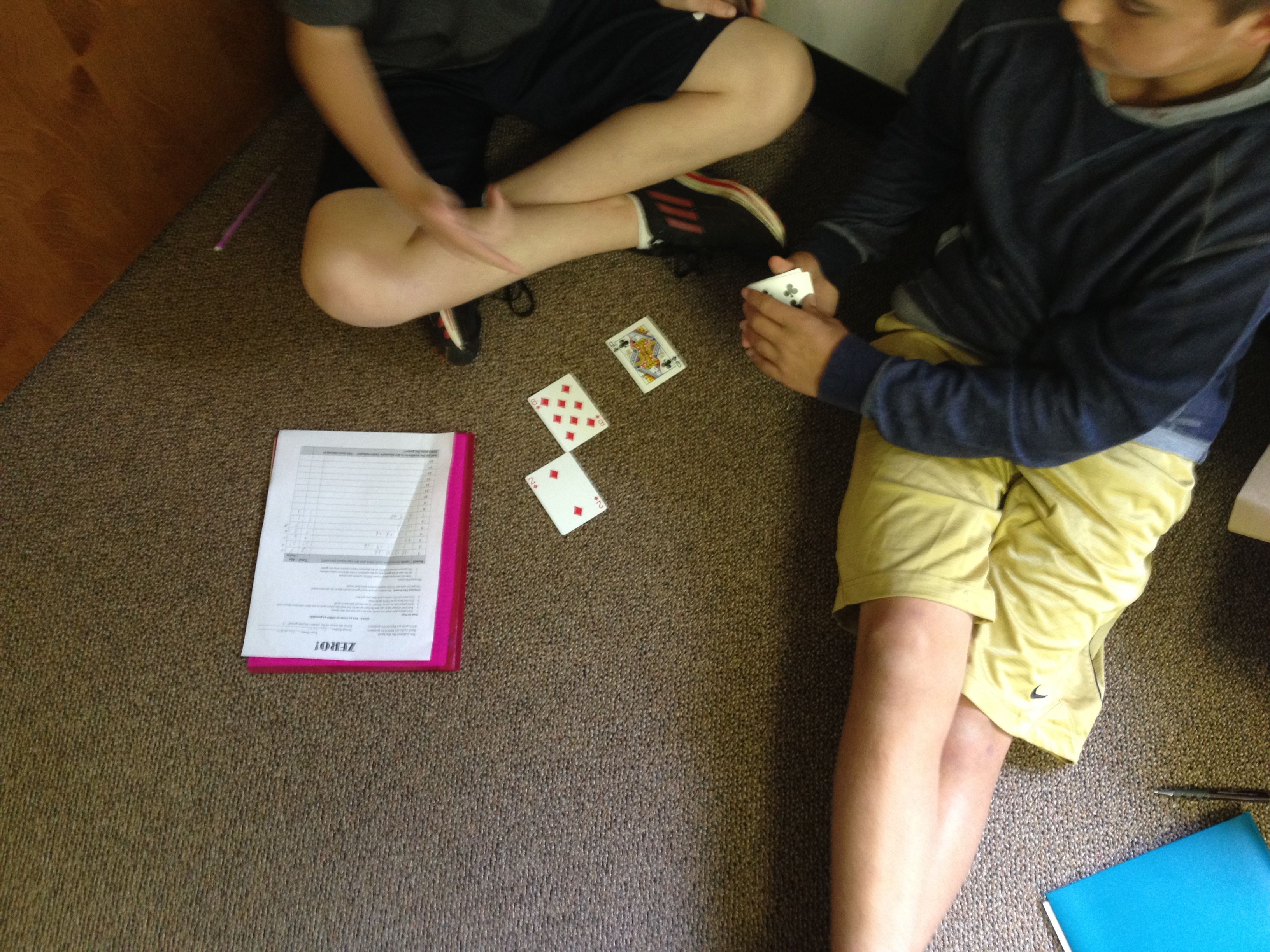
I got this amazing game from Denise at Let’s Play Math.  It is played like Blackjack because the kids are dealt 2 cards, and can say “Hit Me!” to get up to 4 cards.  They love, love, love it.

Supplies Needed:

  • Zero Game Sheet (below) for each player
  • 1 deck of cards per group of students (3 to 4 students per group).  It doesn’t matter if the decks are missing cards or mixed up.

Object of the Game – Getting the total absolute value score closest to Zero!

Object of each HAND – Getting each hand closest to Zero!

How to Play:

  1. Red cards are negative, black are positive. Jacks – 11, Queens – 12, Kings -13 Aces 1 or 14 (depending what you need).
  2. Deal each player 2 cards.  One facing up and a hidden one facing down.
  3. Each player adds up their cards to see if they are close to zero.  They can say “Hit Me” and get another card.  They can get up to FOUR cards but must use all of their cards in their final total.  They can also HOLD at two cards.
  4. Once everyone is finished being “Hit” all cards are turned over.  Each player writes all of their cards down and then adds up their total in the total box.  The person with the smallest total wins the hand and gets to be the dealer!
  5. Each player finds the absolute value of their total in the absolute value column.
  6. When time is up, each player adds up the absolute value column.  The person closest to zero wins the game!

I usually have a winner for each group of people playing, and then a winner for the entire room!  This really gets them excited when we see kids who have very low total scores.  It is great fun and the kids BEG to play it for many days after we play it the first time.  It is also great practice!  Just be sure that they are writing down their numbers so you can check their sums if needed.

Zero Game Sheet

Instructions via ppt presentation (prepared for Global Math Dept presentation):


Variations:

  • If your students don’t know absolute value yet, you can just leave the last column blank.  Just add up the sum of the Totals column to determine the game winner.
  • I used to let them do multiplication and division but it gets very complicated.  They have more fun (and get to practice combining integers more) by just doing addition.
  • You could also use a + , – dice and have the dealer roll it each round to see if everyone at the table should do addition or subtraction of negative numbers (to make it more difficult).