Problem Solving – MS Sunday Funday

#msSunFun

For the next eight weeks, MS Sunday Funday will be participating in Explore the MTBoS!  Instead of blogging about MS Sunday Funday topics, I would like to encourage everyone who currently blogs (or would like to start blogging), to come and Explore with us!

October is problem solving month at Global Math and they have many great speakers this month.  Be sure to check it out!

Global Math

In honor of Global Math, this week’s topic was Problem Solving.  A special thanks to Beth who so consistently participates each week in MS Sunday Funday!

#msSunFun

Problem Solving Webinar – Global Math

Tonight on Global Math, we will be discussing problem solving and our favorite problem based lessons and tasks.  I will be presenting, along with Alisan Royster and Justin Aion.  We would love to see you there!

To see the recorded webinar, click here to watch it on the Global Math site.

Algebraic Expressions with 6th Grade

At Twitter Math Camp, Nicole Paris introduced us all to the “orangamallow“.  Wow.  So simple, yet so brilliant.  How many times have I SAID, “a + b doesn’t make an applebanana“?  But Nicole took it one step further and SHOWED this to her students, bridging the gap from the concrete to the abstract.  Never underestimate the power of manipulatives, or visuals.

My students loved this so much, and got so excited about it, that I even recorded them today.  This is big for me because I have never recorded myself teaching.  But, I wanted Nicole to see how her idea inspired my class.  THIS is why you all should be blogging and sharing, even if you don’t think you have that much to add.  OR, if you think that what you have to add is obvious and couldn’t help much.  Please find the time and blog your lessons!  Just watch my students, who got so excited when I brought out the bag today that I was instantly sad I wasn’t already recording.

I also didn’t really want to record myself, so I hid behind the table as much as I could.  I should record my lessons more as I noticed so much that I can improve upon in just one short video.  Wow.  I noticed that I talk way too much, no surprises there.  But, when I talk too much, I say stupid things.  I actually said algebraic equation instead of expression twice.  Oh my.

Bedtime Math for Math Club

Sadly, my math club has been cut down to 25 minutes this year, and that includes students eating lunch.  So, I need fun, engaging activities that are shorter in nature and are great for both 6th and 7th grade students.

Today I decided to try an interesting problem I saw in my email this morning from Bedtime Math.

Screen Shot 2013-09-23 at 12.29.32 PMI like these problems because not only are the brief, interesting and relevant, they have multiple questions, depending on your level of student.  For us, all of these questions made us think of even more questions!  My students extended the question to ask, “Do you make more money doing this study than working a minimum wage job for the same time period?”

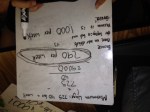
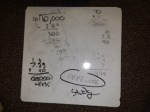
They went right to work and loved it!  We talked about the minimum wage amount ($7.25), and how many work hours were in a typical week.  We also had an interesting decimal discussion when one group of students divided the 10,000 by 70 days but then ROUNDED , coming up with only $994 a week instead of $1,000 per week for the study participants.  After we all decided that you make much more money over 70 days for the study, one student pointed out that you are actually making less per hour since you are really working 24 hours a day in the study.

I have amazing math club students that make every day a joy!  Thank you so much Bedtime Math for your amazing free resource that helps me give them interesting and relevant problems!


Why Teachers Pay Teachers Irks the MTBoS

When I first decided to go back into teaching after taking almost 10 years off I was pretty excited. I was also pretty scared. I knew things had changed in education, and I was going from teaching high school to middle school. Luckily, I was accidentally exposed to math blogs at a NCCTM meeting that I had recently attended. It led me to Dan’s blog and then a host of others through blogs and twitter.

I was completely amazed, an incredibly grateful, that Dan and other math teacher bloggers openly posted everything they made FOR FREE on their websites. Sam’s virtual filing cabinet, Kate’s folder of Row Games, and Shelli’s I Love Math.org pretty much blew my mind. After teaching in a school district where teachers in my own building did not want to share their materials, I could not believe that I could find all of these amazing, editable lessons for FREE online. I admit that I freely stole and adapted as much as I could find. I can’t even express how much this helped me when I was brand new, and starting over. Exposure to this wealth of excellent teaching material changed my teaching practice forever.

Since I was desperately searching for resources, I discovered Teachers Pay Teachers soon after. However, it frustrated me. First of all, since I was starting over, I needed many lesson ideas and $3 a lesson would add up fast. Additionally, as a lesson modifier, I had trouble with the pdf files. I could convert to text or take screen shots, but that was a lot of work for a lesson I had to pay money for. I also noticed that many lessons on TPT were similar to editable ones found on bloggers websites for free! It just took a little more searching (or simply asking for ideas on Twitter) to find these lessons. But most importantly, every lesson on TPT did not come with a heart-filled blog full of methodology, pictures of their students doing the lesson, thoughts for improvement, and great commentary from other bloggers. THIS is what I had become use to, and treasured in each and every one of the lessons that I found for free on every bloggers site. These bloggers and their commenters are what inspired great ideas that helped me adapt their lessons to fit my needs.

Yes, I have had my bad experiences as well that taint me against TPT. I have had material that I developed reformatted and sold. I have seen other teachers original material treated the same way. And I have had tense conversations with TPT bloggers who even swear they created stolen materials. I like to look for the best in everything, so I am assuming that this is the exception, not the rule. No, my main worry with TPT is not stolen lessons but it is that the “lure of the money” for underpaid teachers will entice amazing new teacher bloggers to save their best work to sale, instead of sharing for free. This may be selfish, but nothing makes me happier than seeing a new math teacher blogger arrive on the scene. It is the reason that I have been involved with the blogging initiative for two years in a row. That initiative is an incredible amount of work for me. But it is worth it if I can get more math teacher bloggers online, freely sharing their incredible materials with others. THIS is the way that our community grows and helps each other.

Some great bloggers are using TPT, many of them before they even started blogging. This is not a blog against you. I admire how hard you work. However, I would like all NEW math teacher bloggers to realize that TPT is a business. In contrast, what I would like for our community is not more business people, but more volunteers, who freely share their time and work. I would like to encourage new math teacher bloggers who benefit from our gift community (explained best by Kate here and here) to freely give back as well.

I am sure that some will disagree with me.  But this is the community that I want to be a part of.

Megan Hayes-Golding's avatarMegan Hayes-Golding

The online math teacher community[1] has I have a problem with Teachers Pay Teachers (TpT) and I intend to explain my own understanding of why.

First, a disclaimer: The MTBoS is a loose confederation of teachers all around the world. I don’t even know it’s fair to say “we” share beliefs and practices. However, I think our community has come to rally around this one idea probably more than any other single idea: we share freely. We share freely to help other teachers out, we share freely because we know we get more than we take, we share freely because we understand more users help make a better product.

Those ideas are more than a grand altruistic vision. It’s not about all the feels we get from sharing, at least not for me.

Part I: Why Share Freely?

mp5ov

If I offer a resource for sale on TpT, I get…

View original post 1,733 more words

Favorite Resources – MS Sunday Funday

#msSunFun

This week’s theme is Favorite Resources.   It’s not too late!  Submit you post for this week.  Next week, we will be focusing on our favorite problems.

Kinesthetic Algebra – Making Abstract Variables Concrete

If you haven’t signed up for Explore the MathTwitterBlogosphere initiative, YOU SHOULD.  Because, as Tina said best,

No matter how much time I spend online, I’m always happening upon new parts of our awesome math teacher community. Even yesterday, when we were planning the first few missions for this oh so exciting event, I learned about some sites I didn’t know existed. This is exactly why I am inviting you to join me on an exploration of the best parts of the internet – the Math Twitter Blogosphere.

Tina Cardone

Yes, this exact same thing happened to me on Sunday.  I got this idea from Emma McCrea.   I tweeted her immediately to tell her how much I enjoyed her lesson, and she tweeted back that she has signed up for Explore MTBoS!  Win-Win!

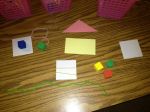
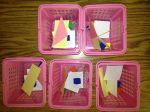
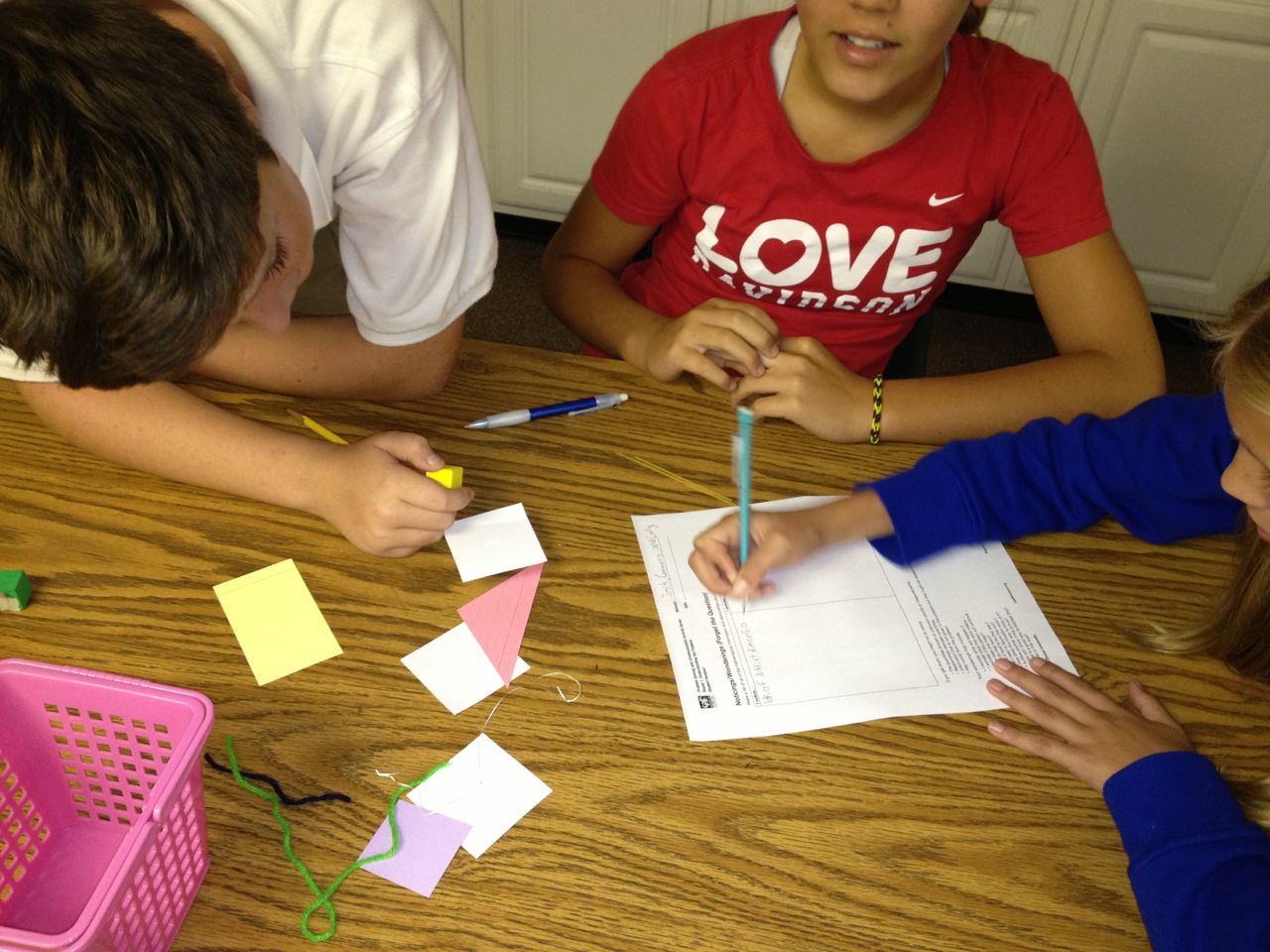
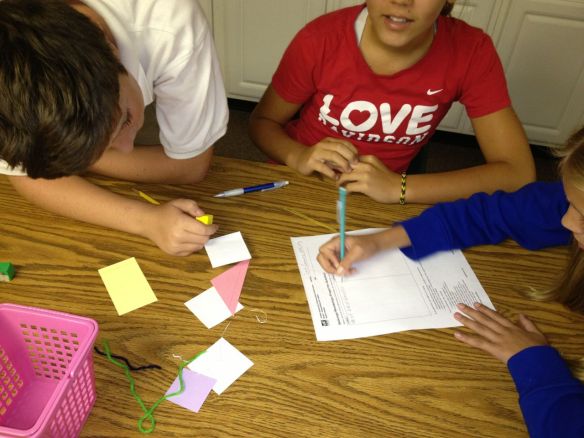
I gathered spaghetti, yarn, and dental floss cut into different lengths, colored index cards cut into squares and rectangles, foam cubes, and then more of these pieces taped to other pieces.  I dumped them into five bins.  This was actually pretty fun for me.

Notice and Wonder:

When the students came in, I gave each table group a Notice and Wonder form and a bin of stuff.  I told them nothing except, “Fill out the Notice and Wonder form with your group.” We have done Notice and Wonder many times before, so they got right to it.
IMG_5879

They were FABULOUS.  Groups had great questions for me such as, “Is this 2D or 3D?”.  They noticed the different size shapes, lengths, and combinations.  They wondered if they were 1D, 2D, 3D or all 3D?  They wondered if they combined shapes were 4D.  Many groups even started sorting them.  Great idea.

Sorting:

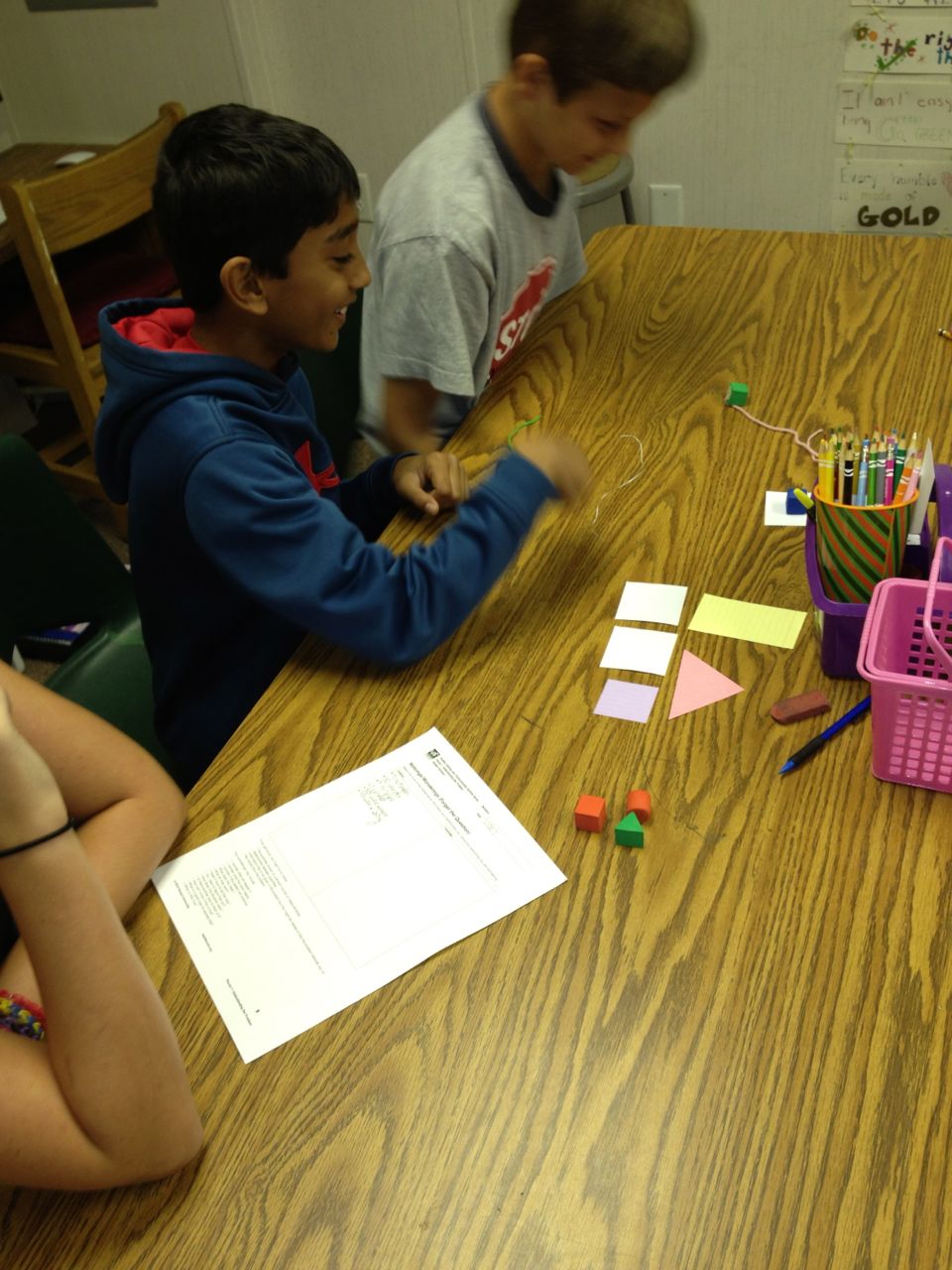
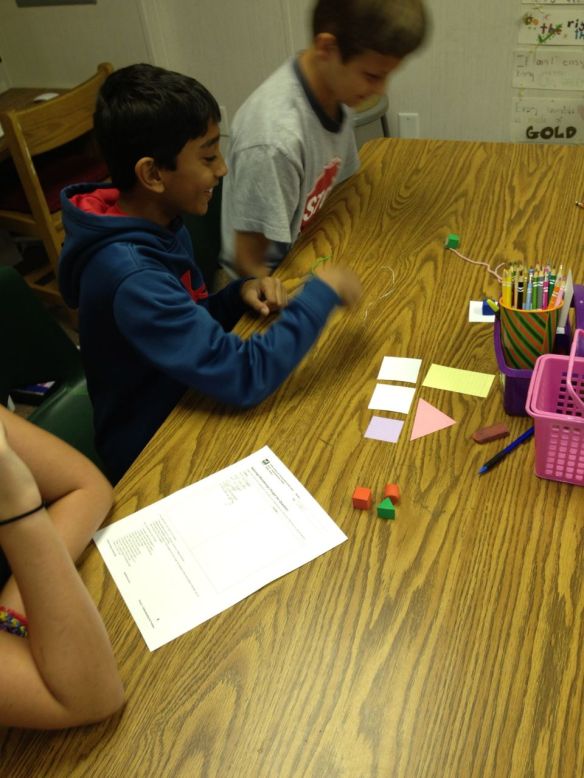
I then had the groups sort their objects however they wanted.  I did get a couple of interesting sorts, but almost almost all groups sorted the same way.  So they could see what I was seeing, I had all of the groups walk around and look at all of the sorts.  My crazy sorters were able to see how most of the groups had sorted.
IMG_5878


After sorting, they shared their notice and wonder.  I explained to them that ALL of the objects were actually 3D, but we were going to look at them as 1D (length), 2D (flat paper), and 3D (3D objects).  At this point, the kids all said, “Like Flatland!” and a connection was born.

After that I drew pictures of the objects on the board, starting with 1D and moving up to 3D.  We talked about how the lengths of all of our green string were close, but different sizes, and how we can use a variable to name an unknown length.  To make this more interesting, I let them name the unknown lengths.  This was a HUGE hit, and they picked funny names like Wormy (w) and Doofy (d).  As we picked more lengths, it was a great chat when they wanted to name a new length Wanda (w), but could NOT because we already had a w and it was NOT the same length.  It was a blast!

When we had progressed all of the way to the cubes, the kids noticed a pattern.  They noticed that the variables for the 1D objects had 1 as an exponent, some 2D objects had an exponent of 2, and some variable of the 3D objects had an exponent of 3.  I love it when magic happens.

To end up the first day, we discussed the difference between wormy + wormy and wormy times wormy.  I held two wormy strings together to illustrate addition of two lengths.  I also drew a 2×3 multiplication array to illustrate multiplication and make sure they were getting the difference.

They seemed to get it (and seemed to enjoy it).  Tomorrow, I am going to let them cut their own lengths from spaghetti and draw their own 1D, 2D, and 3D shapes.

The next day, I will do Emma’s great sorting activity!  It is at the bottom of the page.  I will let you all know how it goes!
Explore the MathTwitterBlogosphere With Us!

Finally, at long last, the wait is over!  This October, everyone from seasoned bloggers and tweeters to math teachers who have never even used twitter before, are invited to jump on board and Explore the MathTwitterBlogosphere (also know as #MTBoS) with us!

Screen Shot 2013-09-15 at 9.17.01 PM

What is the MathTwitterBlogosphere?  It is the world of dedicated math teachers that create and share resources every day through Twitter, blogs, math chats, websites, online webinars and more.  It is the most amazing professional development that you will ever experience as a math teacher!

You should come and explore with us because as soon as you jump in, YOU become one of the many math teachers that make the MathTwitterBlogosphere more and more amazing everyday.  You will also meet other like minded teachers, who are just as passionate about their field as you are.

We know that you are all crazy busy math teachers.  But, Exploring the MTBoS should only take about an hour of your time each week.  And it is a zero pressure zone, so you don’t even have to participate every week.  Fair Warning:  The MTBoS is pretty addictive, so once you are in, you will probably want to do each and every week!

To learn more about it and sign up, just visit the Exploring the MTBoS website and add yourself by commenting at the bottom.  If you sign up for the “Weekly Missions Via Email”, your first mission will arrive in your inbox on October 6th.

The MTBoS has changed my teaching and enriched my life!  I hope that you can make the time to jump in and join in this adventure with us!

One Good Thing – MS Sunday Funday

#msSunFun

This week’s theme is One Good Thing.   It’s not too late!  Submit you post for this week. 

Four Fours Problem Puzzler/Game

Problem solving has been the best thing that I have incorporated this year!  It’s more than one good thing.  It is actually many good things that happen every day that I MAKE the time to do problem solving with my students.  And yes, I do have to make the time.

The most important thing that I learned from this activity is that I also need to have students do individual problem solving, so that each student will learn to persevere in mathematics, and not rely on a group member.

I first heard about the Four Fours Problem while taking Jo Boaler’s “How To Learn Math” class this summer.  It sounded like a fun activity and I couldn’t wait to try it with my classes.

After doing Fawn’s PEMDAS Relay earlier in the week, I knew we still had some work to do with the order of operations.  I decided to give them the Four Fours for their problem solving brains.  However, I also wanted their work checked and corrected – but not by me.

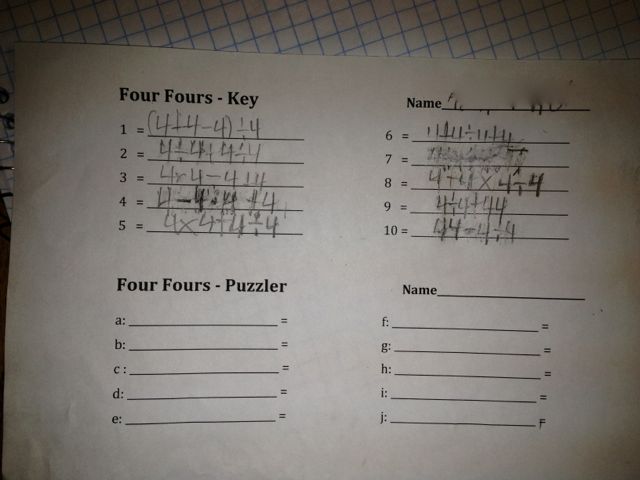
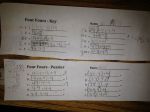
Enter the Four Fours Problem GAME.  I reduced the assignment to make the numbers 1 – 10.  I explained the Four Fours, and then had them brainstorm answers for the number 1.  I then showed them 44/44, and they loved that!  Then, they had to fill out the top half of a sheet that I made with the remaining Four Fours problems.

IMG_5852

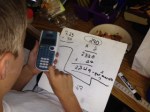
After completing their Four Fours, I had them randomly assign the letters a-j to each problem.  Then, they wrote the problem, but not the solution, on the bottom half of their worksheet.  Once that was complete, they cut the sheet apart and swapped with another student.  That student then worked out their problems to see if they could find which number it equaled.  If they did not get a number between 1 and 10, or ALL of the numbers 1 through 10, someone made a mistake.  Then, they were to get with their partner and figure out who made the mistake.

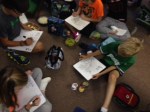
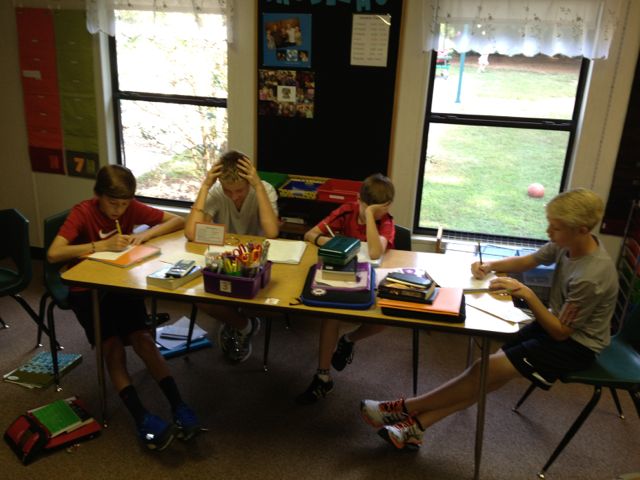
IMG_5851When I first introduced this problem, there were many groans around the room.  I am not used to this so I was a taken a bit off guard.  They did not think they were going to like this lesson.  “Do we HAVE to use four fours?“, “Why are we doing this?“, and “Really?”  I was worried, but, I had planned this lesson so I plowed on.  After a few minutes however, my students were totally into it!  All it took was a friend to go, “I found five!” to get their competitive juices flowing and see this as a challenge.  They worked so hard!  After they started coming up with their problems, they really got into it.  I even had to quiet them down several times with “Other students cannot think if you are screaming!”

Not every student was ecstatic however.  They have been doing problem solving in groups so far this year.  Since they had to trade papers, their problems had to be kept “secret”, so this was an individual assignment.  It was frustrating for several students.  They wanted to quit, constantly wanted me to check their work, or kept begging me to give them “just ONE hint for the number ____ !!!” They even begged me to let them switch solutions for just one number with another student.  “I need two and she needs five.  It’s just one number!”   “NO, you CAN do this!” was my answer every time.

Overall, it was a thrilling success.  At the end of class, I had several students ask me for an additional copy so they could take it home and give it to their siblings or parents, or come up with more Four Fours.  One student wanted to come up with negative answers.  This would actually be a great twist for 7th grade!

After doing this activity in class, I changed the Four Fours sheet to include instructions for the students and I made it a whole sheet of paper so they would have more room to work.

Screen Shot 2013-09-15 at 9.49.05 AM Four Fours Game 1-10

Side Note:  This is more of a puzzle game than an actual competition and students weren’t really racing each other to finish first.  Of course, some students will finish this much more quickly than others.  That actually works out very well.  As they finish, they trade and work each other’s problems.  Then, they work on something else while the other students finish.  I use this time for in class project work but you could also have a row game ready for pairs who finish more quickly.