Resource Sites I Love

I’m new to both subjects that I teach this year so it’s “new lesson time” every night at my house – times two.  I love searching the internet for interesting activities so that the lessons will be fun to teach (oh, and interesting for the kids too).  I rely heavily on my Diigo and the Math Teacher Wiki, but tonight, @fouss and @druinok reminded me of a great resource site that I keep forgetting about!  I Love Math.org

I Love Math

I Love Math is a great site because teachers can upload their own files and links to share.  These are usually Word, Excel, or Powerpoint documents.  Anyone can join, and it is free to upload and download files.  There are only 25 middle school documents on there, but there are 144 documents for Algebra!

I haven’t made an official file cabinet yet like so many other great bloggers out there.  But, even though I have bookmarked the I Love Math site three separate times in Diigo, I keep forgetting about it.  I wanted to blog about this site so my overworked, overtaxed brain will remember to come back to it again!
If you have any wonderful resource sites that you love, please share the link in the comments.

Amazing Algebra Tiles

Not like I’m opinionated or anything, but if you are teaching students younger students (or struggling students) algebra and you are not using Algebra Tiles, then you are missing the boat!  Not that I can be too judgmental, I had them on my shelf and missed fabulous opportunities to use them all year.

I bought them solely for multiplying polynomials with my 7th graders.  I only bought a few sets because I didn’t want to waste too much money if we all hated them.  I have taught older students Algebra (Pre-Algebra, Algebra IA, Algebra IB, Alg II for seniors) many times in the past and never used them.  With those classes the kids had seen Algebra before, sometimes many times, and I didn’t think it would benefit them very much.  The tiles seem very elementary, not to mention a lot of trouble, and I was afraid it would be, “too little, too late”.  So yeah, I was WRONG again.

I pretty much bought them for one purpose.  I wanted to show 7th graders who had never multiplied x by x to SEE the difference between

x + x = 2x     and    x times x = x^2.

Plus, they are young (12-13) and thus more concrete thinkers so I felt it was a good tool to use for this age group.  I wanted to explore taking them from the concrete to the abstract with Algebra Tiles.  I was skeptical but hopeful.  I’ll try anything once!

However, once I pulled these things out though there was no stopping us!  For the first time ever, my students did not mix up 2x and x^2.  W-O-W.  If you’ve taught Algebra before, you know that is big.  My students knew not only what it meant, but what it looked like.  They knew why the 2x and x^2 were different.  They did not ask me a gazillion times if it was 2x or x^2.  And if they did, all I had to do was pull out three tiles and viola – instant understanding.  I mean, HELLO – Look at them!  They look nothing alike!  You cannot ask for a better explanation than that!

One thing that I discovered that really helped my students is how you can represent negatives with the tiles.   This was wonderfully helpful with multiplying a negative through a polynomial.  My kids always stumble over that or even “forget” it.  However, since we have been doing the tiles they can see what they are doing and are no longer forgetting it.  Bonus!

I bought them to teach polynomials to 7th grade, but once I got them out, I have not put them away!  The tiles put ACTION with the MATH.  More great uses for the tiles:

  1. Illustrating the distributive property.  As fun as “The Claw” is, seeing is really believing for my students.
    3(x + 2) is just THREE sets of x and three 2’s.   (Ahhh,… so THAT’s what we’ve been doing all year.)
  2. Negative Operations – The opposite of a positive number is it’s negative.  For the tiles, to get the negative (or opposite), we flipped the tile over to the other side.  (one side is yellow – positive, the other is red – negative).  This can even illustrate basic concepts, like – (-4).  What is the opposite of  -4?  Flip it over and see!
  3. Multiplying a negative + distributive property.  – (x – 3)  or  -2(x – 4).  When you see   – (x – 3) you are taking the opposite of (flipping) everything inside of the parenthesis.
  4. Equation solving – I draw a line down the center of the paper and use the algebra tiles to solve equations.  When kids tried to subtract 4 from 6x, I would take out 6 x-tiles and 4 constant tiles and say, “Now, how can I combine these?”  The answer, “Oh you can’t, they aren’t like terms.”
  5. Equation solving – divide by a number.    3x = 6.  Three x’s = 6, so one x must be 2.  Then, I would split the x’s and line up the constants on the other side, dividing the x’s.
  6. Equation solving – FRACTIONS.    x/2 = 3 .  If HALF of an x = 3, then what does an entire x equal?
  7. Multi-step equation solving – This was especially helpful when I was teaching multi-step equations.  With tons of tiles spread out all over the paper, the students could easily SEE that of course I needed to combine like terms before trying to get x alone on one side!

(I used Hands On Equations at the beginning of the year, but I think that the Algebra Tiles beat them “hands” down.  They are just more intuitive, especially when it comes to the negatives.)

Of course I still do my crazy songs, dances and rhymes so that math will be stuck in their brains – FOREVER.  (And yeah, I just LOVE to sing and dance!)  But, I think that it is important for every student to know what they are doing, and not to just be  following random steps!   So, one day in the future, when they can’t get our annoying equation song out of their head, maybe they will also recall the Algebra Tiles, and remember WHY x times x = x^2 and NOT 2x.

Links:

Algebra Tiles Video

Interactive Online Algebra Tiles
Math Hunt – Time for Targeted Help

Do not delay, try this activity NOW.

Whenever I discover an activity that lets all students in my class work at their own level while I get to assist students that need extra attention I have to share it.  I know that many other teachers are already using this activity, but for those who have not yet discovered it, I must insist that you try it now.

A great friend of mine who is an amazing teacher uses this game regularly in public school with classes of 35 students, and it works for her.  She has been telling me about the virtues of this activity for two years (thanks Les!), but it always seemed like too much work so I didn’t try it.  I was wrong.  It is not much work at all.  It is very easy to plan, and the kids love it.  But, best of all, it is an activity where every student in your class will be challenged at their level.

 Procedure:

  1. Make up at least 16 math problems.  (I would do more if I had a larger class.)  Make them progressively harder.  Make the first few very easy and make the last few really tough!
  2. Print these 16 problems on one sheet of paper.
  3. Fold the paper in half.  The question is on the outside.  Write the answer on the inside so it is not visible.
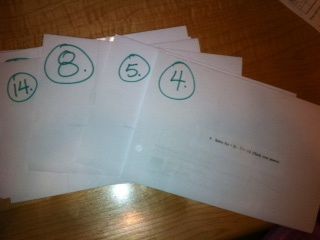
  4. Assign each paper a number from 1 – 16, marked very visibly on the front.
  5. Place (tape/tack) these problems all around the room, but not in order.  This is where the “Hunt” comes in.  They have to find where the next problem is.
  6. Assign students a “start number” based on their ability level.  Struggling students would be assigned #1, advanced students #8.  I usually assign two or three students to each number to start.
  7. Students will go in order.  If they start with #5, the next problem they work with be #6.
  8. Students travel at their own pace – they do not have to wait on the other students that were assigned their number to finish the same problem.
  9. Have the students write down the question and all work on their own papers.  Once they are finished with a problem, they can check the answer.  If they miss it, they have to RE-work the problem.  If they can’t figure it out, they can call you over to help them out.
  10. Be sure to tell them that they will probably NOT finish all of the problems in a class.
  11. Some students WILL finish all of the problems.  When they come to you to tell you they are done, you can them make them “additional helpers”.  They walk around the class assisting students who need help using the work on their papers.  I do not tell students this in advance, as I don’t want them “racing” to get finished so that they can be a helper.

 Additional thoughts:

  • I taped beginning problems to the tables so that I could have room to sit with struggling students and help them.
  • I didn’t want to waste 16 sheets of paper so I printed out 16 problems on one sheet, cut the problems out, and then glued the problems to the outside of recycled paper.
  • Next time I am not going to make the easy problems #1.  I am going to make the easier problems start at #8 and then go from there.  (So the hardest problem would be #7).
  • I let students help each other as long as they are not just telling each other the answer.

You don’t have to make the last problems really hard, especially if you have a large class and aren’t going to have the time to help out your advanced students too.  Don’t feel bad about this.  When they “fly” through your problems, they get to help teach their peers.  And, we all know how much more we learn when we are teaching something.  Everyone still wins!  J

I did this activity so that I could work individually with struggling students and so that advanced students would get a chance to work on really challenging problems.   A fabulous side benefit of this activity was that my advanced students needed my help too!  These are students who usually “get everything” the first time and rarely need my help.  I was thrilled to get to work one on one with them as well.

I talked Elissa into doing this game today.  I really hope that it went well for her.  I am sure that she will make it better AND color coordinated.  I am hoping that she will blog about it as well because I am looking forward to stealing some ideas from her (hint, hint Elissa).

Suggestions Welcome!

Some of my students wanted a “prize” at the end for finishing.  I didn’t want to do this because not all students would finish and I did not want them to feel bad about that.  Plus, I didn’t want them to rush to finish (and feel like they just needed to get the right answer).  I wanted them to focus on the “process”.  But, there is usually something at the end of a scavenger hunt…

Equation of a Line Song

Today we recorded the two songs that we have been singing lately.  I made up a slope-intercept song that is sung to the tune of YMCA.  We also did  Sweeney’s “Dance Steps to Solving an Equation”.

For the occasion, I was lucky enough to find a really fun Slope-Intercept form t-shirt.  I even had a pair of primary colored “chalkboard” Converse hi-tops that actually matched my shirt.  Yessss, I was in total “math teacher” mode and loving every minute of it.

I decided to try my hand at iMovie tonight.  It was great fun!  I started the movie with a picture of my students.  The YMCA intro music is rather long so I decided to included the pictures of their finished “Slope Man” projects.  Then, comes all of the action!  Their “Equation of a Line” song and dance!

I will post our version of “Dance Steps to Solving An Equation of a Line” soon!

The Equation of a Line song is sung to the tune of YMCA.  The words are below, watch the movie for the motions.

Y = Mx + B,

Equation of a line!

Y = Mx + B

Puff, puff positive,

Nice negative,

Zero slope

And undefined!