Volume of 3D Shapes with Play-doh

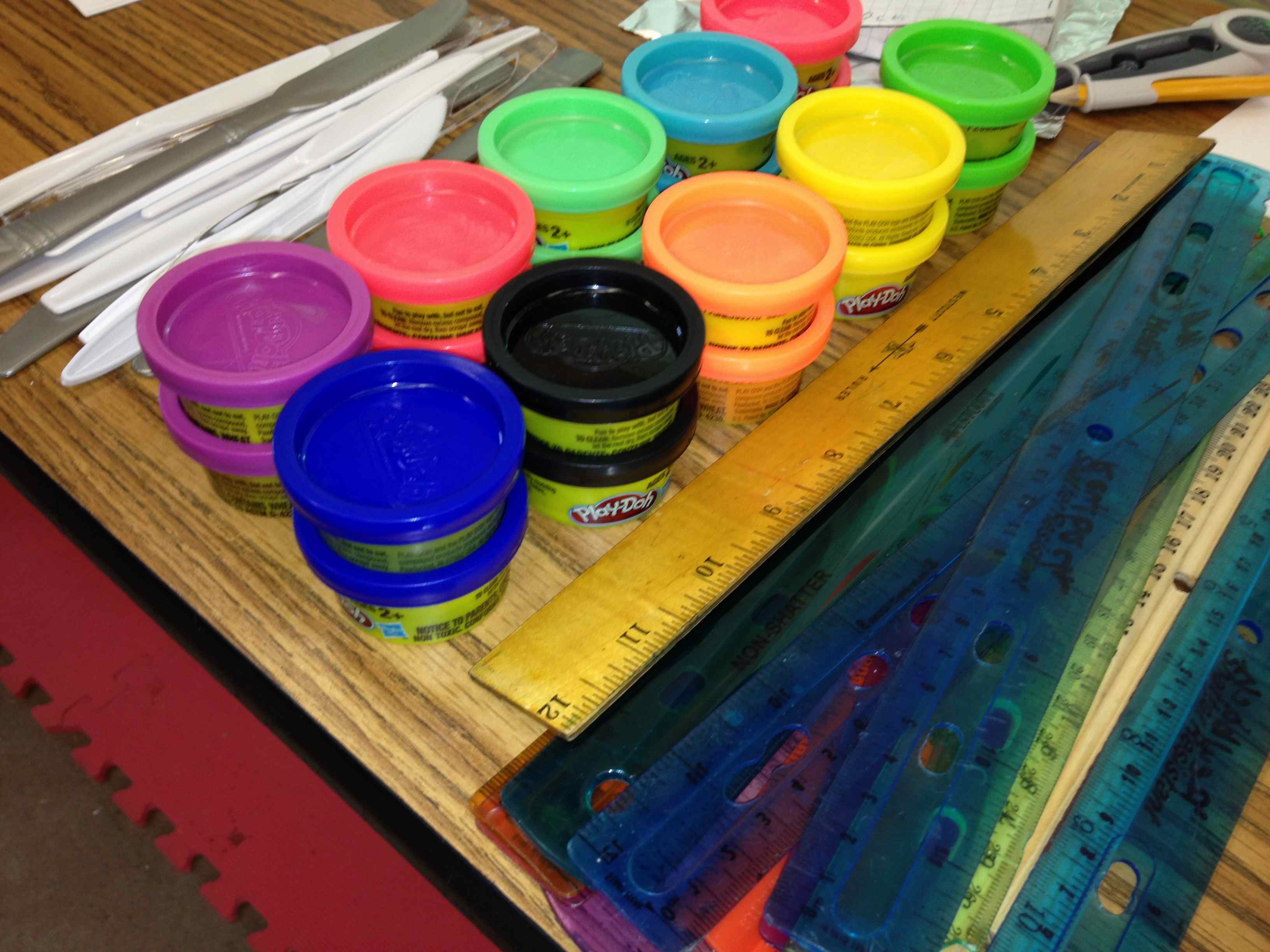
When my students are excited about what they are doing in class, they are engaged.  They will listen and best of all, learn.  The kids were ecstatic when they saw the Play-doh.  They couldn’t wait to get their hands on it!  The benefits for learning were amazing.  All I had to say was “Remember the Play-doh?” and they knew what to do for any volume problem.

Supplies per student:

  • One fun-sized Play-doh
  • Ruler
  • Plastic knife
  • Ruler

Instructions:
Many of my students had heard somewhere along the way that volume equaled length times width times height.  So, I started by having them make a rectangular prism out of their Play-Doh.

Once it was made, I had them draw a picture of it in their Geometry Booklets.  Then they measured and recorded the length, width, and height of their prism in centimeters.  Next, I had them cut their prism into 1 centimeter lengths.  They observed that the cross sections were squares.  I had them find the area of this square.  We talked about how many slices they had.  So if their area was 6 centimeters squared and they had four slices how could they find the volume of the box?  They quickly deduced that they needed to multiply the 6 by 4 to arrive at 24 cm cubed.

I repeated this for a cylinder and a triangular prism.  We observed what the cross sections were, found the areas of our cross sections, and then found the volume.  To sum it all up, we talked about how volume of a prism or cylinder is the area of the base (cross-section) times the height (number of slices).

It was so much fun!


Square Roots with Cheez-Its and a Graphic Organizer

I saw a cute picture on Pinterest using Cheez-It’s to practice area and perimeter.  My first thought was, “Pefect Squares!” and could not wait to develop a Square Roots Cheez-It lesson.

I made a graphic organizer to go into their Geometry Booklets so that they could more effectively take notes.  It is half-sheet sized so it will also fit into composition books.

Square Roots Graphic Organizer

I used one box of Cheez-It’s per class.  What I loved the most about this activity was that it was very visual for my students (and they remembered it well because of the food addition).  Each time we did a square root, I would ask them, “Do 6 cheez-it’s make a square?”  And they remember it is a rectangle.

The kids loved making perfect squares with their Cheez-It’s and I even had a few groups combine their Cheez-It’s at the end to see who could make the largest perfect square!

The Numberline:
The number line is one of the most important aspects of this lesson.  I have them label it (see pictures) so that they can quickly estimate what a square root SHOULD be before they blindly punch it into their calculators.  This also helps when simplifying square roots using the radical sign instead of decimals.  I challenge them to see how close they come when estimating square roots with decimals.  They estimate, and then check it with their calculators.  The next day I played “Around the World” with perfects squares and estimating square roots in their heads.  Here is the Around the World PPT.  Square Roots – Around the World

This slideshow requires JavaScript.