Supporting Students – Homework

As I teach an accelerated math class, I feel that a small amount of homework is crucial for success for my students (and, not just “doing” homework, but doing it well).  I got closer to being happy with my homework system this year, but it still took too much time for me to  check and especially to record.

What I did this year:

  • Published solutions – This goes first because it is KEY and so amazing.  I published fully worked out solutions to homework every day by 3PM.  I encouraged students to check homework AS THEY WORKED instead of afterwards.  No-one learns well when they are practicing incorrectly.
  • Required students to check their completed homework against my solutions and mark the ones they missed or did not understand with a different colored pencil.  Kids really did this at the beginning of the year.  It made such a difference.  They knew which ones they had missed and we hit the ground running everyday.
  • Assigned a manageable amount of homework.  I aim for no more than 30 minutes each night.
  • “Lagged” the homework.  I assigned previous material each night and starter homework (easy, skills based) on new topics.  I only assigned tougher questions after we had been working with the material a couple of days.  This way there was no pressure to finish my lesson so they could do the homework.  Also, students didn’t complain as much about not understanding how to do the homework.
  • Checked the homework each day, 2 points per assignment, 1 point for incomplete homework.
  • Entered the grades in the grade book once a week.

What did not go well is that checking homework took up too much of my class time.  I walk around with my grade book, stop at each child, look at their homework, then take time to record the grade in my gradebook.  And, after Christmas I did not do a great job of checking it everyday.  As a result, many students stopped doing it.

Additionally, some students never checked their solutions online.  They did their homework as fast as possible, just to get the credit.  They had zero idea if they were doing it right.  They did not care if it was correct, as long as it was “complete”.  This did not help them and wasted my time looking at their barely complete work day after day, trying to decipher if they had actually done it or were just scribbling anything down.  This has to stop.

I loved Amy’s post about accountability.  And even though I hate taking the time, if I really want students to be accountable, I need to make sure they are actually doing their homework well, and be more systematic about checking it.  I also loved how Julia is planning to check homework next year.

Next Year:

So, here is what I am planning for next year.   I am still working on it though and any thoughts or ideas would be greatly appreciated.

My biggest change is that I am going to have students keep a Homework Journal.  I will require every student to do every homework assignment (even Delta Math problem sets) in a graphing composition book.

  • Lagging Homework and publishing the answers as I did last year.
  • Require students to check answers and mark ones they did incorrectly with a different color pen/pencil.
  • Homework Journal – Students will do all of their homework in a graphing composition book.  The only thing in this book will be homework.  Our calc teacher does this and loves it.  He talks about it all of the time so I have to try it next year.  He calls it a journal and encourages them to write in it.  He tells them to write what did they not understand, what questions they have, and so on.  I could even have them write about how well they felt they understood each assignment.  I do a red/yellow/green for each assessment and think this may be valuable for the homework assignments as well.
  • I will have a section in the back of the journal for their weekly Delta Math problem sets.  I want students working these problems out (and Photo-math is a problem).  Hopefully this will help with both things.  This will make it take longer to do some sets, so I will assign less problems per set.
  • Incorporate “Criteria for Credit” to illustrate to students what a well done math assignment should look like.  A teacher at my school has the students create and then follow this criteria at the beginning of the year.  It is great and I am going to adopt it.  I have also talked her into guest blogging about it now that school is out!
  • From Julia – Each day I will circle any questions they did not fully and correctly complete with a red pen.  I will walk around the room and do this, I will not take them up.
  • Students are encouraged to complete circled problems ( to earn partial credit) before the homework journal is graded.
  • On quiz/test day (or about once every week), I will take the journals up and grade them.  I will take off full credit for every problem not completed, and give half-credit back for any completed circled problems (problems that were incomplete before).
  • Absent students would need to write down each assignment in the book, and ideally complete them before taking any assessments.  I would like to check this, but it may be too hard to keep up with.

Last year I walked around recording their homework scores as I went around the room on my grade sheet.  This is such a pain.  It takes time to look at the work, then time to put a grade down.  And I don’t even mark on their paper.  With Julia’s new system,  I can just walk around the room circling without having to record anything.  So checking homework each day should go much faster.  Then I can take the time once  a week to get the grades down.  And, since incomplete homework is already circled, it should not take long to grade (hopefully).

I love the idea of homework quizzes, but I don’t know if I would keep this up.  Making, distributing, grading, and recording a quiz takes a ton of work, even if it is online.  And I don’t want to create more work for myself.

I am hoping that more work setting things up at the beginning of the year will make the rest of the year easier.
 

Appreciating Discovery in Mathematics

Most students are unsettled by my “discovery” based style of teaching, at first.  However, once they let go of the way they have always done math, they really enjoy it.  I feel that they retain more, as my focus is never on memorizing formulas and procedures that are always quickly forgotten.  Well, maybe they don’t always retain more, but they seem to understand more of what they do retain.  We do use some formulas in my class, they are just not our first “go to”.  Formulas are what my students develop, individually and then as a class.  We only use formulas after we have investigated them, and understand them.

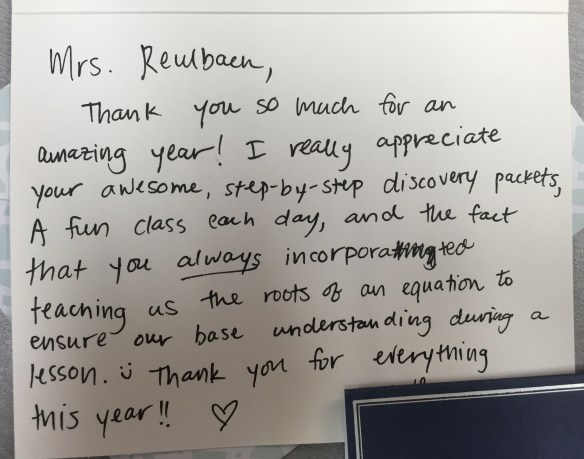
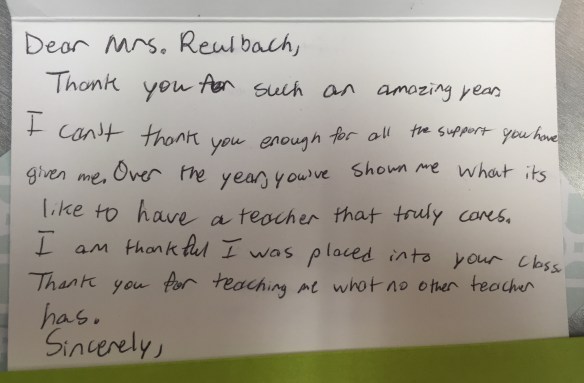
At the end of the year it is wonderful to see how much they appreciate this and feel that they understand the math they are doing!  I received a couple of lovely thank you notes from my freshmen, and other students wrote comments on my end of year survey as well.

Thank you so much for giving us context in math so we fully understand where things come from. No math teachers have done that for me.

Keep making us discover patterns, it helps us to think more in-depth.

Understand the WHY!!! just because productive struggle isn’t always fun doesn’t mean it isn’t helpful! it makes understanding and remembering concepts easier.

Thanks for a great year and challenging me to grow in this class!

FullSizeRender 22FullSizeRender 23

Supporting Students – Reviewing the Basics

I teach Algebra 2 to students who have just completed a year of Geometry. They do some algebra throughout the year, but are still rusty on many skills when their year with me begins.

This summer I am assigning an optional review on Delta Math for my students. It’s mostly basics with some beginning Algebra 1 topics. I included rounding, basic percents, fraction operations, order of operations, exponents, slope and linear equations, and basic factoring.

I will give my students a pre-assessment in the first week of school so they will know exactly what concepts they still need to work on.  I plan on reteaching the concepts that the majority of the students struggle with.

However, I’m not quite sure of the best way to help students that need more support than this.  I will leave the Delta Math set live so students can continue to practice those topics.  I plan on holding algebra one review sessions during student choice times for students that need, or want, extra support.  But I would like to make sure it is enough, enough time and enough support.  I want to support students who need review, but I am afraid of spending too much class time reviewing basics.  I don’t want students who do not need the review to be bored in my class.

Mattie suggested that I spend some time putting students together that can help each other, and letting them work with each other.  I do like this idea, as it will be more individualized help for students (instead of just me trying to help many students on many different concepts).  Also, often students understand other students better than the teacher.  I could do this in class occasionally or make it during student choice times.  If students volunteered to help others during choice times they could even earn service hours.  But, I haven’t even thought about how to structure this.

I would love ideas.  How do you support students that need extra help with basic skills during an already hectic school day/year?


Teaching Students How to Study with One-Sheets

I would love for my students to learn how to prepare for a math test. This one-sheet idea is the closest I’ve come, as they (eventually) do it all on their own.

At the end of last year I had my students create a study guide for their final exam. I had them make one page (or notecard) of notes for each chapter we had studied. My students commented that although they liked the idea, this was difficult to do at the end of the year. They wish we had summarized each chapter while we were in the chapter so they could remember more things to put on their sheets.  My best ideas often come from students.

So this year at the end of every chapter I had my students summarize the most important topics on the front of one sheet of paper.  Since this was new for them, I gave them a list of topics, then had them brainstorm in groups on whiteboard. Afterwards I had them fold one sheet of paper into sections (one section per topic), and then write the information on their sheets.  I encouraged them to include homework problems they had difficulty on, and notes from the in-class review.

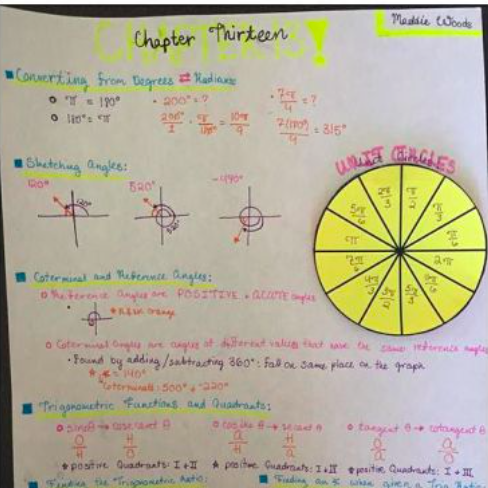
As you can see from the picture above, some students created really thorough one-sheets, while others barely wrote the basics. To help model great one-sheets, I shared the most detailed ones with the class.  But this was after the fact and didn’t help students who had not made thorough one-sheets.


In the end of year survey, most students mentioned how much they loved the one-sheets. But several students mentioned that while they liked having one-sheets, they did not enjoy making them (or make helpful ones).  And that they would love help making a great one sheet.  After reading their comments, I talked to them in class about how to help them create better one-sheets. Overall, more of my boys mentioned that they struggled with making helpful one-sheets.  They suggested that we make the actual one-sheets together in class, especially at the beginning of the year when they are just learning how to make them (and before they realize how valuable the one-sheets will be).

So next year this is how I plan on introducing one sheets.  The first time we do one-sheets, we will make the entire one-sheet together as a class.

  1. Give students a list of topics and let them brainstorm together on whiteboards.
  2. Instruct then how to fold the sheet into sections and label each section.
  3. Give them class time to fill in the sections, guiding them about what is important to include and modeling how to organize the material.
  4. Share great examples as I see them in class so other students can add that information to their sheets.
  5. Finish the one-sheet in class (instead of taking it home to finish).

As the year progresses and they get more practice making the one sheets, we will do less in class.  I want them to learn how to make the one-sheets on their own so they will have this skill for future classes.  However, I will make sure to give them class time at the end of every unit to start making their one-sheets.

About halfway through the year my students became upset with me when I didn’t have them make a one sheet for a chapter.  Some students did it on their own but they missed the class time to brainstorm and work on it together.  By the end of the year most students were creating incredibly detailed one-sheets.  Seriously, some of these one sheets were a work of ART.

Screen Shot 2016-05-20 at 6.29.42 PM

Here are some of the white-boards and one-sheets that my students created this year:


Because Anne

And because May.  I never do these things, but Anne, you are awesome.  So here goes…

A- Age: I’m better with age.

B- Biggest fear: The dark

C- Current time:  9:11 (I was going to bed when I realized I hadn’t posted this!)

D- Drink you last had: Moscow Mule

E- Every day starts with: Working out to Game of Thrones.  Obsessed with the rower.

F- Favorite song:  F-ing Perfect, by Pink

G- Ghosts, are they real? NO

H- Hometown: Catlettsburg, KY

I- In love with: Life

J- Jealous of: Huff

K- killed someone?: hahahaha, not yet.  I have amazing restraint.

L- Last time you cried?: Today in the math office.  I laughed so hard I cried.  Real tears – last week, family can be tough (see K).

M- Middle name: Rae

N- Number of siblings: 3

O- One wish:  That everyone could just get along.

P- Person you last called: My sister

Q- Question you’re always asked:  What is going to be on the test?

R- Reason to smile: Summer

S- Song last sang:  Jamming by Marley

T- Time you woke up: 4:45 am

U- Underwear color:  pink

V- Vacation destination: Hawaii

W- Worst habit: so many….if you know me, you know my bad habits.

Y- Your favorite food: rare Ahi Tuna

X- X-Rays you’ve had: Teeth

Z- Zodiac sign: Capricorn


Nominate 8 more people…

Julia, Sam, Mattie, Chris, Elizabeth, Rachel, MeganSean

Survey Results in Word Clouds!

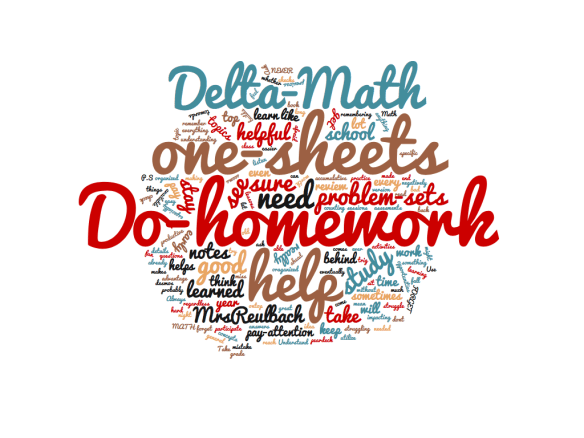
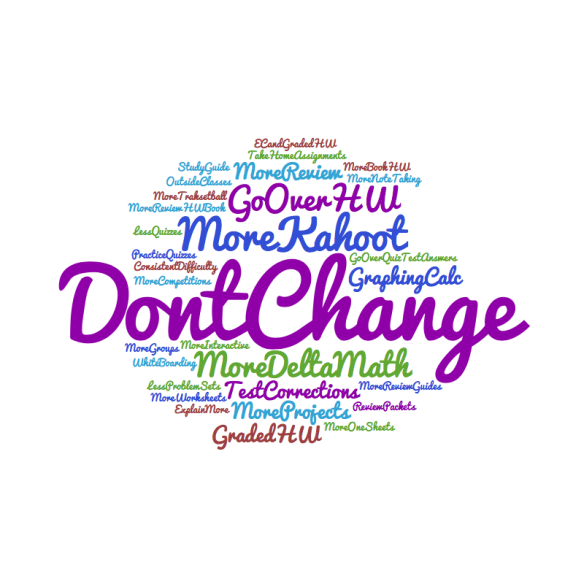
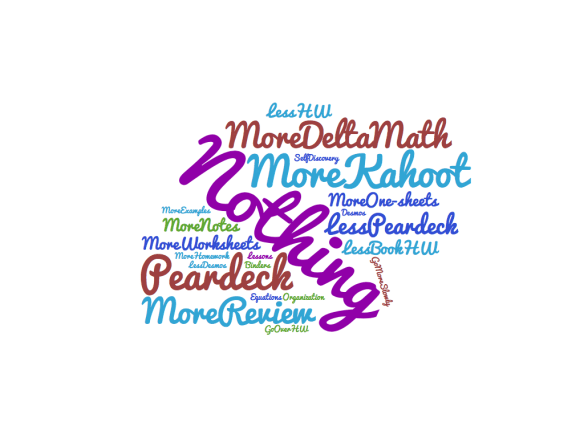
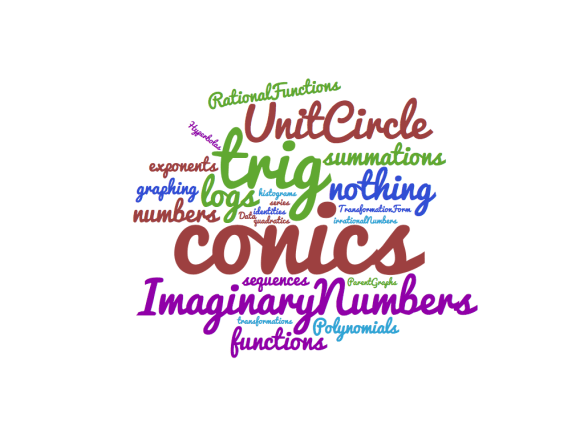
I made word clouds from the student responses on the end of the year survey I just gave.  I am going to share them with my students tomorrow.

I love and have always used Wordle, but I cannot get Java working on any computer I use.  I am sure I could if I had time, but I’m a teacher and it is MAY for goodness sakes.

Instead I discovered Word Cloud.  I loved using the  WordCloud website because you don’t need Java to use it!  And you can use different shapes and even upload an image.

One Word To Describe This Class:

One Word

One Word To Describe This Class

Keep

KEEP!

wordcloud

Advice to Next Year’s Students

Start 3

START

Change

CHANGE

HardestThing

Most Difficult Topic To Learn

Favorite Topic

Favorite Topic of the Year

My Teacher Evaluation Survey

Thanks to so, so many of you who shared your amazing surveys with me!  I took questions from almost all of them and combined them. My students gave me some of the best information I’ve ever received from a survey so it was worth the time.

I made it anonymous so students would be honest. If you decide to make it anonymous, be aware that sometimes it may be tough to read.  Remember that it is probably not possible to please everyone.  Focus on the good comments and the majority of the comments.  Also, sometimes students are just in the wrong class. It’s not their fault, and it’s not your fault, but it still can make it a tough year for the student.  I need to read those comments, because I want to be able to help all students, especially the ones that may be struggling.

I’d like to survey students on a more regular basis next year so I can make sure that all of my students are in an ok place. (Again, I’m not trying to please everyone, but I would like to know if someone is really miserable when I still have a chance to help them.)  Instead of a formal survey on a regular basis, I’m planning on putting a quick question on every test, and doing a great idea that Megan gave me, which is asking post-it note questions.

I took some of the responses and made wordles with them that I plan on sharing with my students.  I’m still waiting on two classes to finish the survey, so I will publish the Word Clouds tomorrow!  Here is a quick preview of one word they would use to describe my class.

One word to describe

And here is the editable survey.

Screen Shot 2016-05-17 at 8.50.34 PM

Student Survey Question on Assessment

Since I have been creating an evaluation survey for the end of the year, I decided to throw a quick survey question on the assessment I gave today.

Please tell me what you like and what you think could be improved about this data chapter.

I got all types of responses, from bullet points to entire paragraphs!  I did not expect such a thorough response.  My students wrote GREAT thoughts, and I really enjoyed reading them.  I replied to every one of them.  It took a bit longer than it usually takes me to grade papers, but I felt like I was talking to every single one of them, about their opinions.  I don’t get to do that often enough in math.  I think I may put this type of question on every major assessment next year.

FullSizeRender 16


Teenagers Used Their Phones 21 Hours Per Week

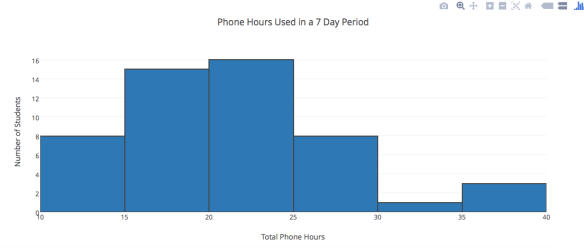
Wow.  My Algebra 2 with Trigonometry students are actively using their phones (screen is lit and active) an average of 21 hours per week.  Two students used their phones for about 35 hours in just one week.

Screen Shot 2016-05-15 at 11.21.56 AM

We started our data unit last week.  Wow, do I love our data unit!  We start with box plots, then move to histograms and land on standard deviations.  The calculations actually make so much sense, but they can be pretty dry.  I love data analysis, so I wanted to spice it up using an idea I saw from Illustrative Mathematics.  They compared the heights of women’s basketball and field hockey teams at the University of Maryland.  Since we are in NC, I looked up the data for UNC athletes for my classes to compare.  They really enjoyed it so I decided we should analyze their heights and sent them a Google Survey Form.  Wow.  High school kids love nothing more than data about their classmates!  We compared boys to girls, and even class periods against each other.  I had a blast!  The data had become real!  Instead of saying, “Outliers”, we could not say, “our outliers, Brian and Jairus” and the students had a visual point of reference.

This was so much fun I sent them another survey about shoe size, number of shoes, and number of hours they spent watching tv and playing video games in the last week.  We were all ready to dig into this data the next day when we were thrown a curve ball.  A student in my first class of the day showed us all how to find out how many HOURS we had all been on our iPhones in the past week, including listing all of the apps and how much they used each app for.  STOP THE PRESS.  Who the heck cares about shoe sizes when we could see not only how much our friends have been on their phone, but what their top app was!  We instantly started adding up and analyzing the data.  And it was incredible!

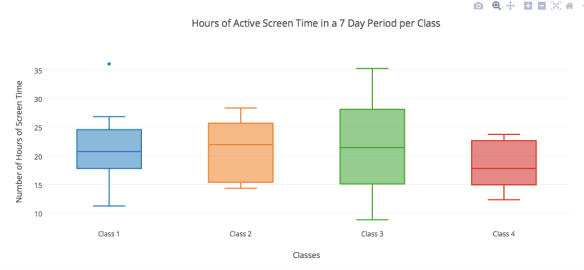
We found out that my students use their phone an average of 21 hours per week.  This is SCREEN time, when they are actively engaged in their screens, not apps running in the background.

Screen Shot 2016-05-15 at 12.00.47 PM

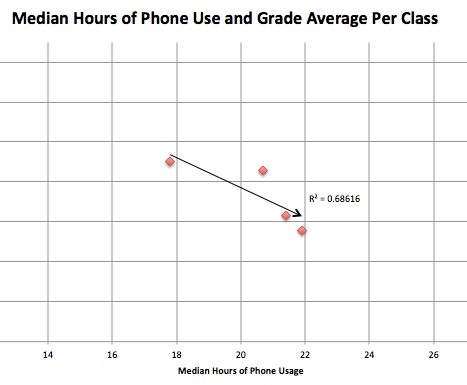
After seeing this data per class, I wondered if this much screen time was affecting their grades.  Because of some outliers in some classes, I decided to use median phone usage instead of the mean.  I compared it again the average grades for each class.  With even just a few data points, it appears to be negatively correlated.  Of course talking about the averages does not accurate reflect each student.  To get the actual regression I would need to correlate each students phone hours with their grade average.  Maybe this summer I will have time to look at it.  This quick chart does make me wonder.  As a high school teacher and a parents of teenagers it makes me very concerned.

Screen Shot 2016-05-15 at 11.52.24 AM

We had so much to analyze that we all leaned on Plotly for help.  What an amazing, easy to use, and FREE program.  And what an amazing data unit.

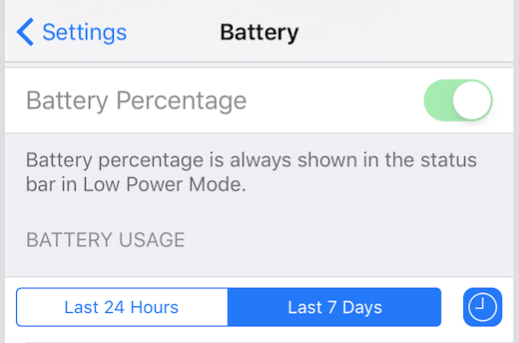
To see the screen time, students must have updated their phones, and they need to have an iPhone.  I am sure that other phones probably provide this as well, but we could not find it.  Go to Setting, Battery, Battery Percentage, Last 7 Days, then hit the little clock icon.  Prepare to be shocked.


Screen Shot 2016-05-14 at 9.41.07 PM

Infinitely Many Bounces

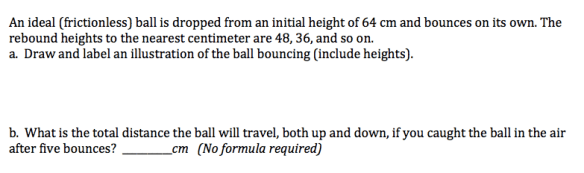
We recently finished up our series chapter.  One of the last questions we talked about was about a bouncing ball.  We just touched the surface of infinite geometric series, so I didn’t want to start out the question with infinitely many bounces.  I wanted to scaffold the question so it was easier for them, then hit them with the zinger!

Screen Shot 2016-05-14 at 7.42.16 PM

First of all, their illustrations were awesome (and varied).  Almost every student found the total distance after five bounces.  Once they had confidence, I threw down the challenge, “What if I asked you what the total distance would be in infinitely many bounces?”  Since they all summed 5 bounces painfully by hand, they looked at me like I was crazy.  There were even some moans (infinitely many bounces, ALL that math)?  But after I gave them “the look”, and they knew there had to be a better way.  I told them they could work on the problem by themselves or in groups.  Several kids wanted some help, or even a hint.  But since I had just decided to ask them about infinitely many bounces, I didn’t have the answer yet.  I truly had nothing to give them, and I purposefully tried NOT to think of the formula or answer so I couldn’t give it away.  I try not to help students too much, but helping is in my teaching nature so sometimes I just can’t help myself!

Many groups of students came up with the infinite sum, and developed explicit formulas that seemed to work (but didn’t recreate the sequence of bounces).  With five minutes left, one student actually started screaming in class, “I got it!  I think I got it!”  And she did.

I didn’t tell her she was correct until the next day (I didn’t want the answer to get out before I gave all classes a chance to solve it).  When she found out she was correct, she literally went screaming down the hall.  The history teacher walking down the hall at that moment thought something was actually wrong with her.

THAT is the joy of mathematics, and I wish every student could feel it just once.  But more than once, I wish they could feel it everyday.  I also wish I could do this everyday.

I just discovered that we have motion sensors that will record bouncing data for us!  We could collect our own data.

I need to get better.