Geometry Chat is BACK! Tonight on Twitter at 9PM EST

Please join us tonight for Geometry Chat at 9PM EST.  Geometry Chat will be held the first Thursday of each month.  Just follow the hashtag, #geomchat, to see all of the action!  Also, be sure to include the #geomchat hashtag when you reply so everyone can read your tweets.  This also ensures that the entire chat will be Storified for others to read later.  

Also, if you’re tweets are private, others will not be able to see your replies, so you can make yourself unprotected just for the chat, and the re-protect yourself after the chat is over if you would like.

We hope to see you all there!  

Geometry Construction Challenges – Compass, Patty Paper, and Euclid the Game

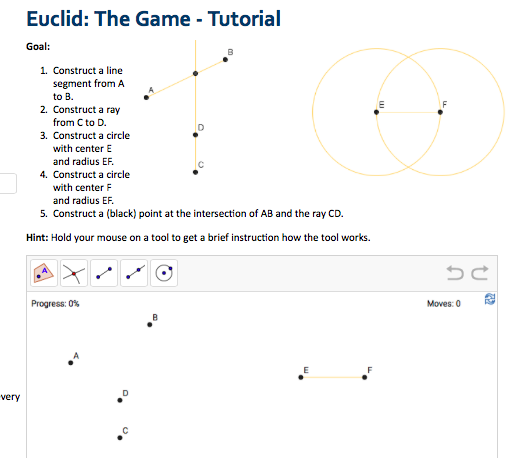
First of all, Euclid the Game is an amazing Geogebra based construction game!  THANK YOU to @mathhombre John Golden and @mrhodotnet.  It’s fun, challenging, and teaches students the basics of construction AND Geogebra all at once for the (double) win!  I told my students that it was a problem solving game.   So I would not tell them what to do, and I would not tell them the answers, even if they BEGGED (and they did – it was awesome).  But NO, I told them that they would have to THINK.  This was great for some of my freshmen, who want me to explain everything to them, step by step.  I felt today was a giant leap forward towards becoming independent learnings and being positively frustrated problem solvers.  After a while I did help students who were still stuck in the tutorial.  But basically, they all figured it out, and begged to go on.  It was awesome.

Screen Shot 2014-09-07 at 9.39.41 PM

We do constructions by hand at my school.  We start with a compass, then throw a little patty paper into the mix.  (Fun fact – Most students couldn’t guess what patty paper was actually used for.)  I have never constructed before.  Ever.  Not only learning it, but teaching it was a huge challenge that first day.  But now I am in the groove.  Although I did seriously underestimated the skill and dexterity the smart notebook compass took to master, much less all of the nuances.  After two days of painstakingly using that damn thing, I am still not even close.  At one point I just grabbed a regular compass and (gasp!) an actual piece of paper and had students gather around me so I could demonstrate.  I also “sketched” a construction freehand on the board.  Sigh.  That smart board hates me now, but I do think it will grow to love me!  I’m persistent.  I would love to throw in some Geogebra constructions to the mix, and that is why I introduced them to Euclid the Game.  But right now I am just trying to keep my head above water.  My mantra?  “Keep swimming Dory!” 

I loved Euclid the Game because students were learning how to construct things that we haven’t done in class yet.  I did Euclid the Game after only teaching them copying a segment and an angle.  So, as I am introducing new constructions now they are saying things like, “Oh yeah, you just need to find the intersection of those two points!”  It really makes my job so much easier!  It’s also more fun for them because they feel more involved.  

Finally, I’d love to give an extra special thanks to Jen Silverman who made a Geogebra Geometry Constructions “crash course” for me (note: for teachers, not classroom use)!  She is one of the kindest and most giving people in this community!  Also thanks to all of the other amazing members of the #mtbos that sent links to my construction SOS call on Twitter.  Again, I can’t even begin to express how grateful I am for this community.  How did anyone ever teach math before Twitter?  Thank goodness I don’t have to!

Recursively Defined Sequence with Limits Investigation – Skittles Activity

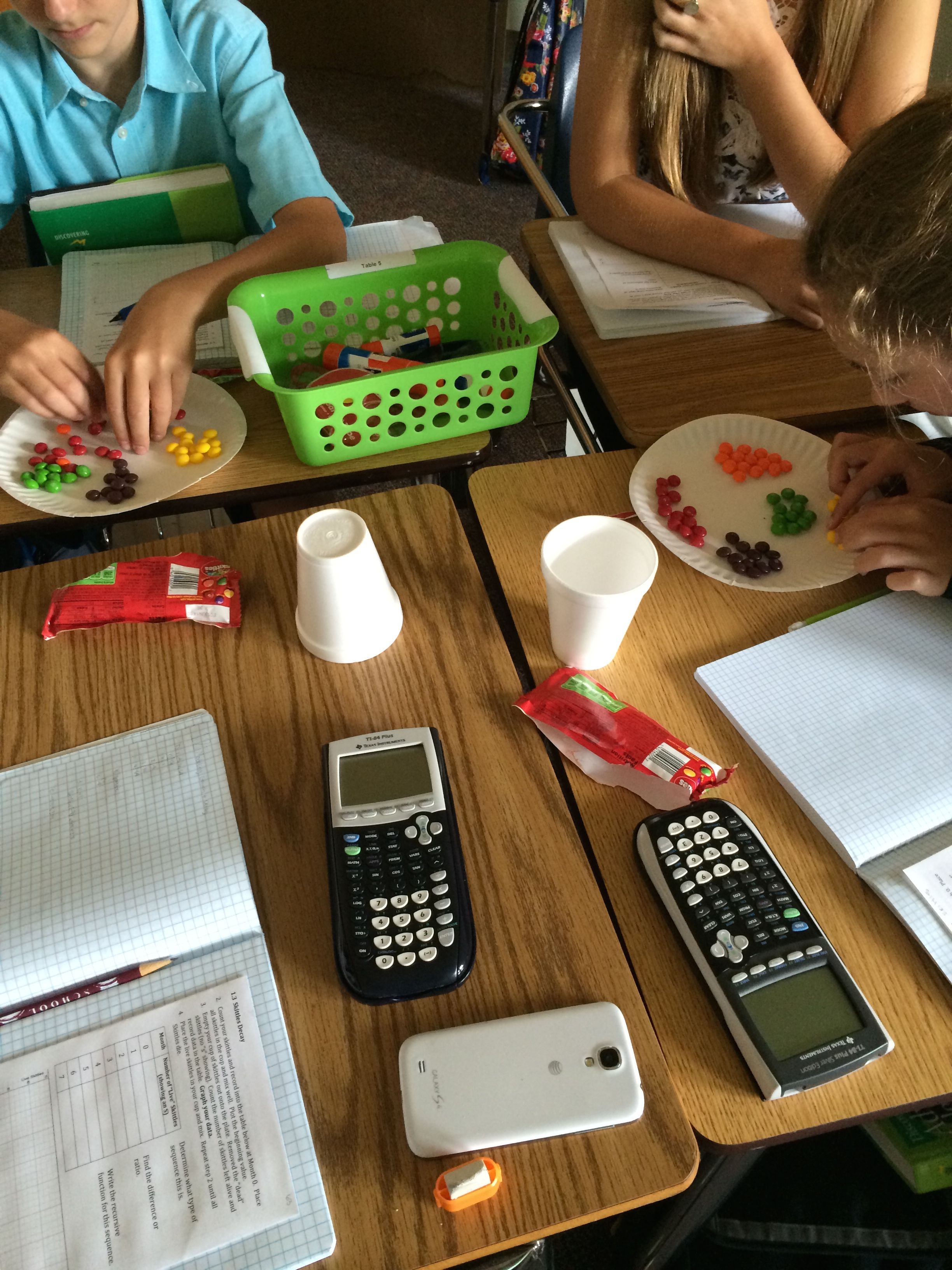
Yikes.  So the title is dreadful.  I need to work on that now that I will share my HS lessons!  Also, I only took two pictures of the action and they aren’t great.  As soon as I pulled out my phone, a student asked me, “Is this for your blog?”.  And then the subsequent comments were either, “Please don’t take my picture.” or “Please, take MY picture!”, and then posing for me.  So, this threw me a bit.  I don’t care if they know, as all my MS students at my last school knew (and begged me daily to take their pictures and blog about it).  I just wasn’t expecting it yet.  Again, it’s hard being new.
IMG_1628

First of all, I needed an entire 90 minute block period for this activity.  So, if you do not have a block period, I would set aside two days.  However, this activity is worth the investment!  I am using the book Discovering Advanced Algebra for my class, and this one activity covers decaying geometric sequences, decaying shifted geometric sequences with limits, and graphs of geometric sequences.

I got the idea from Sarah (thank you Sarah!) but needed to alter it because I wanted to define the function recursively, and I wanted to include limits.  I did not tackle growth, as I plan on teaching that through finances next week, so I only covered decay.
IMG_1629

Experiment 1 – Decaying Sequence:

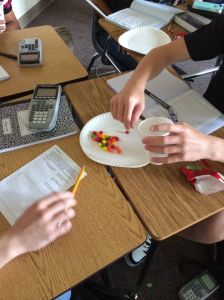
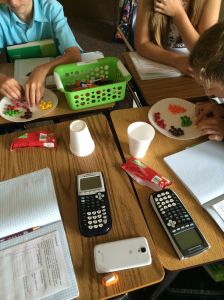
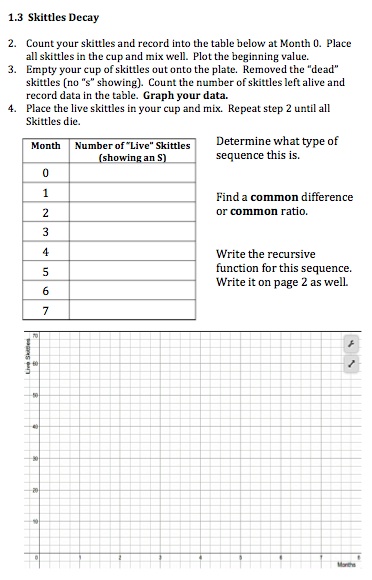
I gave each pair of students a package of Skittles, a plate, and a cup.  Most of the work we had done the previous day was with patterns that started at step 1, so I wanted to start with an existing value.  This is a good precursor for financial functions as well.  Thus, I had them count, record, and graph their initial Skittle population before we started “killing them off”.  They then put them in a cup, shook them up, and spilled them out on the plate.  We recorded the Skittles that had an S on them as “Live Skittles) and put the dead aside.  I had them count even Skittles with a partial S and told the kids, “They aren’t dead yet!  They are still hanging on!  They are only partially dead!”  You must be very clear about how to pour out and count the Skittles.  I do not have a document camera this year to show everyone what to do.  I had a couple of groups doing wacky things, like trying to rub the S off of the Skittles (in effect, actually killing them), counting only Skittles that were blank on both sides, or taking out the Skittles one by one instead of just dumping and counting.  As they repeated the procedure they recorded everything in a table and graphed each point.  ** Note to next year self:  Remind them to graph as they go along. **   We talked about the percentage of Skittles that were dying each time.  They noticed that it was a geometric sequence and that the ratio of each term was similar.  At this point, we talked about how to find a ratio that could best represent the experiment for any stage and averaged all of the ratios.  After each group found their common ratio, I had each group tell me their common ratio.  I wrote them all on the board and we found the common ratio for the entire class.  I should have emphasized that we needed ONE “common” ratio in order to define the function.  Again, next year.  Last, we defined the Skittle death sequence for the entire class.
Screen Shot 2014-08-24 at 8.21.27 AM

Experiment 2 – Decaying Sequence with a Limit

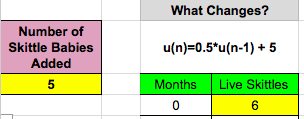
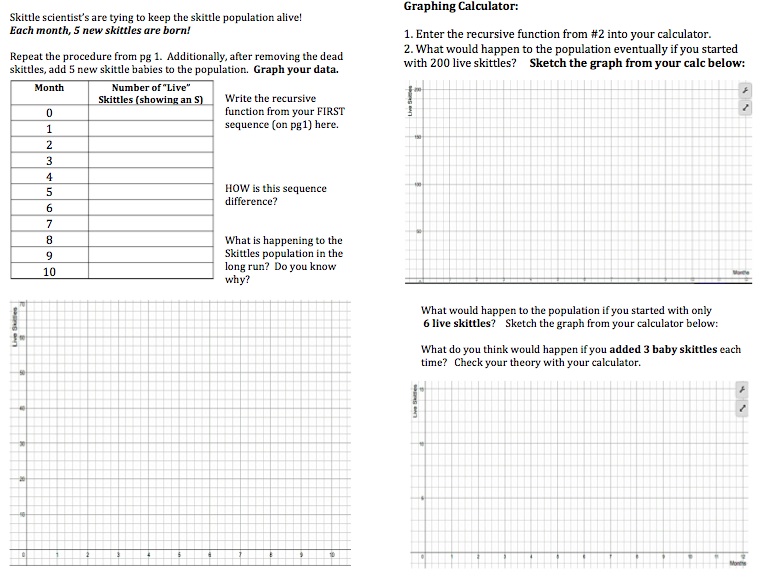
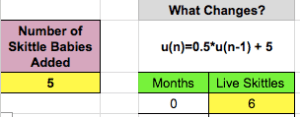
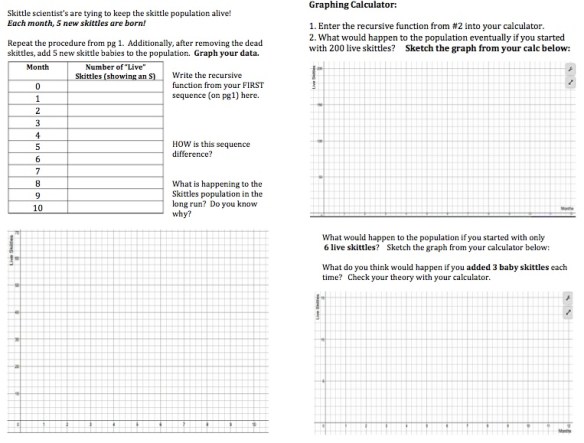
Once they defined their sequence, we started again.  But this time, we ADDED five Skittle babies every time we killed a bunch off.  I put WAY too many trials in this section and have shorted it for you.  However, the frustration did prove for some much needed teacher entertainment.  “Why won’t they all just DIE already?”,  “WHEN are they all going to die?”, and finally, “Oh my gosh, they are NEVER all going to die, ARE THEY Mrs. Reulbach?!?”  The Skittle population wasn’t the only thing that had reached it’s limit!  But we forged on and added our +5 to the function.

Graphing Calculator Investigation – Changing the initial number of Skittles.

I totally ran out of time for this stage because I had no idea it would take so long to kill, record, and graph Skittles.  I had started class off with an additional activity before I started with the Skittles.  (It was my FIRST block period ever and 90 minutes seemed like an eternity – especially if we finished early!  I have so much to learn.)  I asked them what would happen if we started with 200 Skittles.  I was pleasantly surprised that many students actually knew.  But, I acted like I didn’t believe them and made them enter their brand new shifted geometric sequence into their graphing calculators to prove it to me anyway.  The next step was to change the initial Skittle population to only SIX skittles and then watch the graph shift magically before their eyes.  But it was 3:00 and we were all at our limit.  So I will pick up here on Monday.  The last question asks what will happen if we change the number of skittle babies added each year so they can see what makes the limit actually change.
Screen Shot 2014-08-24 at 8.44.39 AM

They were really annoyed that the Skittles didn’t die in the second experiment AND it was the last block period after two days of block periods, on Friday no less.  So, I have no idea if they even liked this activity.  I don’t care if they loved it as long as they didn’t hate it and as long as they learned from it.  But since it’s the first week of school and I am totally new to HS students I have zero idea at this point.  I guess only time will tell!
Screen Shot 2014-08-24 at 8.21.37 AM

Any thoughts and/or improvements would be extremely appreciated.  Love, the Newbie.

Important Notes:

  1. This takes the entire block period.
  2. SHOW them how to dump and count Live Skittles.  Do not put dead Skittles back into the cup.  Or, give them two cups!
  3. Remind them to graph as they go along.
  4. Emphasize that we need ONE “common” ratio in order to best define the function.

The Doc and PDF files are on Box here.  They are in landscape booklet style so students can fold it and tape it into their notebooks.
Sequences, Subscripts, and Being a Newbie

Welcome back to high school!  School started this past Monday for me and after four years teaching middle school I am back in high school!  Although I do miss my sweet middle school kids and my colleagues at my last school,  I must admit that I love teaching high school students again.  And I LOVE THE MATH.  I’m not sure if it’s so great for me because it is high school math, or if it is just nice to change things up after a while.  Whatever the reason, I am extremely happy right now.  I love my new school and everyone in it.  I love my students already, and I love the subjects that I am teaching.  Life is crazy busy, but good.  Please don’t pinch me, because I don’t want to wake up from all of this amazingness.

Not that everything is smooth sailing, of course, because I am a NEWBIE.  I get still get confused (or physically lost) almost everyday.  I don’t know everyone’s names or what school seminars I’m supposed to go to (or again, WHERE), or how I’m supposed to do things, or where I’m supposed to get things.  I can’t wait until I just know things!  

As exciting as it is to teach a new level, and new subjects, there are some unavoidable pitfalls as well.  Enter Algebra 2.  My first unit is recursively defined sequences.  I knew (and had even been forewarned) that subscripts would be difficult for them.  But, before I actually taught it I didn’t know know how difficult or how to do it better.  Experience really is the best teacher.  So, day one was rather rough, but I adjusted and (hopefully) day two was much better for them.  Next year I will know that this topic will take two days, and I will be able to structure it so that they do not go home freaked out the first day.  Yes, I feel bad about that.

Next year, I think I will not even introduce subscripts until day two.  I may just write sequence = previous term + common difference or x common ratio.  Tables and graphs have really been our friends.  I will need to create a homework that has patterns, tables, graphs, and then just ask them to write in words how to find the subsequent terms.  Then, day two I will let them help me develop the notation so that the sequence definition will be more efficient to write (and subsequently put into the graphing calculators).  Also, the graphs of sequences on the TI-84 are just treacherous.  The zooms are nuts and the window option is so complicated.  Eli promised me that they were working on recursively defined sequences in Desmos.  I am just praying it is finished before next August so we won’t all have to suffer the TI graphing torture again next year.  (Side note:  I also didn’t know that Alg2 students weren’t proficient at the graphing calculator.  I’m not either, and I was hoping that they could teach me.  It may be good that we will all learn together though!)  This year, I taught them how to enter the sequences in the TI-84 and we leaned on the tables, but the graphs were a mess.  I made all of my graphs in Google Spreadsheets so I could show them what was happening in the long run.  Thank goodness for spreadsheets!

I created an activity using Skittles for recursively defined sequences that decay.  It went pretty well and I hope to blog about it in the next couple of days.

Thanks again to Sam for his AMAZING sequence and series packet!  I leaned on it heavily during these two days and plan on using parts of it to make this new day one homework assignment that I am dreaming up in my head.  As I have said many times before, I love this village. 


“Don’t Say That!” Project – Making First period more like Third

My amazing new TMC14 teacher friend Matt came up with this brilliant idea. He created an open source document where experienced math teachers can tell “newbie” teachers what NOT to say in class. Since Matt and I are both newbies to Alg 2 and Geometry, we would love your help! However, there are also sections for elementary math through Calculus! So please join in the fun and help all newbies out! Thanks in advance.

Mattie B's avatarPythagoras was a Nerd

The thing about being a first-year teacher is that you make a lot of stupid mistakes. It’s completely understandable, first-year anythings make a ton of mistakes. But I always felt much worse making mistakes as a teacher because I’m affecting these kids’ future. Plus it’s a hell of a lot harder to go back and correct deeply ingrained misconceptions than it is to go back and change some cells on a spreadsheet or some grammar in a report.

Last year, when I was up way too late planning for the next day, I would always try to predict where my students would get turned around. I worked my butt off to anticipate all of their mistakes. And then came the day when kids didn’t know the difference between and angle and a side. I was flabbergasted, so I asked another teacher friend, and they were like “oh, yeah, you have…

View original post 506 more words

Math-magic for Solving Multi-Step Equations

I don’t know why it took me so long to get on this band wagon.  DON’T be stupid like me and say, “I’ll get to it.”  Read all about it and decide now to do this with your students next year!

Screen Shot 2014-05-20 at 10.49.20 PM

Magic Tricks for solving equations is brilliant.  Not only is it very fun for the students, it makes learning how to solve multi-step equations very easy for them to understand.  It’s brilliant.  I read all about it on Dan (week 3) and Sadie’s blogs.  Go and read them to get the entire picture, especially since I harassed Sadie to blog about it forever!  Thanks Sadie!

I teach my students one-step equation solving with my silly “monster math” first.  Then, we start the magic tricks.  After just one lesson they are hooked.  My homework the first night is to make up your own magic trick and try it on someone at home, preferable a younger sibling!  This year, a student even videoed this and sent it to me.  See how fun this is?

After the first day, I teach them how to do more complicated equations that should fool even their older siblings and parents.  It is all about simplifying algebraic expressions. This is also a great application of the distributive property.  They can actually see when and why it makes sense to use parenthesis in an algebraic expression.  I love fun lessons that have it all!

Barbie Bungee – Special Request Edition

Barbie Bungee is the most anticipated and talked about activity that I do in my 7th grade Pre-Algebra class.  Sadly, I will not get to teach next year’s 7th graders since I am changing schools. So, my 6th grade students asked me if we could do Barbie Bungee THIS year!  Barbie Bungee is such a great learning experience, and what other time do students actually BEG for a math lesson?  Of course I said yes!  I had a blast, and I hope that they gained experience in scatterplots, lines of best fit, and linear equations.

Barbie Bungee – 6th Grade

Tremont 2014 – 6th Overnight Trip

I finally finished the video for the 6th grade overnight trip!  Our 6th graders go to the  Great Smoky Mountains Institute at Tremont every year.  It is an amazing trip where they look for salamanders, learn wilderness navigation, learn about rock formations, take a hike to the waterfalls, meet new friends, and play lots of fun games!

Thanks so much to Mary and the entire Tremont staff for an amazing trip!


Discovery Place Field Trip – Van Gogh Alive!

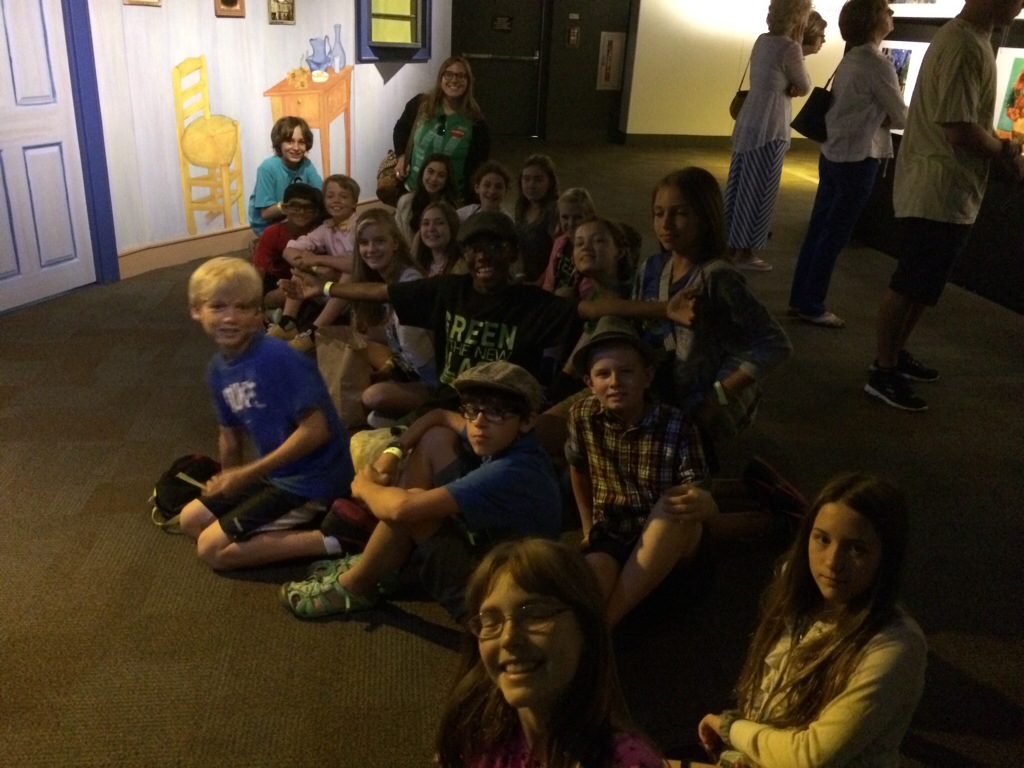
Today I went with our amazing MS Art teachers to the Discovery Place to see the Van Gogh Alive exhibit. It was amazing. I highly recommend going to see it if it comes to a city near you! It was vey moving.

20140528-185357-68037702.jpg

20140528-185358-68038032.jpg

20140528-185357-68037269.jpg

20140528-185358-68038612.jpg

20140528-185359-68039236.jpg

20140528-185358-68038951.jpg

20140528-185359-68039538.jpg

Stickers for Self-Assessment

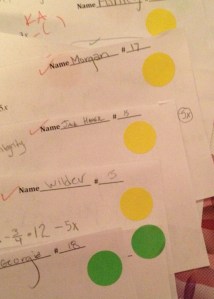
StickersAfter students complete an assessment in my class, they chose either a green, yellow, or red sticker to put on the front of their paper.  The green sticker indicates that they felt they did well on the assessment.  The yellow sticker indicates that they felt ok.  And, I refer to the red sticker as “SOS!  I need help”.
  • Green = GREAT!
  • Yellow = OK
  • Red = SOS, I need help.


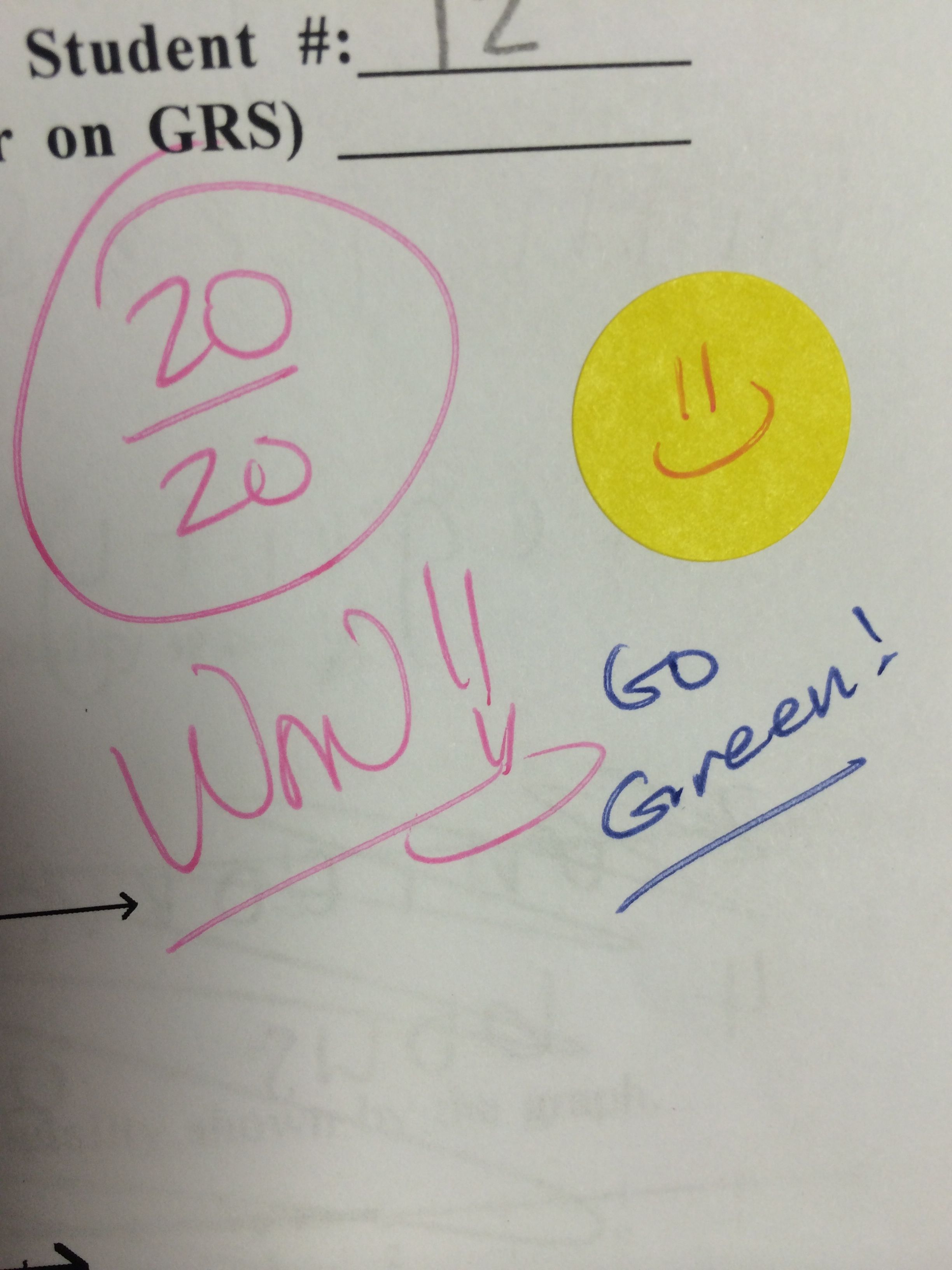
When I grade the papers, I comment if a student chose a sticker that did not match their score.  For instance, if a student put a yellow sticker on their paper, but did very well, I usually write, “Go Green!”.  They love this.

Go Green Sticker