Amazing Things to do with Google Docs

I love meeting great teachers who have great ideas!  Today I got some ideas about how to use Google Docs from @msgregson and wanted to get them down here to share with everyone.  I have tagged her as “Gregson Google Goddess”.

  • First Day Information Form – Students go online during class and fill in all of their information.  This is BRILLIANT bc the info that THEY type in goes into your beautiful, sortable, Google Spreadsheet
  • Parent Information Form – Almost the same form as the students.  This way you get the parents preferred email, cell phone, method of contact.  Also, @msgregson said she liked it bc parents could send you info they would not want their child to see on a form they had to fill out and send back via child.
  • Google Powerpoint Presentations – Up to 5 students can work together on one Google Powerpoint presentation simultaneously.  I think this would be a great “teach the class a topic” lesson.
  • Google Spreadsheets – Up to 50 kids can work on a Google spreadsheet simultaneously.  Wow.  I can see them all in class entering their data at the beginning and then being able to instantly start working with the combined data.
  • Google Forms for tests – you cannot put equations or pictures in a google form so she worked around that by making another site with the test, then you just enter the answers on the Google docs.  Great work around.

If you are using Google Docs (or any other amazing technology) in your classrooms, please post it here or to the Math Teacher’s Wiki.  Alternatively, you can email me and I will add it for you.

Homework Paradigm – Part II or Wanna Be Happy? Then don’t grade homework

I analyzed the homework survey results from Sam’s blog.  He asked teachers a series of questions about their homework polices.

What I was most interested in how teachers were grading and if they were happy.  Sixty-eight percent of teachers that answered the survey are grading homework for completion only.
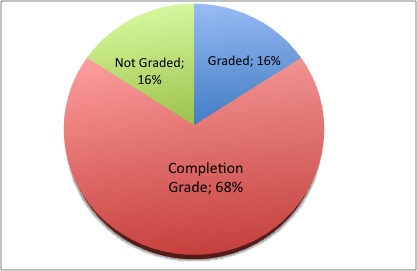
Homework Graded Pie Chart

However, I was most interested in which teachers were the happiest with their homework procedures.  Apparently…
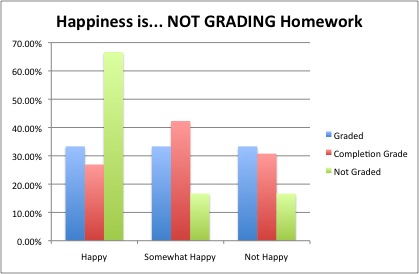
Teachers who are the happiest with their homework procedures are NOT grading homework, not even for completion.  I was thrilled by this result.  Forget the fact that I am going to be a happier person if I do not have to spend many hours grading homework.  Apparently I will also be happier with my homework system if I do not grade homework.  This is classic win-win.

Limitations:

Numbers.  Sam received 40 responses, which satisfies the minimum number required needed to perform statistical calculations.  However, I did not run the numbers through any tests, I just analyzed the resulting percentages, quick and dirty.

Subjectivity. As the responses were open-ended response, I had to use my judgment in categorizing the responses regarding happiness.  I used a scale from 1 – 3.  With 1 being very forms of not happy (i.e. – dislike, hate it), 2 being somewhat happy, and 3 being happy or very happy.

Best Homework Practices – Summary of Ideas

I pulled these ideas from the teachers comments in the survey and my own thoughts.  Specific quotes from the actual survey are at the end.  Many of the ideas here came from and are presented on the Math Teacher Wiki Homework page.

Atmosphere:

  • Create the proper homework culture at the beginning of the year
  • Be consistent – do not give up or change it
  • Call homework “assignments” or “practice”
  • Do not make it a large percentage of students grade if you do decide to grade it

Assignments:

  • Make it relevant (homework as preparation for class discussions)
  • Include review problems
  • Exit Card – One problem each day at end of lesson to be quickly graded, then can base hw off of that (maybe the hw levels)?
  • Differentiated HW –
    • Optional Homework
    • Assign section only – do as many or as few as you need (time limit idea – work for 30 minutes)
    • Pick 5 problems that are not too easy for you to do out of section
    • Recommended / Suggested problems from teacher

At Home:

  • Put the responsibility on students to self-evaluate what they don’t understand
  • Online homework evaluation each night
  • Law of Diminishing returns – don’t kill em with homework. A Duke Study cites a “10 minute per grade level” rule that my school lives by.  I love it.
    • STOP after you have worked 30 minutes on hw (with no other distractions)

After the Homework is completed:

  • Have students put up problems they don’t understand, other students work them on board
  • Red/Yellow/Green
  • Homework Quizzes

In Summary:

I think our major problem as educators is that most students are not intrinsically motivated to do homework.  Until we can change this, I don’t think that any of us are going to be very “happy” with homework results for long.  This got me thinking…

What is the motivation to do homework?

Homework is the definition of anti-climatic.  It comes at the very end and doesn’t play into the story at all.  The lesson is finished, the homework is independent, it won’t even be “really” graded, and tomorrow we will be talking about something entirely different.

Why would students care about homework?  Because we force them? Because we are going to give them a bad grade?  Because we are going to call their parents?  Because they are going to be “embarrassed” that they did not do it?  These are not motivators – these are threats.  These threats are what lead students to do a poor, sloppy job on homework, the period before it is due, half-copying from their classmates.

In order to change the effectiveness of homework assignments, we need to change how these assignments work.  We need to make homework relevant, not only to the lesson of the past, but also to the lesson of the next day, if possible.  Can we make it practice of the current day, and the topic of the next day?  If this is too hard to accomplish, then what CAN we do to motivate students to do homework?

What can we do to make homework important to students, to make it relevant, and most importantly, to make them want to do it well?

Continue reading

The Homework Paradigm

Student homework is my Achilles Heel, my fatal flaw as a teacher, my nemesis.  The only thing I am worse at in teaching is taking daily attendance.

Some math teachers do not give or are doing away with homework.  I am not sure how I feel about this yet.  I feel that mathematics is a building skill, like a musical instrument, or a sport.  The more time you spend practicing the better you will become.  But, that practice has to be done well to be effective.  Also, I don’t feel that you need a large amount of practice, just a little bit every day.  Since most students have math class five days a week, is this enough practice?  Do students get enough practice by doing mathematics each day in class?  Many times I have seen students really feel like they “have it” in class, only to get home and have trouble doing it independently.

I worked as a research director in television advertising for a while. The rule of thumb there was “Frequency of 3”.  This meant that the consumer had to be exposed to the advertisement at least three different times in order for it to be effective. There was NO WAY any customer was buying ad spots where they were getting less than a frequency of three.  The sales people didn’t even pitch it.  Even the noobs knew this.  I think about this every time I consider throwing out homework.  I worry – is once in class enough, even if it IS independent practice? Because, it is only ONE event, not three.

Homework’s Flaws:

  • Checking homework the next day takes forever
  • Assigning the correct amount / level of work
  • Going over homework questions.  Students are either in two camps here – either I didn’t explain it enough or I am killing them explaining it too much.
  • Going over hw can really eat into new lesson
  • I feel bad bc I push hw questions aside in order to do the new lesson
  • If you make it for a grade, some students will copy other’s hw
  • If you make it for a completion grade, they will write anything down just to get “credit”
  • It is not effective if not taken seriously, (ie. copied, write down anything)

Reasons I feel homework is important (if it’s done effectively):

  • Students can figure out what really do and do not know how to do
  • Students can take more ownership of their mathematics learning.
  • Students practice more, thus they learn more

Fortunately, some wonderful teachers ( McTownsley and Shah )have gotten a big jump on me, and I can’t wait to learn more from their ideas!

At this point I am still going to assign homework for my classes.  What I would like to do is:

  1. Effectively checking that it was attempted / completed
  2. Ensuring it is effective
  3. Motivating students to really DO the homework effectively.
  4. Assign reading and a few problems of the next section to get the students thinking.

I would like the students to do homework and then I will check it, but not grade it.  I feel that the student wants to be acknowledged for their effort, and am hoping that just checking it but not grading it will give them the external praise that they like.  As I plan on giving them all of the answers AS I give them the homework, I feel that grading is pretty pointless anyway.

I would love to develop a hw system that works for most and can easily be adapted for all. I know that I am dreaming here.  But, if I can’t figure out why this is so hard to do, then it should be doable!  Luckily, I have amazing math teacher tweeps who are hard at work on this with me as well over at the Math Wiki.  We plan on sharing ideas then building something together, or at least that is my plan!

Please join us over there and add your ideas and methodology.  It is a public wiki party and everyone’s invited!

How Do You Group Effectively?

I plan on grouping often, if not daily. My needs are…

  1. Be able to switch up the groups easily and quickly
  2. Have students get into groups quickly.
  3. Designate group roles such as leader and recorder easily.
  4. Did I mention quickly ???

One more caveat – I will probably be switching rooms for each class so I will need something portable.

I would like to do these things with a minimum of talk. More talk = more confusion = more wasted time. After visiting my son’s kindergarten class last year I got an great idea! His teacher had clothespins with their names written on them in sharpie and she “clipped” them to the weekly job chart. I want to do something similar with groups. I plan on using magnets however.

MAGNETS for GROUPING Idea:

  • Purchase magnetic board
  • Divide the board into colors (using construction paper maybe)?
  • Purchase something small and put all kids names on each one. (like writing their names on clothespins)
  • Attach a magnet to the back of each thing (clothespin)
  • Before class put the clothespin on the board corresponding to which group they will be in.
  • Place a “flag” on the table to indicate which color group goes where
  • Designate group rolls – Write on the board group roles like “leader” and “recorder” and put their clip in that spot.

I am thinking I could then switch it up, like add more colors for more groups and such but just adding more colored paper on the board. This is only in the planning stages. Once I design it I will post a pic.

If you’ve got them, ideas would be LOVELY before I start actually purchasing materials.

Oooooozzzzing with Technology This Week!

In Math Teacher Twitter land I am officially, “A Noob”.

I taught for years, but after being out for eight years I am amazed at what I have missed.  Twitter, Blogs, Wiki’s, and Google Docs top my list of “things I cannot believe I have missed out on even though I wasn’t teaching”.

But, I am back!!

With my type A++++ personality, this is technology deficit is more than mildly irritating so I am racing to catch up.  However, most days I feel like I am running just to stand still.  This week my children are in all-day soccer camp so I have been especially technologically productive (even though I haven’t done ANY of the lesson planning I had slated for the week).

What I have done this week:

1.  Made a new Wiki for math teachers – Math Teacher Wiki

What I have learned this week making the Wiki.

  • How to make it public so that everyone can participate without having to manually give everyone permission.
  • What a “steal lock” was and what it meant, thanks @misscalcul8!
  • How to invite tweeps to participate
  • What a sidebar does
  • That I need to learn how to make it pretty b/c it is UGLY now.  : )

2.  I created a MathLog calendar on Google Calendars for my new MathLog Club for teachers.

I learned how to:

  • Make it public
  • Invite people
  • Find the link to share it on Twitter
  • Add my “out” dates and view other’s “out” dates
  • Imbed it into the Math Wiki!

3.   Created a Facebook Fan Page for my future students.  Thanks to some amazing Twitter friends this was amazing fun to learn!  However, it turns out that I will be unable to do a FB Fan page with my students.  Turns out that you have to be at least 13 to get a FB account.  Since I teach 6th and 7th grade the majority of my students will not “officially” qualify.  I am sure that many of them already have accounts, however I do not feel comfortable “officially” encouraging it.  This is the day I realized how young the students are that I am going to teach!

I learned:

  • You can make a FB Fan page with your account, but it is not visibly linked to you
  • When you make a FB Fan page under your log in you can easily edit and update the page without having to log out and log into another FB account.
  • You have to “like” the page to become a fan of your own page so you will get the updates
  • Others can “like” your page without becoming your friend.  This is crucial for me as I don’t friend my students
  • You are SUPPOSED to be 13 to get a FB account.

4.  I also learned how to change the DELETE key on my Mac keyboard to act like the classic BACKSPACE key on a PC.  This was essential to my way of typing life.

As I’m still the NOOB please feel free to tell me all about great things that you do with technology in the comments section or on the Math Wiki.