Lesson Plan Organization

#msSunFun

This week’s theme is Lesson Organization.   It’s not too late!  Submit you post for this week. 

My lesson plan organization needs help!  Many years ago, I kept all of my lessons in a giant 3-ring binder.  But, I couldn’t keep up with it, and I really hate all of that hole punching.  I then kept a file folder for each lesson, but that was too many file folders.  Now, I keep everything from one chapter / unit in one file folder, but it’s all jumbled up.  I’m always looking for a certain sheet to make copies of or a homework key.  I would love to have it all in order in this file folder.  Is this possible?  Basically, I would love to have a better system, but it needs to be low maintenance.  Please help if you have a great idea!  Blog about your awesome system or just throw some help in the comments.  THANK YOU in advance!  And thanks to Beth and Mary for blogging this week.

Pizza + Linear Equations = Fun, Free Mathalicious Lesson

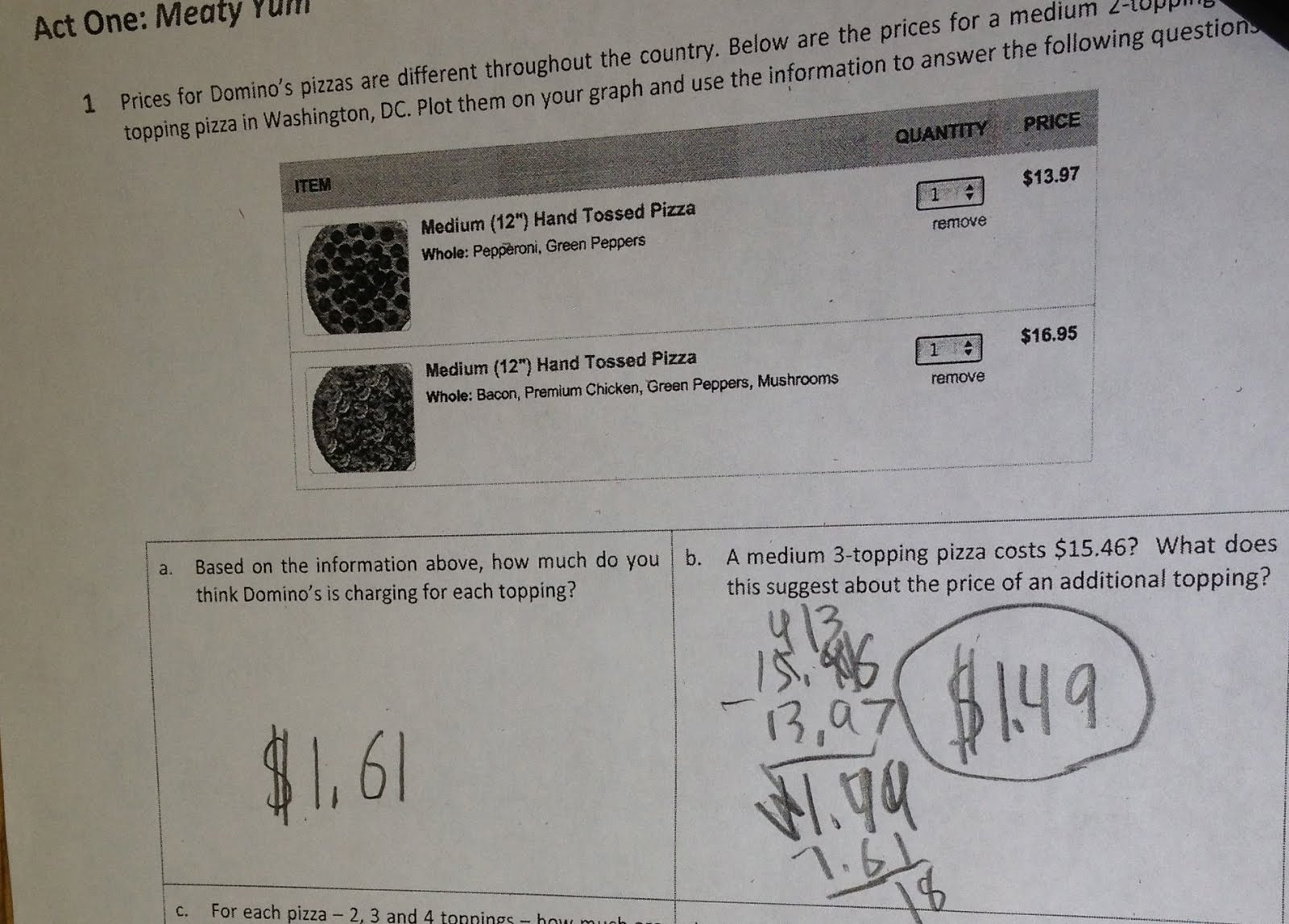
Every kid loves pizza, right?  Well, my students do, and they LOVED their first Mathalicious lesson, Domino Effect.  The best part is that it is one of the sample lessons from Mathalicious so you can try it for free!

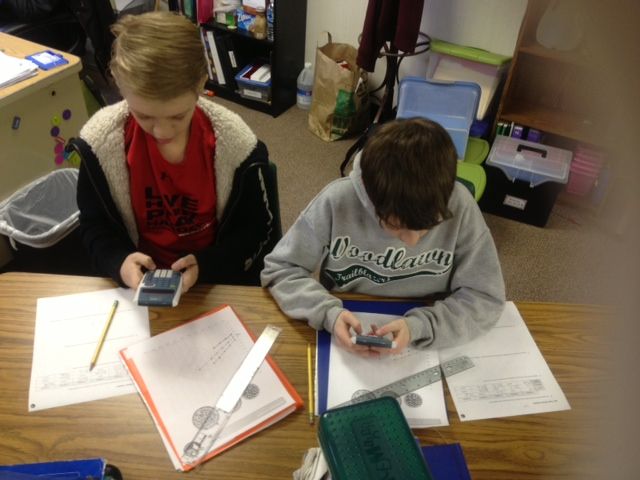
This lesson is intended for students in Algebra 1. However I did this lesson with 6th grade students who had not learned linear equations yet. After introducing the lesson, I gave them the student handouts. The student handout was self-explanatory and easy for my 6th grade students to follow.  I gave each student their own set of handouts but let them work in pairs so they had someone to talk through their work with.

I appreciated that there were several related questions.  This made students aware that they had made a mistake in a previous question so they knew they had to go back and rethink it.

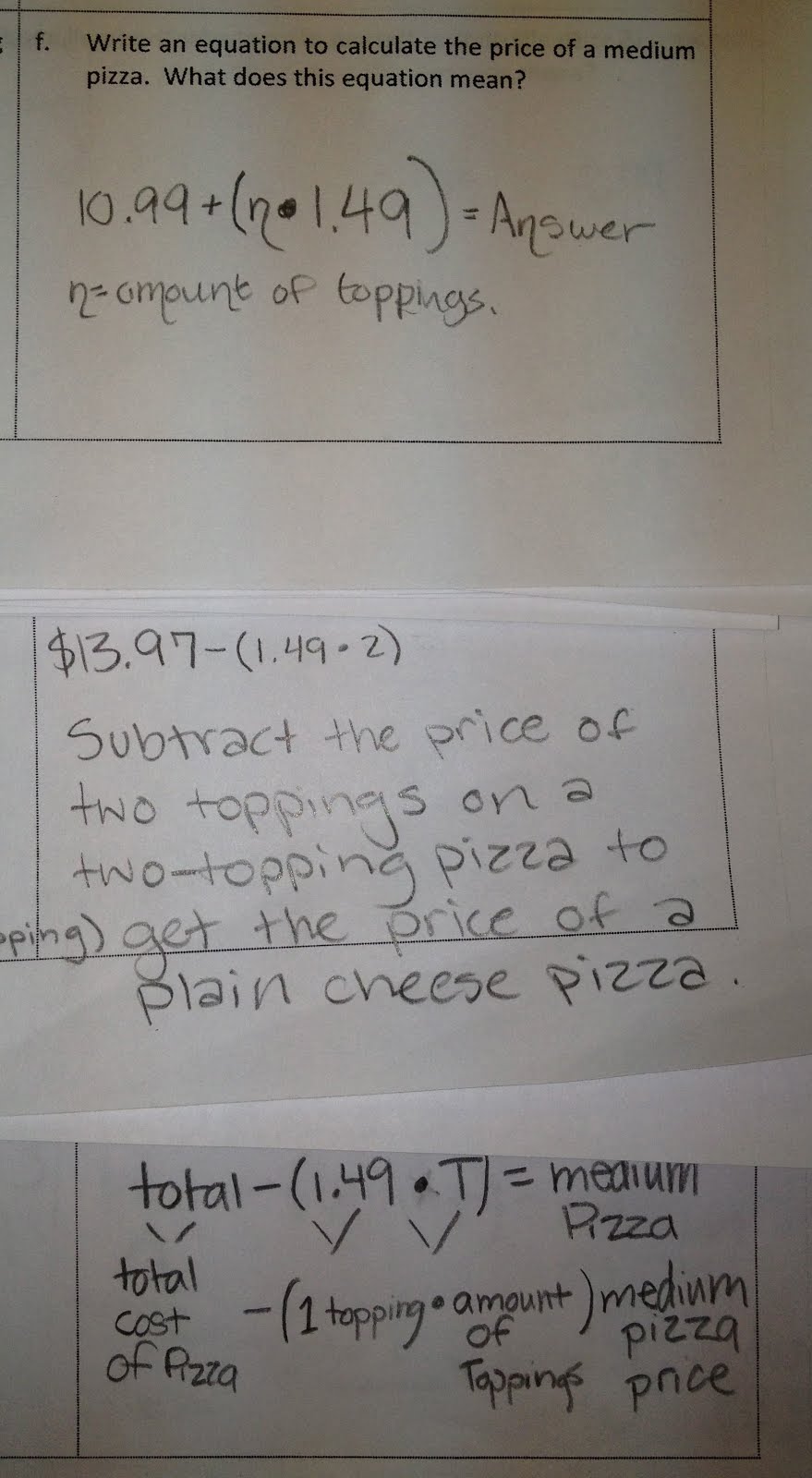
The questions were leading enough so that my students (who had not written linear equations yet) were able to summarize their findings.  I was pleasantly surprised that several students even came up with an equation.

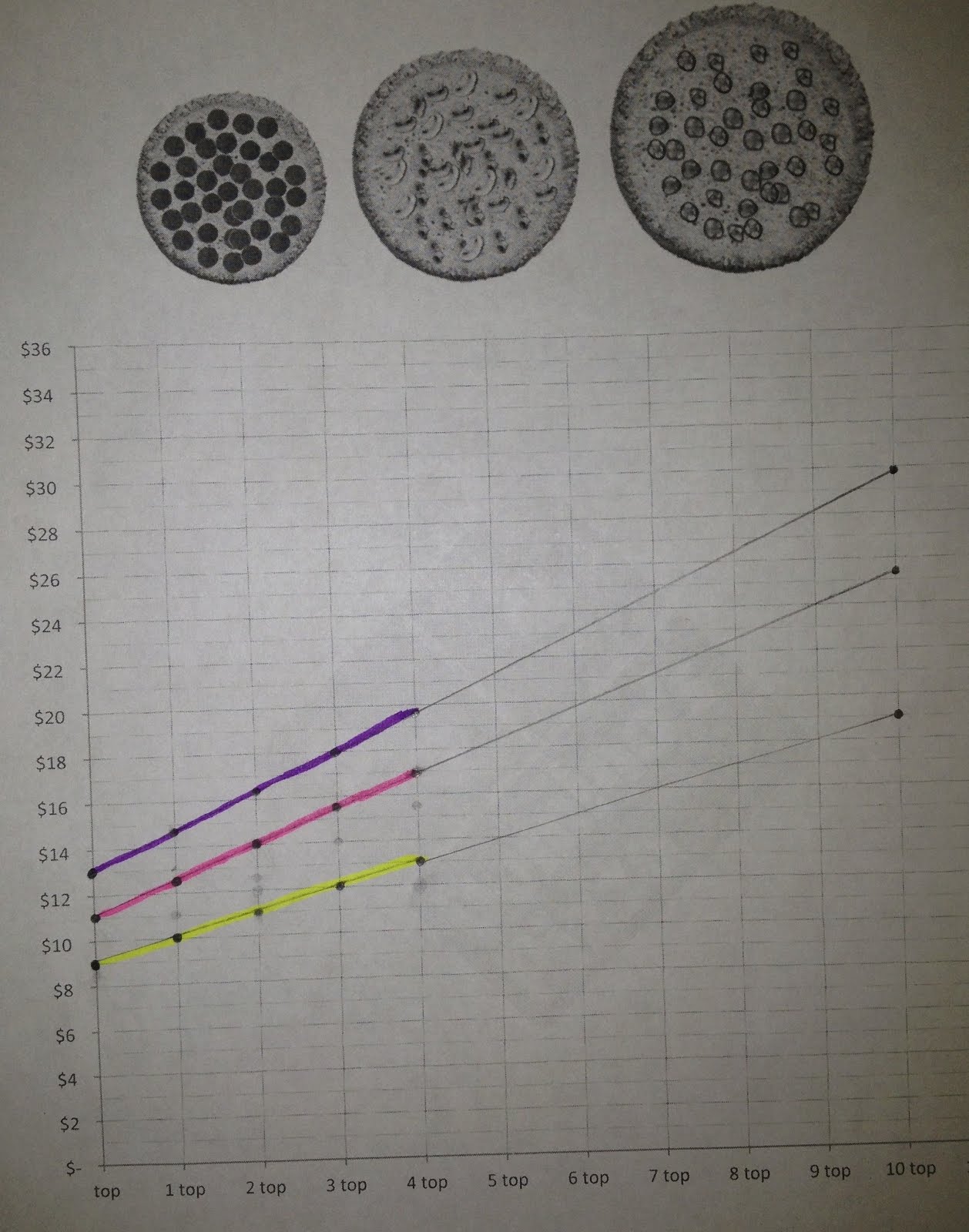
Many students ran into trouble in Act 2 on question number 2, when they assumed that the medium topping price was the price of toppings for all pizza sizes.  The layout of the chart alerted most of these students that they had made a mistake when they noticed that a 2-topping small pizza was $10.48, but a 3-topping small was only $10.99.  Other students discovered this when graphing the points.  I noticed that some students did not notice this discrepancy at all, but and let them continue to fill out the chart incorrectly.  To help students discover their mistake, I asked them if they could figure out how much a small, medium, and large 10-topping pizza would be.

Some students went straight to their calculators.  Other students wanted to use their graphs but were not sure that they were allowed to extend the lines.  This was another opportunity for discussing lines and patterns.  They loved this “shortcut” and that it quickly helped them price their 10 topping pizzas.  

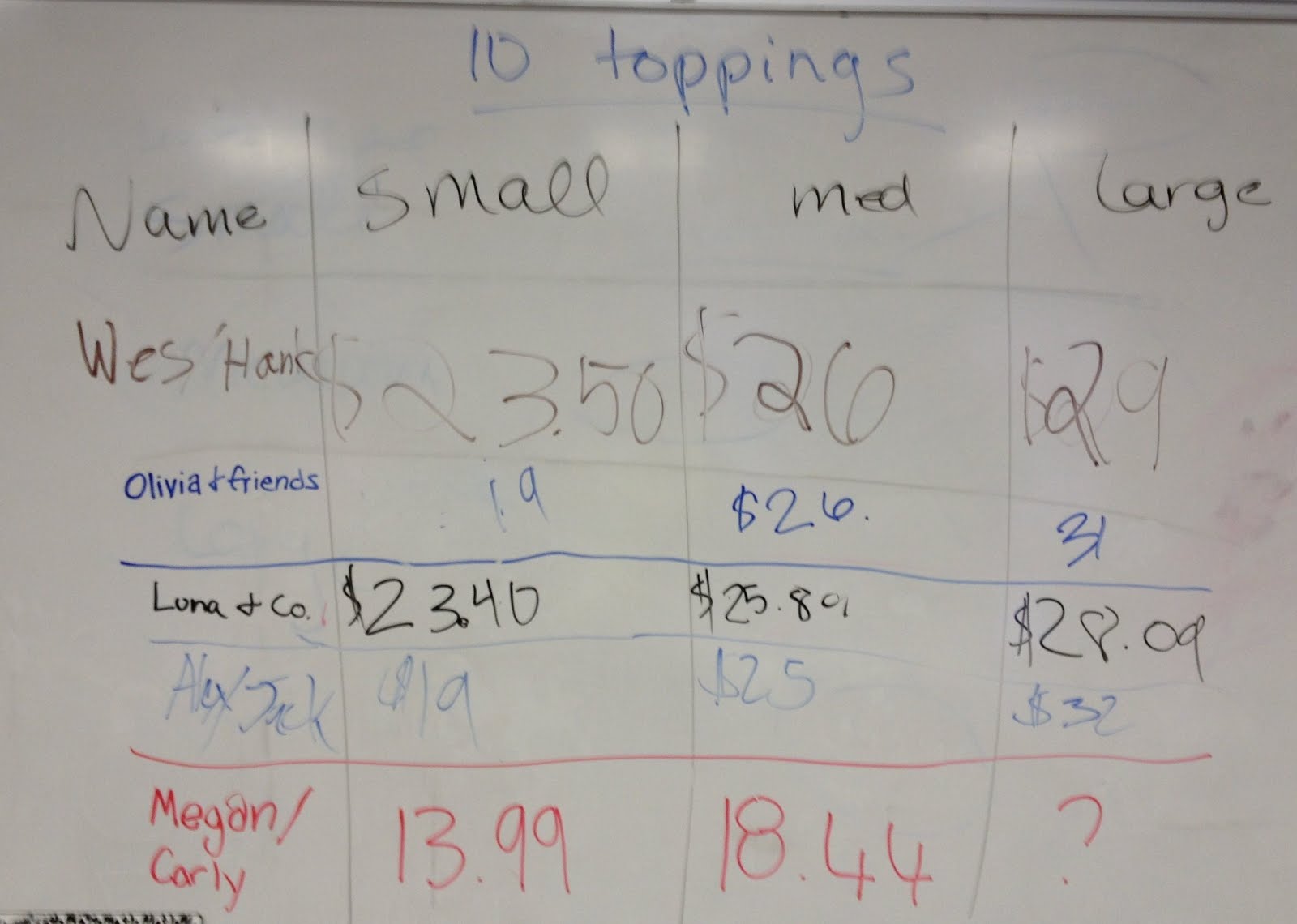
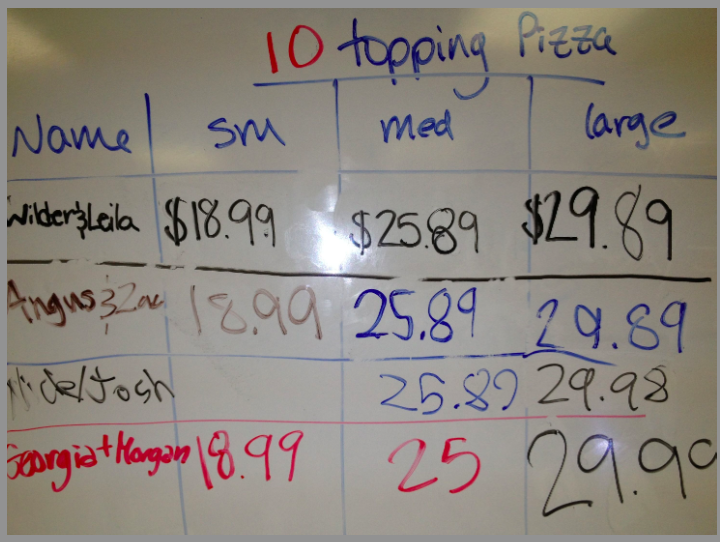
After all of the groups had come up with their 10-topping pizza prices, I drew a large chart on the board and had the groups fill in their prices to illuminate the differences.  

Once they saw that other students pizza pricings were different, they had a heated class discussion about who was right.  “Proving” their calculations to each other helped all of the groups realize that the topping price was supposed to be different for differently sized pizzas.  After everyone had time to find and fix their mistakes, they updated the board chart to make sure everyone was now on the same page.


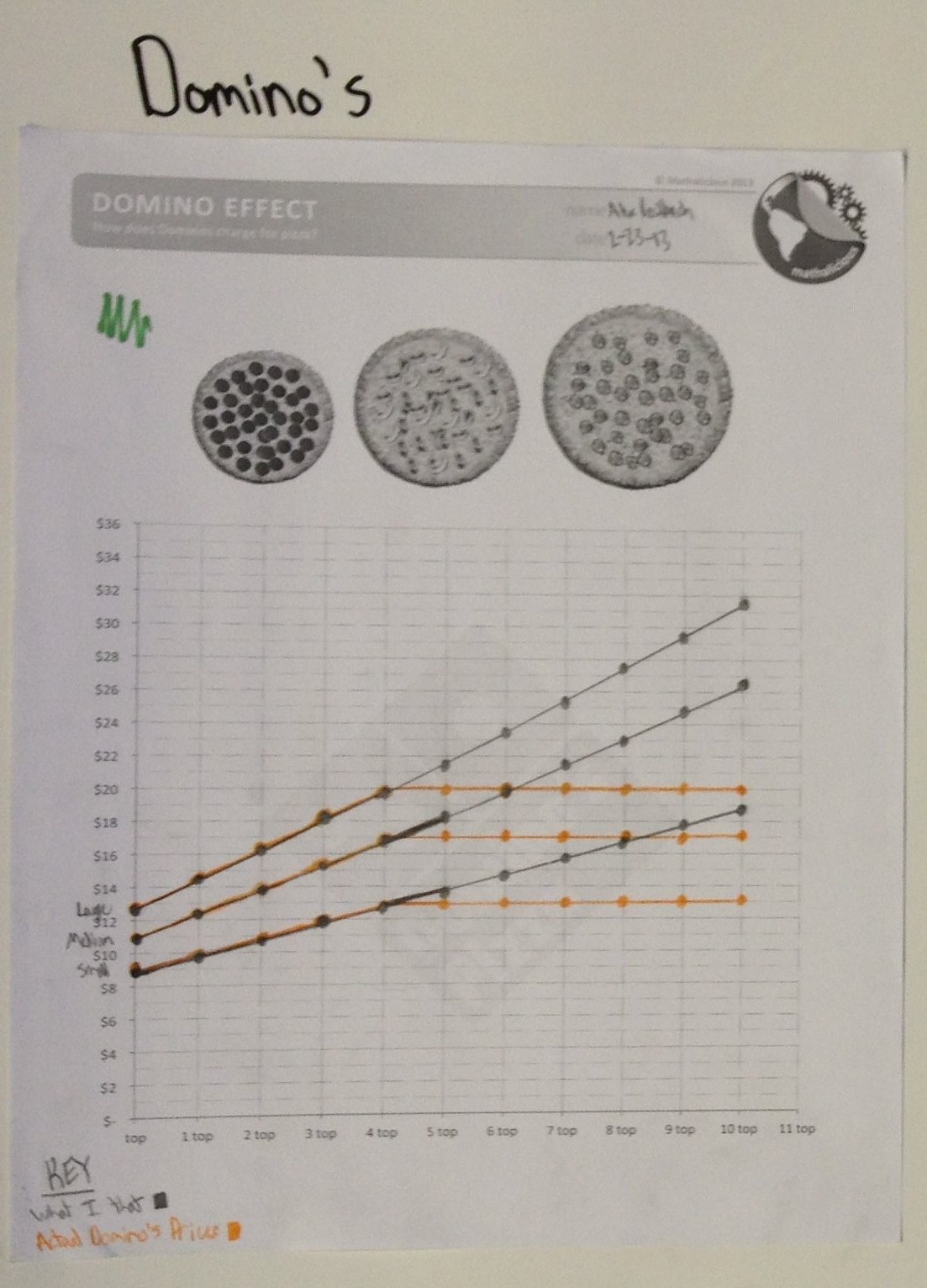
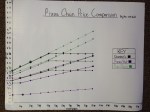
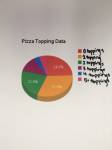
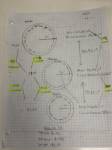
I liked having them find the price of a 10-topping pizza because it prepared them for the big reveal.  My students pretty much lost it when they saw Domino’s actual pricing, since it was so much less than they had calculated.  They all wanted to fix their graphs, which of course, I was thrilled about, so I let them.  Notice the key at the bottom on the picture.  (That is supposed to be thought).


I loved this lesson because it was fun, self-explanatory, and easy to implement.  It was written so that I was able to walk around the room and support students that needed extra assistance or were going down the wrong path.  I did not “teach a lesson”, but at the end of Act 1 several of my students had figured out the equation by going through the questions.

This can be done with younger students, even if you haven’t taught linear equations yet.  In fact, this is a great introduction to the topic of linear equations.  Next time I do this lesson with 6th grade students, I will do this over two days.  The first day I will do Act 1, and then finish with the chart on Act 2.  Then, on the second day I will explore Act 2, questions 3 and 4 in more depth.  Only a few students were able to come up with the equation in Act 1, so I will need more in class time to help them discover this in Act 2.  I anticipate that I can teach students about writing equations of lines and even explore what the y-intercept really means with this lesson.

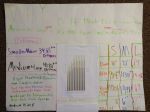
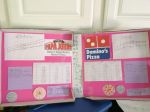
Pictures of my students finished projects:

PIzza Project Rubric


Factor Craze – Success With Problem Solving

The first week of school I tried out Factor Craze on my students.

Screen Shot 2013-09-01 at 12.27.46 PM

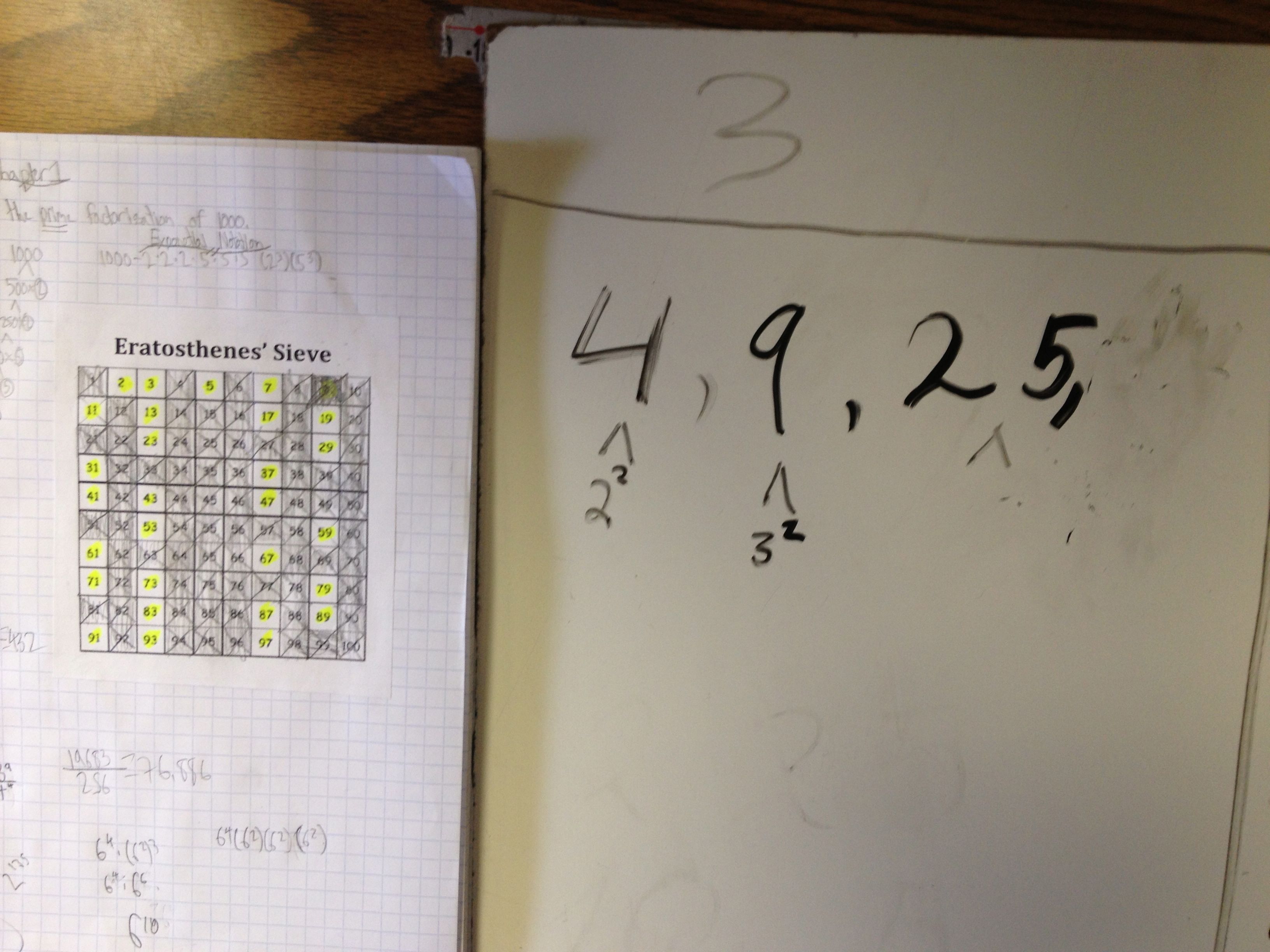
It’s great timing for the beginning of school as we are reviewing prime factorization, exponential notation, and exponents in Pre-Algebra.  We had just finished working on the Sieve of Eratosthenes the day before, and this proved very helpful for the problem.

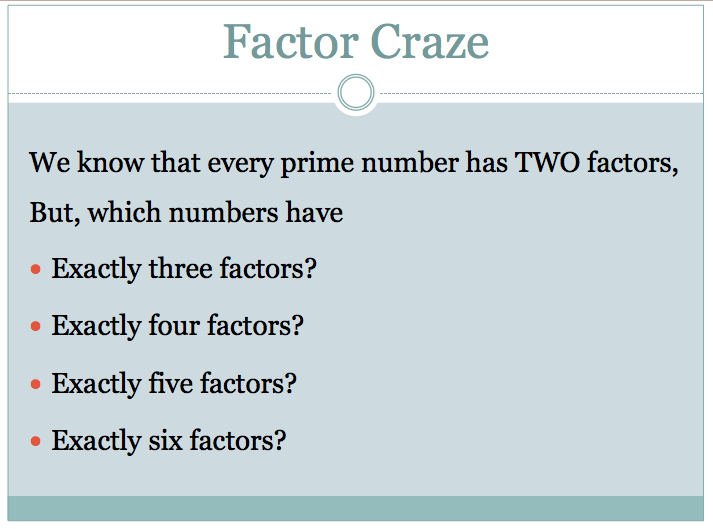
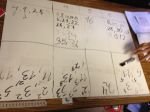
I made this slide to show them the problem, put them on the giant whiteboards, and off they went!  Factor Craze Slide

I gave zero directions, and most students started out the same way, listing the numbers that go with each rule.  I let them work and work.

During this work I had some questions and heard many great comments.

  • Does one count as a factor?
  • There has to be an easier way to do this.
  • Guys, let’s look for a pattern.
  • There’s got to be a pattern here!

There were having an impossible time finding any pattern (well, any pattern that actually worked).  They were very creative however, and came up with many patterns that worked for some numbers.

Finally, I couldn’t take it anymore and asked the class, “What have we been working on the past couple of days?”  “Prime factorization.” they answered.  I gave them the hint, “Well, maybe you should look at the prime factors of all of those numbers you have listed.  They looked at me doubtfully, but were happy to have any hint at this point in time so they went to it.

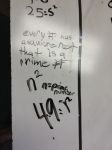
Not long after, students actually started screaming, “I found it!  I see a pattern!”  Well, they thought they had found part of a pattern, but weren’t quite there.  I told them how excited I was that they had found a pattern!  Then I asked them to test the next number and see if their pattern worked!  “Oh no! The three’s rule doesn’t work for 4! Maybe it’s all ODD numbers!”  After they tested AGAIN, “Oh no, it doesn’t work for 9!”  It took each group a while, but eventually they all discovered the rule for exactly three factors.  I encouraged them to write down their rule in words.  Then, I asked them if they could make it more, efficient or algebraic.  They were all able to make “a prime number squared”  into p^2.

Once this happened, they were inspired!  Most of them quickly discovered that this worked for each question.  And then I said, “That is sooo awesome!  Hey!  Look at your 4’s, does your rule work for all numbers listed?  What about 6, 10, 14, 15,… ?”  I was very excited when someone asked me if there could be more than one rule that worked, because I really didn’t want to give them another hint.

At the end of the class, all students had discovered at least one rule.  I had them all take notes of what they had done on the giant whiteboards into their graph books.  For homework, I told them that I wanted them to continue to work on the problem, and see if they could discover any more rules.  Then, I told them that they could work together tonight, with anyone they wanted in both 7th grade classes.  At that point, students started making plans to chat on Skype and Google + that night.  I’m not going to lie, that was a pretty exciting moment for me.

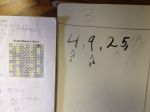
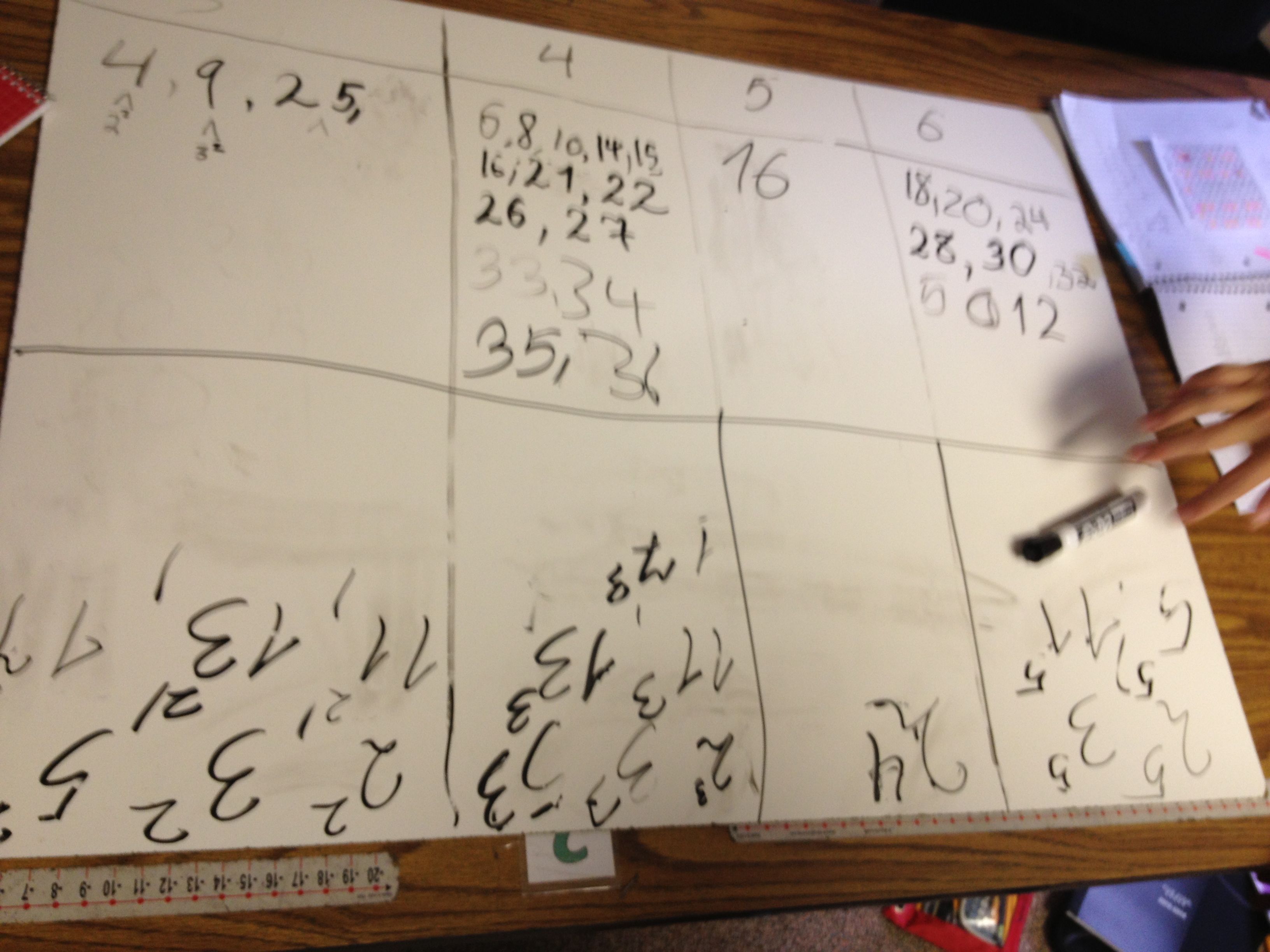
The next day they all came in excited to tell me the new rules they had found.  I made a chart and posted it up on the board, and let all of the students come and write their rules.

The students had discovered all of the rules, although they did need just a small bit of questioning to help realize that they couldn’t write prime times a different prime as prime squared.  Luckily, they remembered their subscripts.  So, we used p sub 1 and p sub 2.

IMG_5781After they finished pulling all of their ideas together, I went over each rule again as a summary.  This helped clear up remaining questions for some students.  Problem solving for the win!
 

Weekly Math Subject Chats are Live Now

The math chats for each subject area, middle school through Calculus, have all officially begun!  Here is the list of chats.

Subject Twitter # Day / Time Facilitator
Middle School Math  #msmathchat Monday 9PM EDT @justinaion  @luvbcd @shlagteach
Algebra 1  #alg1chat Sunday 9 PM EDT @lmhenry9  @_MattOwen_  @anthonya @kathrynfreed
Algebra 2  #alg2chat Monday 9PM EDT @druinok  @wmukluk  @lbburke
Geometry #geomchat Wednesday 9 PM EDT @algebrainiac1  @barbarawmadden
PreCalculus #Precalcchat Thursday 8:30 PM EST @mrlenadj  @untilnextstop
Calculus #calcchat Friday 11AM as per IST – that is 12:30am EST and 1:30am EDT @ajitmishra71
Statistics #statschat Thursday 9pm EDT @jkindred13

Helpful Hints:

  • If you have never participated in a Twitter chat before you are in for a treat!  To participate, you just need to include the hashtag (example: #msMathChat) in your 140 characters.
  • The moderator will ask a question and then everyone can answer it and discuss.  (The format for chats is usually a question, Q1 from moderator, then you will answer with an A1 at the start of your answer.)
  • Don’t feel intimidated, because you don’t actually have to “chat” if you do not want to.  You can simply log into twitter and watch the conversations.  To do this, follow the hashtag.  To follow a hashtag, simply perform a search on Twitter.
  • If your Twitter account is private, you may want to unlock your tweets during the math chat.  This will allow people who do not follow you to read your chats for the hour.

If you can’t come to a chat, but want to catch up on the conversation, the math chats are archived on the Math Chat Wiki.

First Day / First Week 2013-2014

#msSunFun

This week’s theme is First Day / First Week for 2013-2014.  It’s not too late!  Submit you post for this week.  Next week we will blog about lesson organization to help get ourselves reorganized from the beginning of the school year.

First Week! Factor Craze and Pascal’s Triangle

I had an exhausting but amazing first week!  We set up math graph books in both classes, boring but necessary.  This introduced 6th grade to foldables and garnered the comment, “We sure use a lot of glue in this class.”  Hahaha.  Not THAT much glue!

This week in…

6th grade – We reviewed place value, fraction to decimal conversion, rounding, and rulers! I always have several 6th graders who write that 32/4 = 0.125 and my, “Estimate before you evaluate.” talk ensues, full of cookie examples.  But, my first lesson in 6th grade is to introduce them to patterns, and I do this with the “Math in Nature” YouTube video followed by an almost blank Pascal’s Triangle.  I just tell them, “There are a ton of patterns in here, can you figure them out?” and off they go!  At the end we color the odd and even numbers different colors and I show them the large colored interactive Pascal Triangle online.  This is a huge hit with 6th grade students and I even had 5 students request larger blank grids. They are bringing them back to me next week so I can hang them on my bulletin board.  Did I mention how much I adore 6th graders??

IMG_5774 IMG_57757th grade was too exciting for words.  I am focusing on “Notice and Wonder“, and problem solving with them.  Everyday I hear kids say, “Whoa, mind blown!”.  It’s pretty electric in there and I only have problem solving to thank!  I took pictures last week but next time, I’m getting video clips.  I cannot believe how much they have taken to the problem solving and how excited they are about it!  After completing the Sieve Of Eratosthenes the first problem was “Factor Craze“.  Thanks so much to Fawn for blogging about this great problem!  I’m going to blog about just this problem when I have more time!  It was a wonderful beginning of the year problem for 7th graders who are working on prime factorization and exponents.  I told them they could try to find the rest of the patterns together and many groups of students emailed and googled chatted about it that night.  Who can ask for more than kids chatting at night about math?  Later that week we talked about number systems and I got to entertain them with Vi Hart’s video.  They were mesmerized!  And, they have blown my mind with their energy and enthusiasm so far!  I’m counting on problem solving to keep puberty apathy at bay this year!

How to Get Sharpie Off Whiteboards

Thank you to my wonderful curriculum director, Kim Lysne, for this tip!  She hadn’t tried it, just heard about it.  I told her NO WAY would this work.  But it did!  It’s a good day.

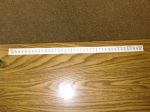
  1. Write over the sharpie with an Expo maker.
  2. Erase.

MAGIC!  Yes, it’s that easy!  I wouldn’t have believed it if I didn’t see it for myself so I just had to share!

Math Classroom Setup

#msSunFun

Click here to submit your MS Sunday Funday post!

Teachers have been working hard getting ready for their students these past weeks.  Check out all of our amazing math classroom decor!  Next week, blogs will be about First Day / First Week.  The blogs will be about our first day/week plans or reflections on how the first days went!

My Room

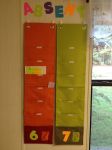
Friday was our open house. It was so great to see all of my students! I cannot wait until Monday. My room is pretty much the same as last year. The only things left that I need to do are put the days of the week on the homework board and make a backboard for trasketball on the front wall. Enjoy!

Read the #msMathChat Archive – 500+ Tweets in One Hour

Wow!  What an exciting #msMathChat we had tonight!  We had over 38 participants and over 500 tweets in one hour!  I followed all of these amazing middle school teachers and favorited many tweets.  I can’t wait to use the ideas I got tonight and go back and explore all of the links I favorited.  Simply, I’m invigorated!

But don’t worry if you missed it!  I archived the entire chat with Storify.  You can go to the Storify link or just read about it here.  It should work, I’m new to Storify.  To see the archives of the other subject chats, check out the Math Chat wiki!

[View the story “Middle School Math Chat #msMathChat 8/19/13” on Storify]