Dispelling the Great Math Myth: Effort Trumps Ability in Mathematics Achievement

It’s the mystery of the century.  How has an entire nation of children come to believe that people are either good at math, or they are not?  Full of rock stars, superstars, and super athletes, we are a nation of have’s and have nots.  Being spectacular is something you are born with, or it’s because whom you are born to.  Our culture feeds this belief.  As math educators, it is our duty to dispel this myth.  We need to convince our students that effort matters more than ability in mathematics achievement.

Why is this important?  Because if students do not believe that they have the “math gene” then what is their motivation to even try?  No one wants to work hard at something and then fail.  Why take that chance?  Why even waste the effort?  We need to convince students that there IS NO MATH GENE, that everyone can be successful at mathematics.

In middle school I did not have a positive mathematics experience.  I went to high school not liking math and even thinking that I was “bad” at math.  An amazing teacher turned this all around for me and changed the course of my life.  (My story is here.)

This amazing teacher proved to me that everyone can not only learn mathematics, but also be very successful at it.  Her secret?  All you have to do is keep trying until you get it.  Students never believe me at first, but data is on my side.  Research has repeated proven that contrary to what everybody thinks, achievement in mathematics is determined more by your effort than your ability.  Let me repeat that, loudly

EFFORT MATTERS MORE THAN ABILITY IN MATHEMATICS!!!

This does not say that some people are not naturally gifted in mathematics, because, as in all other aspects of life, we know that individuals are gifted in many different disciplines.  However, what this means to me is that everyone can be wildly successful in mathematics, if they are willing to put in the effort.  Do you think you aren’t that great at math?  Well then, your problem is solved.  Because now you know that all you have to do is just keep trying and you will have success.  Not only am I a living example of this, but I have taught many students in my years of teaching that have lived up to this research as well.  I used to hate math, but now I love math, and I love teaching math.

Dispelling the Great Math Myth – A 4-Step Program:

Many students won’t buy this.  But, even if you only can reach a few it is worth the time.  Even if they don’t believe you now, it will stick in their minds.  Maybe they’ll believe you later.  To change a student’s motivation to do math you need to change their attitude.  Many students don’t give effort in mathematics because they believe are going to fail before they even begin. Change their math.

1)   Sell It – Tell them that effort matters more than ability in math achievement.  You need to make this real to get them on board.  Tell them about your struggles in math.  If you didn’t have any, feel free to tell them about mine.  Show them the research.

2)   Face Their Fear – Focus on small topics that they have had trouble with in the past.  Do something different.  Do an investigation, make index cards, play a game.  Show them that math is accessible.  I love Dan’s post regarding this.

3)   Back It Up – with assessments.  Small quizzes work wonders here.  Make index cards in class for them to study.  One good grade at a crucial time in a math student’s year can make an amazing difference in effort.  Two good grades might even convince them that it was effort, and not just luck.  On an ongoing basis, I think this is where Standards Based Grading really shines.

4)   Did I Say SELL IT?! – Yes, this again, and again, and again.  Think salespeople here.  The “Three Times Rule” is king in advertising (frequency = 3).  Everyone in the advertising industry believes that in order for a message to “stick” with a potential customer, they must hear it at least THREE times.  Good salespeople never let up, they keep coming at you.  They keep calling you, and they repeat their message as much as it takes, until they get a sale.

Don’t expect instant success, don’t quit because you think it isn’t working.  One year I had a student that just wouldn’t buy it.  A year later I ran into her and she said, “Hey Mrs. Reulbach!  You were RIGHT!  It turns out that I CAN be good at math!”   That is why I do this.  I am passing the torch.

Here is some of the research.  Please feel free to send me links of research you are aware of and I will post it here (and on the Math Teacher’s Wiki).
Continue reading

Change Someone’s Math…Care

Please don’t give up on the student that is “too far behind”, even if they are a senior in high school.  You may not even know it, and the student definitely won’t know it, but it is possible to change their life.

I grew up in a small town with very average schools.  Few graduates went on to 4-year colleges, far fewer graduated.  I was an advanced student and in the “honors track”, however, I had miserable middle school math experiences.  I had terrible teachers, I sat in the back, I tuned out.  They let me.  I scraped by.  I was quiet, so they were happy.  They didn’t care.

In high school I switched from regular Alg II to Honors Alg II because the honors teacher didn’t check homework, ever.  This teacher also taught my older brother, whom she loved.  I got to run all of the class errands.  On test days, she would walk over to my desk and point out the answers of the multiple choice tests.  She didn’t care.

I landed in Pre-Calculus junior year.  I was beyond lost.  I wanted to drop.  My teacher wouldn’t let me.  For the first time, my math teacher cared.   In this school system, many of her students had been through all of these average math teachers.  Enter mathematics basic boot camp.  She started us out with algebra.  She then moved us through geometry.  By Christmas we had finally made it t0 pre-calculus.  We worked hard.  I now know that she worked harder than any of us.

My senior year she taught calculus, so I took it.  It was the only class I had to work at that year.  At the end of the year, I made an A on the University of Kentucky’s calculus final exam.

She didn’t give up on me because I was “too far behind” or because “it was too late”.  She changed the course of my life.  I graduated college summa cum laude with a bachelor of science degree in mathematics.  I received a full graduate fellowship to Wake Forest University in mathematics.  I was able to choose the mathematics path because ONE teacher cared.

She is why I became a teacher.  She will forever be my inspiration.  I may not ever be as gifted of a teacher as she is.  However, I can care as much for my students as she cared for me.  Hopefully, I can improve someone’s life as she improved mine.

Thank you Mrs. Miracle, for being a perfect model of how to care, and for changing my life because of it.

Thanks to all of the teachers out there that work with students that everyone else has given up on because they are “too far behind” or because it is “too late”.   It’s not always fun, and it is never easy, but it is always worth it.

Amazing Things to do with Google Docs

I love meeting great teachers who have great ideas!  Today I got some ideas about how to use Google Docs from @msgregson and wanted to get them down here to share with everyone.  I have tagged her as “Gregson Google Goddess”.

  • First Day Information Form – Students go online during class and fill in all of their information.  This is BRILLIANT bc the info that THEY type in goes into your beautiful, sortable, Google Spreadsheet
  • Parent Information Form – Almost the same form as the students.  This way you get the parents preferred email, cell phone, method of contact.  Also, @msgregson said she liked it bc parents could send you info they would not want their child to see on a form they had to fill out and send back via child.
  • Google Powerpoint Presentations – Up to 5 students can work together on one Google Powerpoint presentation simultaneously.  I think this would be a great “teach the class a topic” lesson.
  • Google Spreadsheets – Up to 50 kids can work on a Google spreadsheet simultaneously.  Wow.  I can see them all in class entering their data at the beginning and then being able to instantly start working with the combined data.
  • Google Forms for tests – you cannot put equations or pictures in a google form so she worked around that by making another site with the test, then you just enter the answers on the Google docs.  Great work around.

If you are using Google Docs (or any other amazing technology) in your classrooms, please post it here or to the Math Teacher’s Wiki.  Alternatively, you can email me and I will add it for you.

Homework Paradigm – Part II or Wanna Be Happy? Then don’t grade homework

I analyzed the homework survey results from Sam’s blog.  He asked teachers a series of questions about their homework polices.

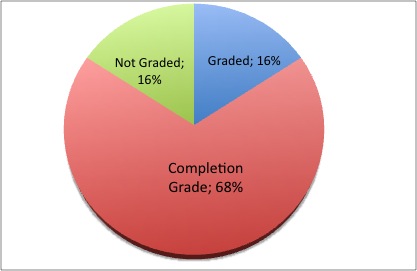
What I was most interested in how teachers were grading and if they were happy.  Sixty-eight percent of teachers that answered the survey are grading homework for completion only.

Homework Graded Pie Chart

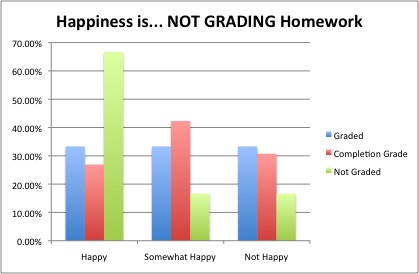
However, I was most interested in which teachers were the happiest with their homework procedures.  Apparently…

Teachers who are the happiest with their homework procedures are NOT grading homework, not even for completion.  I was thrilled by this result.  Forget the fact that I am going to be a happier person if I do not have to spend many hours grading homework.  Apparently I will also be happier with my homework system if I do not grade homework.  This is classic win-win.

Limitations:

Numbers.  Sam received 40 responses, which satisfies the minimum number required needed to perform statistical calculations.  However, I did not run the numbers through any tests, I just analyzed the resulting percentages, quick and dirty.

Subjectivity. As the responses were open-ended response, I had to use my judgment in categorizing the responses regarding happiness.  I used a scale from 1 – 3.  With 1 being very forms of not happy (i.e. – dislike, hate it), 2 being somewhat happy, and 3 being happy or very happy.

Best Homework Practices – Summary of Ideas

I pulled these ideas from the teachers comments in the survey and my own thoughts.  Specific quotes from the actual survey are at the end.  Many of the ideas here came from and are presented on the Math Teacher Wiki Homework page.

Atmosphere:

  • Create the proper homework culture at the beginning of the year
  • Be consistent – do not give up or change it
  • Call homework “assignments” or “practice”
  • Do not make it a large percentage of students grade if you do decide to grade it

Assignments:

  • Make it relevant (homework as preparation for class discussions)
  • Include review problems
  • Exit Card – One problem each day at end of lesson to be quickly graded, then can base hw off of that (maybe the hw levels)?
  • Differentiated HW –
    • Optional Homework
    • Assign section only – do as many or as few as you need (time limit idea – work for 30 minutes)
    • Pick 5 problems that are not too easy for you to do out of section
    • Recommended / Suggested problems from teacher

At Home:

  • Put the responsibility on students to self-evaluate what they don’t understand
  • Online homework evaluation each night
  • Law of Diminishing returns – don’t kill em with homework. A Duke Study cites a “10 minute per grade level” rule that my school lives by.  I love it.
    • STOP after you have worked 30 minutes on hw (with no other distractions)

After the Homework is completed:

  • Have students put up problems they don’t understand, other students work them on board
  • Red/Yellow/Green
  • Homework Quizzes

In Summary:

I think our major problem as educators is that most students are not intrinsically motivated to do homework.  Until we can change this, I don’t think that any of us are going to be very “happy” with homework results for long.  This got me thinking…

What is the motivation to do homework?

Homework is the definition of anti-climatic.  It comes at the very end and doesn’t play into the story at all.  The lesson is finished, the homework is independent, it won’t even be “really” graded, and tomorrow we will be talking about something entirely different.

Why would students care about homework?  Because we force them? Because we are going to give them a bad grade?  Because we are going to call their parents?  Because they are going to be “embarrassed” that they did not do it?  These are not motivators – these are threats.  These threats are what lead students to do a poor, sloppy job on homework, the period before it is due, half-copying from their classmates.

In order to change the effectiveness of homework assignments, we need to change how these assignments work.  We need to make homework relevant, not only to the lesson of the past, but also to the lesson of the next day, if possible.  Can we make it practice of the current day, and the topic of the next day?  If this is too hard to accomplish, then what CAN we do to motivate students to do homework?

What can we do to make homework important to students, to make it relevant, and most importantly, to make them want to do it well?

Continue reading

The Homework Paradigm

Student homework is my Achilles Heel, my fatal flaw as a teacher, my nemesis.  The only thing I am worse at in teaching is taking daily attendance.

Some math teachers do not give or are doing away with homework.  I am not sure how I feel about this yet.  I feel that mathematics is a building skill, like a musical instrument, or a sport.  The more time you spend practicing the better you will become.  But, that practice has to be done well to be effective.  Also, I don’t feel that you need a large amount of practice, just a little bit every day.  Since most students have math class five days a week, is this enough practice?  Do students get enough practice by doing mathematics each day in class?  Many times I have seen students really feel like they “have it” in class, only to get home and have trouble doing it independently.

I worked as a research director in television advertising for a while. The rule of thumb there was “Frequency of 3”.  This meant that the consumer had to be exposed to the advertisement at least three different times in order for it to be effective. There was NO WAY any customer was buying ad spots where they were getting less than a frequency of three.  The sales people didn’t even pitch it.  Even the noobs knew this.  I think about this every time I consider throwing out homework.  I worry – is once in class enough, even if it IS independent practice? Because, it is only ONE event, not three.

Homework’s Flaws:

  • Checking homework the next day takes forever
  • Assigning the correct amount / level of work
  • Going over homework questions.  Students are either in two camps here – either I didn’t explain it enough or I am killing them explaining it too much.
  • Going over hw can really eat into new lesson
  • I feel bad bc I push hw questions aside in order to do the new lesson
  • If you make it for a grade, some students will copy other’s hw
  • If you make it for a completion grade, they will write anything down just to get “credit”
  • It is not effective if not taken seriously, (ie. copied, write down anything)

Reasons I feel homework is important (if it’s done effectively):

  • Students can figure out what really do and do not know how to do
  • Students can take more ownership of their mathematics learning.
  • Students practice more, thus they learn more

Fortunately, some wonderful teachers ( McTownsley and Shah )have gotten a big jump on me, and I can’t wait to learn more from their ideas!

At this point I am still going to assign homework for my classes.  What I would like to do is:

  1. Effectively checking that it was attempted / completed
  2. Ensuring it is effective
  3. Motivating students to really DO the homework effectively.
  4. Assign reading and a few problems of the next section to get the students thinking.

I would like the students to do homework and then I will check it, but not grade it.  I feel that the student wants to be acknowledged for their effort, and am hoping that just checking it but not grading it will give them the external praise that they like.  As I plan on giving them all of the answers AS I give them the homework, I feel that grading is pretty pointless anyway.

I would love to develop a hw system that works for most and can easily be adapted for all. I know that I am dreaming here.  But, if I can’t figure out why this is so hard to do, then it should be doable!  Luckily, I have amazing math teacher tweeps who are hard at work on this with me as well over at the Math Wiki.  We plan on sharing ideas then building something together, or at least that is my plan!

Please join us over there and add your ideas and methodology.  It is a public wiki party and everyone’s invited!

How Do You Group Effectively?

I plan on grouping often, if not daily. My needs are…

  1. Be able to switch up the groups easily and quickly
  2. Have students get into groups quickly.
  3. Designate group roles such as leader and recorder easily.
  4. Did I mention quickly ???

One more caveat – I will probably be switching rooms for each class so I will need something portable.

I would like to do these things with a minimum of talk. More talk = more confusion = more wasted time. After visiting my son’s kindergarten class last year I got an great idea! His teacher had clothespins with their names written on them in sharpie and she “clipped” them to the weekly job chart. I want to do something similar with groups. I plan on using magnets however.

MAGNETS for GROUPING Idea:

  • Purchase magnetic board
  • Divide the board into colors (using construction paper maybe)?
  • Purchase something small and put all kids names on each one. (like writing their names on clothespins)
  • Attach a magnet to the back of each thing (clothespin)
  • Before class put the clothespin on the board corresponding to which group they will be in.
  • Place a “flag” on the table to indicate which color group goes where
  • Designate group rolls – Write on the board group roles like “leader” and “recorder” and put their clip in that spot.

I am thinking I could then switch it up, like add more colors for more groups and such but just adding more colored paper on the board. This is only in the planning stages. Once I design it I will post a pic.

If you’ve got them, ideas would be LOVELY before I start actually purchasing materials.

Oooooozzzzing with Technology This Week!

In Math Teacher Twitter land I am officially, “A Noob”.

I taught for years, but after being out for eight years I am amazed at what I have missed.  Twitter, Blogs, Wiki’s, and Google Docs top my list of “things I cannot believe I have missed out on even though I wasn’t teaching”.

But, I am back!!

With my type A++++ personality, this is technology deficit is more than mildly irritating so I am racing to catch up.  However, most days I feel like I am running just to stand still.  This week my children are in all-day soccer camp so I have been especially technologically productive (even though I haven’t done ANY of the lesson planning I had slated for the week).

What I have done this week:

1.  Made a new Wiki for math teachers – Math Teacher Wiki

What I have learned this week making the Wiki.

  • How to make it public so that everyone can participate without having to manually give everyone permission.
  • What a “steal lock” was and what it meant, thanks @misscalcul8!
  • How to invite tweeps to participate
  • What a sidebar does
  • That I need to learn how to make it pretty b/c it is UGLY now.  : )

2.  I created a MathLog calendar on Google Calendars for my new MathLog Club for teachers.

I learned how to:

  • Make it public
  • Invite people
  • Find the link to share it on Twitter
  • Add my “out” dates and view other’s “out” dates
  • Imbed it into the Math Wiki!

3.   Created a Facebook Fan Page for my future students.  Thanks to some amazing Twitter friends this was amazing fun to learn!  However, it turns out that I will be unable to do a FB Fan page with my students.  Turns out that you have to be at least 13 to get a FB account.  Since I teach 6th and 7th grade the majority of my students will not “officially” qualify.  I am sure that many of them already have accounts, however I do not feel comfortable “officially” encouraging it.  This is the day I realized how young the students are that I am going to teach!

I learned:

  • You can make a FB Fan page with your account, but it is not visibly linked to you
  • When you make a FB Fan page under your log in you can easily edit and update the page without having to log out and log into another FB account.
  • You have to “like” the page to become a fan of your own page so you will get the updates
  • Others can “like” your page without becoming your friend.  This is crucial for me as I don’t friend my students
  • You are SUPPOSED to be 13 to get a FB account.

4.  I also learned how to change the DELETE key on my Mac keyboard to act like the classic BACKSPACE key on a PC.  This was essential to my way of typing life.

As I’m still the NOOB please feel free to tell me all about great things that you do with technology in the comments section or on the Math Wiki.

How Do You Use Google Docs?

Thanks to Twitter, and especially @msgregson’s constant promoting of Google Docs I decided that I had to check it out.  I already use the Google calendar to sync my life.  And, all of my wiki sidebar apps come from Google so I was hopeful it would be a great resource.

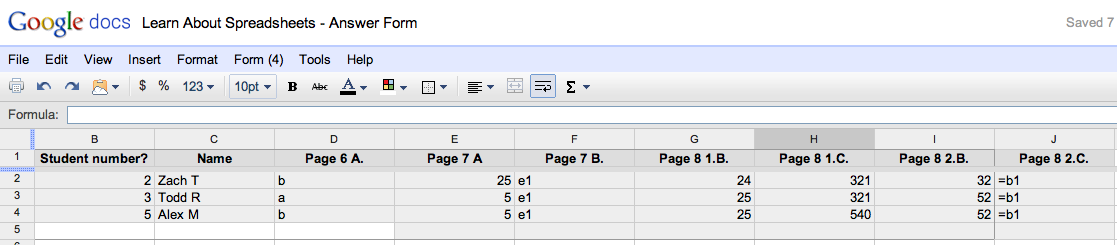
I was not disappointed!  I created a Google Form on my new class wiki.  Students will go to the wiki from home, click an assignment to open it, and then answer the questions in the Spreadsheet Activity Form.  Then, Voila – their answers will instantly appear in a spreadsheet on my computer!

Spreadsheet Activity Form

INSTANTLY, I get the results in a spreadsheet created in my Google Docs.  It looks like this and can be edited and sorted.

Spreadsheet generated by the Google Form

Spreadsheet generated by the Google Form

Why I love this:

1)  It is paperless.  I love that it is green AND I hate dealing with stacks of paper.  So less paper = happy teacher + better earth!

2)  It is all in one place.  I don’t have to carry the papers home with me or stash them in my full, full bag.

3)  It is organized.  I assign my students a number based on their name in the alphabet (1 – 16).  I have them enter that number into the form and then can sort their answers alphabetically so facilitate easy grade recording.  It is also an easy identifier of who has submitted without using last names.  And again, I don’t have to manually alphabetize a stack of papers!

Question – How do you use Google Docs in your class?

How are other math teachers successfully using Google Docs in their classrooms?  If you are, please comment below and please provide a link to an example if you have one handy!

My First Powerpoint Presentation

I just learned Powerpoint and this is my first go at it.  I plan on teaching some data analysis first thing in my 6th and 7th grade math classes so that I may use relevant data to teach with throughout the year.

In Powerpoint:  http://reulbach.pbworks.com/Data-Analysis

In PDF:  http://reulbach.pbworks.com/f/Survey.pdf

I would LOVE comments and suggestions as:

1)  This is my first ppt so I know it needs work.

2)  I plan on doing more ppt asap so I would love tips so I can improve subsequent presentations.

3)  This is my first time teaching to this level (MS) so I don’t want to go too high or low.

Thanks in advance for comments, suggestions, or any assistance you can offer!

Math Tweet Links – Week Ending 5/14/10

One of the things that I love the most about Twitter is all of the great links that I get!  So, inspired by Sam’s favorite tweets of the week, I have made a math tweet links of the week.  Hopefully now I won’t lose all of my favorite links!

Feel free to add any math links that I might have missed that you love in the comments section.  Also, I am sure that there is a “cleaner” way to do this but I don’t know how yet.  If you want to tell me, great!  It has to be quick though.  Also, I can’t get my links to work.  Grrr….

Julie
MeetingWords: Realtime Collaborative Text Editing http://bit.ly/9yg3JA Another entry in the post-EtherPad sweepstakes

xmath2007
MeetingWords: Realtime Collaborative Text Editing http://bit.ly/9yg3JA  Another entry in the post-EtherPad sweepstakes
about 4 hours ago via bit.ly
misscalcul8
@jreulbach Here you go http://bit.ly/byr6DO I probably just confused you with words lol
about 8 hours ago via TweetDeck in reply to jreulbach
msgregson
create your own free flash website at http://www.wix.com!
3:06 PM May 13th via TweetDeck
jreulbach
3:04 PM May 13th via Twitter for BlackBerry®
Fouss
Any great ideas for surface area? I’m considering this http://bit.ly/dhtQZK and this http://bit.ly/av5CfQ .
9:48 AM May 13th via TweetDeck
xmath2007
RT @maggiev: 4 Tips for Integrating Social Media Into the Classroom http://bit.ly/dlFRmT
7:59 AM May 13th via Seesmic
jybuell
RT @mctownsley 2 posts within 24 hours on writing better math tests. wow @samjshah http://bit.ly/a8OTAL and @rileylark http://bit.ly/b9notf
9:23 PM May 12th via Twitterrific
mathfaery
RT @CafeRico: Math Mama Writes…: Math Relax: A Guided Visualization for Overcoming Test Anxiety in Math http://bit.ly/a0KHHh
7:26 PM May 12th via Digsby
Mrs_Fuller
RT @mathblows: Q: What does the Ph.D. in math with a job say to the Ph.D. in math without a job?A: `Paper or plastic?’ #lulz #truth
6:41 PM May 12th via TweetDeck
msgregson
RT @web20classroom: A Plethora Of K-12, All Subject Areas, Videos For The Classroom: http://bit.ly/aMxvhN
4:17 PM May 12th via TweetDeck
msgregson
@jbrtva not sure if this is what you’re looking for, but maybe this? http://bit.ly/bJ06Bi
4:14 PM May 12th via TweetDeck in reply to jbrtva
mathfaery
RT @georgewoodbury @tperran Great site containing dozens of customizable game templates w/ auth theme music and sounds! http://bit.ly/N07Rf
8:19 PM May 11th via Digsby
xmath2007
4 Tips for Integrating Social Media Into the Classroom http://is.gd/c4VNt
8:01 PM May 11th via Gruml
k8nowak
If your class needs to practice Geometry vocab check out the epic I Have/Who Has I just made: http://www.box.net/shared/r9kxp5hbu0
4:31 PM May 11th via web
TeachingIdeas
Teaching News: Teaching Facebook Groups http://bit.ly/blOcxw
2:13 PM May 11th via Twitter Tools
xmath2007
Catch of the Day – TES iboard – May 11, 2010: http://bit.ly/9322LQ EDge21
11:42 AM May 11th via twitterfeed
Fouss
Just found a site with some cool geometric nets: http://bit.ly/9YA6dD
10:51 AM May 11th via TweetDeck
JamiDanielle
@calcdave @jreulbach And I live in a big football area so I melodramatically demonstrate line passing through and “BAM! Intercepted”
9:37 AM May 11th via web
JamiDanielle
@calcdave @jreulbach I usually give a brief explanation 4 the historical mystery but then tell them it helps to think of mountain.
9:36 AM May 11th via web in reply to calcdave
mjruden
@jreulbach it stands for “mountain” which is where the slopes are! Ha!
9:34 AM May 11th via Tweetie in reply to jreulbach
calcdave
@jreulbach @someecards http://bit.ly/9ZuYoA (re: slope = m)
9:04 AM May 11th via Brizzly
monk51295
RT @ShellTerrell: @russell1955: on @NikPeachey ‘s post ‘3 wifi Tools for Presentations’ http://bit.ly/9GvrBh #elearning #edtech – excellent
5:31 PM May 10th via Seesmic
TeachingIdeas
Need some printable nets for 3D shapes? This document has a net for every possible shape you can imagine!… http://bit.ly/cfiAEu
3:52 PM May 10th via Facebook
msgregson
doing a review of factoring using the wheel of partners (http://bit.ly/ba96Eq) LOVE it!!!
11:02 AM May 10th via TweetDeck
xmath2007
Catch of the Day – Mathalicious – 10 May 10: http://bit.ly/cmOhag EDge21
10:03 AM May 10th via twitterfeed
mmorley
Must have tool for K-8 Math teachers: http://tinyurl.com/yhggwju
1:36 PM May 6th via Power Twitter
mwedwards
Interactive Graphic Organizers http://bit.ly/MMVKA via @kellyhines
7:49 AM May 6th via TweetDeck
CmonMattTHINK
Had it with complaining seniors today, so I let them have it a little at the beginning of class. I should do it more often–they were great.
2:21 PM May 5th via web
jagkise
Check out virtual “mathcaching” based on geocaching, at http://www.mathbits.com. Basic math through precalc levels!
4:50 PM May 4th via web
CardsChic
@DebWeinhold Happy, except the post is probably sad looking. I was very tired…
9:17 AM Apr 28th via TweetDeck in reply to DebWeinhold
mctownsley
@ACinIowa @JoPrusha we don’t prohibit the tools in shop class, but instead teach appropriate use. why not w/these tools, too?
8:58 AM Apr 28th via Echofon in reply to ACinIowa
Sarah_IC
@mwmathews We have some 6th grade target drafts. I’m at home right now and will see what I can do once I’m at school today.
8:42 AM Apr 28th via web in reply to mwmathews
CardsChic
@jreulbach Note to self – invest in MANY yellow markers!
6:39 PM Apr 22nd via TweetDeck in reply to jreulbach