Help My Students! Take a 2 Question Pizza Topping Survey

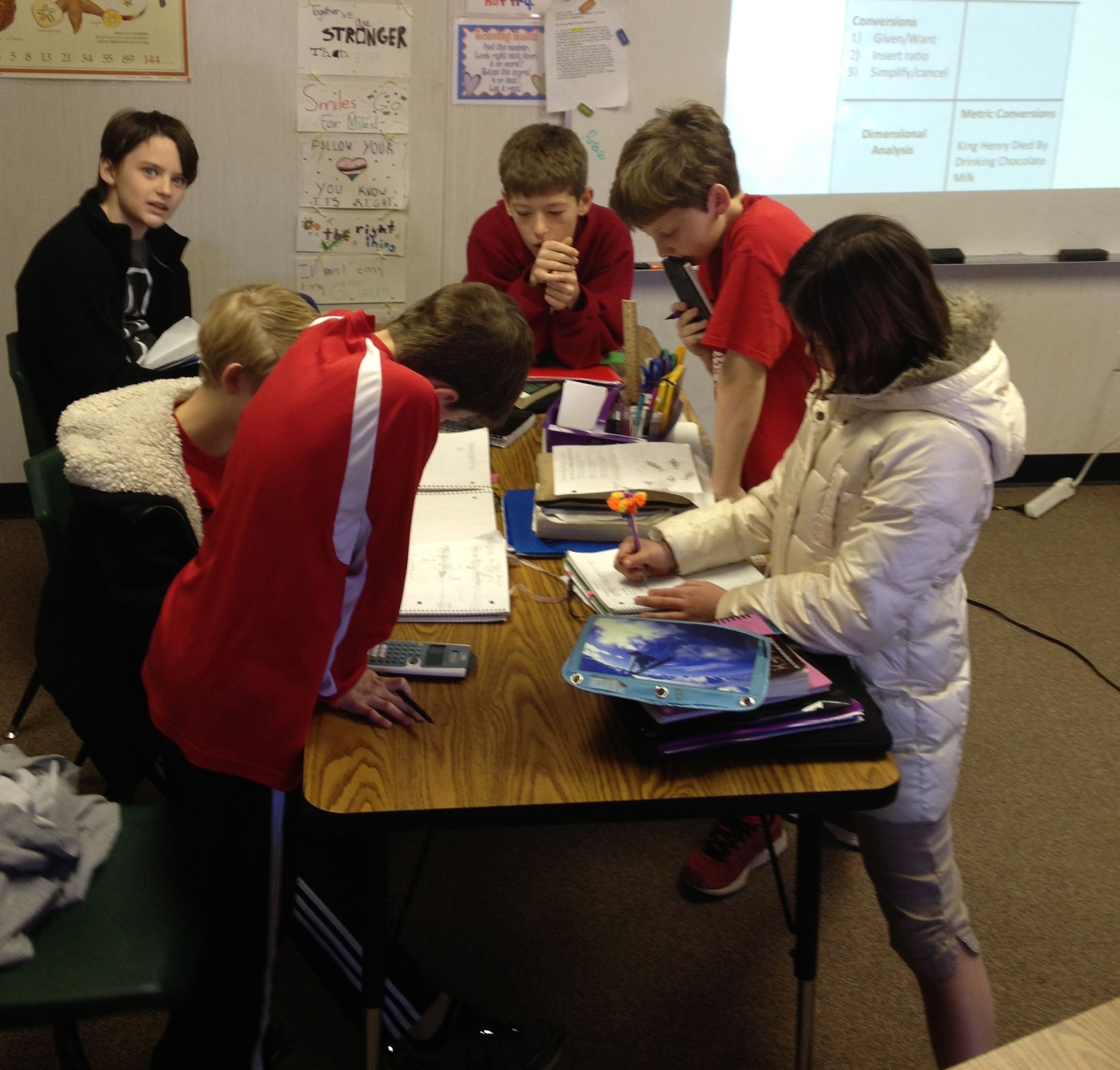
My students are diligently working on a pizza project from Mathalicious.  They are trying to drum up survey results, so I thought I would help them out.  Please fill out these two short ONE QUESTION surveys if you have a moment.

Just to clarify, they need the toppings for a SINGLE pizza.  Thanks Katie!  🙂

Thanks in advance!

Pizza Survey 2

Pizza Survey 1

Just Released – Math Tweeps Harlem Shake!

Math tweeps are the best tweeps ever. This video is proof – and pure fun. Thanks so much for all of your hard work Kate in making this video. I’m incredibly lucky to be part of a network of math educators that are brilliant AND amazingly creative!  Enjoy!

Helping Students That Are Behind In Math

Click here to submit your MS Sunday Funday post!

#msSunFun

Next week:  Blog about your favorite station activities!

Graphing Linear Inequalities – Day 2 and Foldable

I started graphing linear inequalities at the end, with our Knittng Business.  For day two, I gave them a foldable that we went over.  This day we worked on graphing the lines, then picking and testing their “test points” in class.  It went very well as I could refer back to the knitting example with almost every question.

7th – Graphing Inequalities Foldable pdf

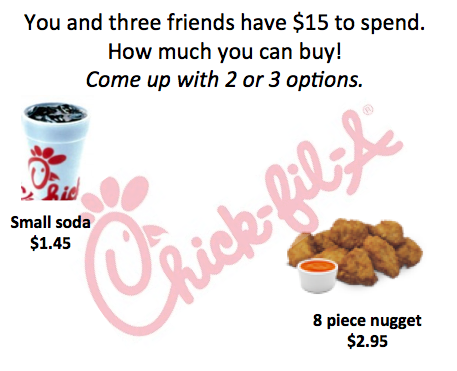
Screen Shot 2013-02-22 at 2.40.25 PMThe next day I wanted them to learn how to write inequality equations.  I used Chick-Fil-A for this example because they have all of their prices online.  I showed them this slide and set them to work with a partner.

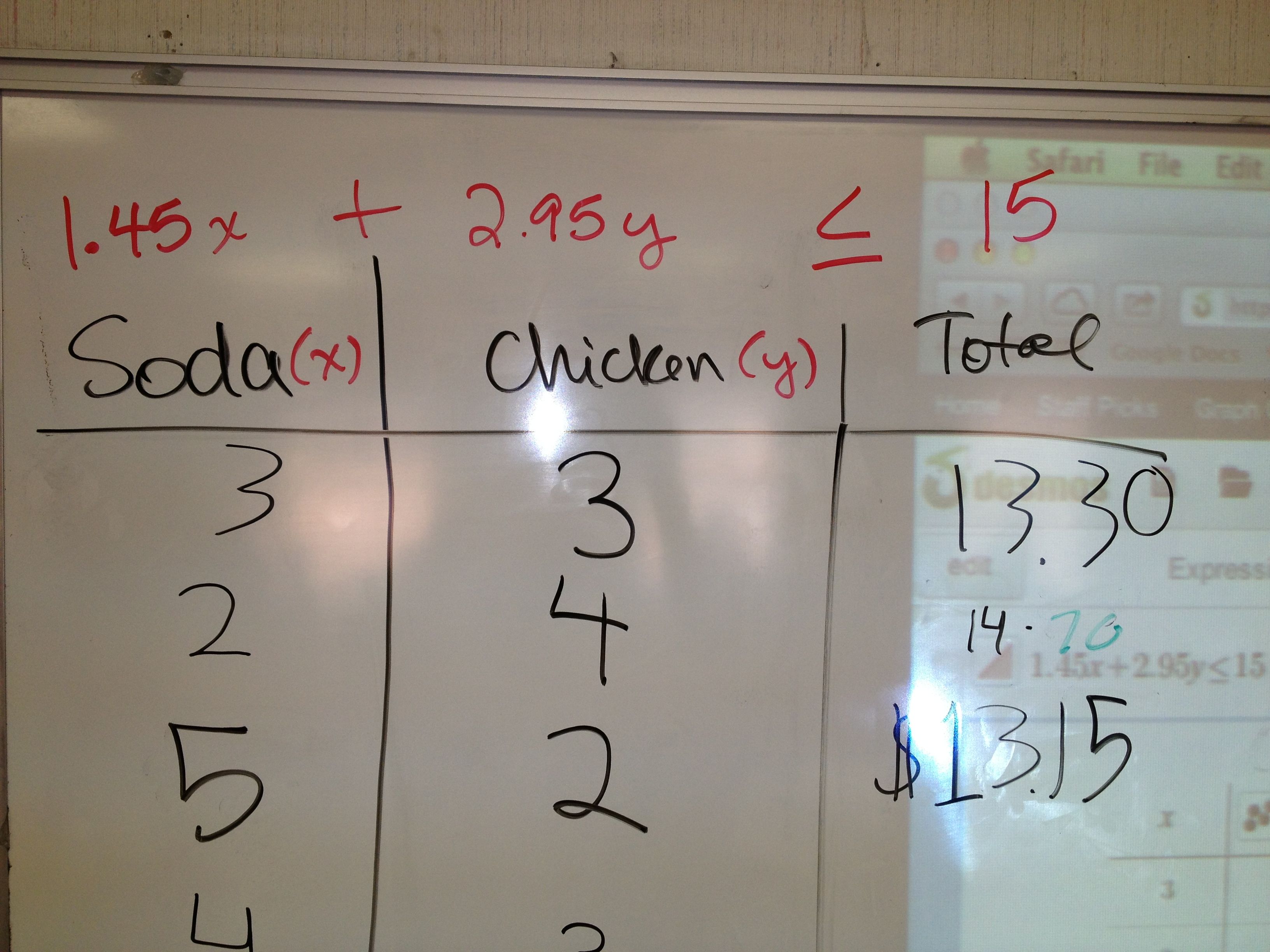
Once they came up with their food and drink combinations, I had them go to the board and enter their information onto a chart.

IMG_4797 Once their information was all on the board, I asked them to try and write an inequality for this information.  Some groups got it right away.  For those that struggled, I gave hints.  First, I put the <= 15 on the board between chicken and total.  That was all most groups needed.  I then asked them HOW they calculated their total.  Almost every student was able to write the equation.  It was fantastic!   I think that the table really helped them visualize the equation.  I had not put in the total column before today – but it was key! IMG_4798


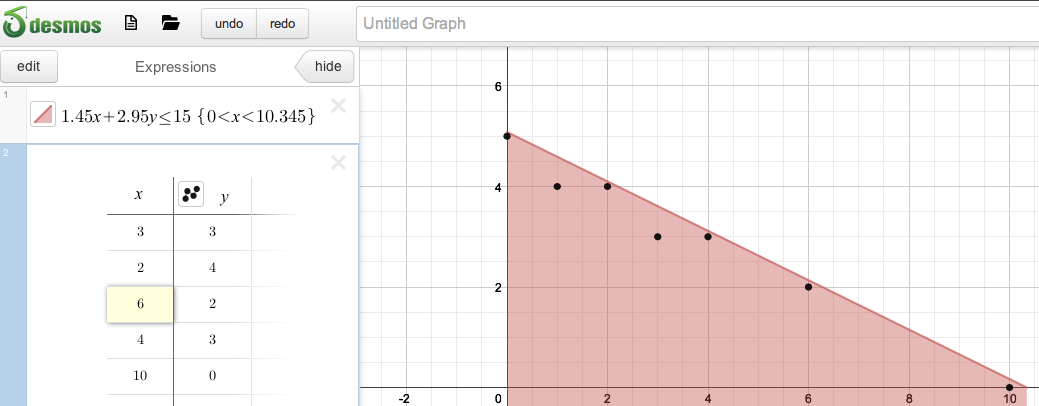
After we wrote the equation we went to Desmos.com and entered the equation with the shading.  They love that.

Screen Shot 2013-02-21 at 2.07.22 PM

After that, we added a table and then entered all of their food and drink combinations!  They noticed that all of the combinations that we entered were actually “test” points.  They also saw what it really meant to use a test point and why it was necessary.  One group in each class had a wrong answer so they even got to see what happens when you shade one side and then pick a combination that doesn’t work!  It was another day of “math-a-magic”!

Screen Shot 2013-02-21 at 2.11.06 PM Screen Shot 2013-02-21 at 2.11.35 PM


Starting at the End (Linear Inequalities)

I can’t say it enough.  Begin at the end.  This is not how I learned when I was in school.  This is not how I used to teach (as recently as a couple of years ago even).  And this is still not how I always teach.  But, it is how I want and NEED to teach, every time.  I’ve been reading much about “real” and “application” problems in mathematics teaching lately.  The value of these problems is that it can make a lesson engaging.  Making a lesson engaging is one of the most important aspects of effective teaching.  If you do not get the students engaged, it will not matter if is an amazing application problem or whether or not students believe it is real.  If they are not engaged, they will not learn.  If they don’t know WHY they are learning the math (be it real, imaginary, or application) they won’t be invested.  If you just throw some new math lesson with a bunch of steps at them, they won’t care about it.  Sure, your good students will learn the steps, and they will even be able to regurgitate them back to you on the test.  But, they probably won’t care or remember it for long.  They won’t be fascinated, and they won’t like math.  Call me crazy, but as much as possible, I’M DOING THE MATH LAST these days.  And I am getting audible “Ah!” moments in class – from 7th graders!  As Ellie said in class on this day, “We just made math-a-magic!”

Enter linear inequalities.  For me, there is almost nothing worse than teaching graphing linear inequalities.  Even when students can graph, the test point alludes them, no matter how many times or how many ways I explain it.  It seems like such an abstract and foreign concept to them, especially at first.  Until now.  Thanks so much to Misty Carver for all of her ideas and links!

Our 7th grade students knit scarves for patrons of the Mooresville Soup Kitchen every year during the holidays.  To begin linear inequalities I proposed a business.  Our Woodlawn students were going to knit scarves and afghans to sell, and donate the proceeds to charity.
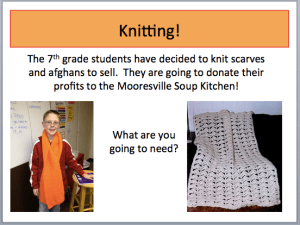
Screen Shot 2013-02-21 at 7.04.26 PM

I put them in groups to brainstorm what they would need.  They created lists and came up with great questions.  They generated a terrific list of things they would need.

  • Sale price
  • Cost of materials
  • How many
  • Amount sold
  • How much we need to sell to break even
  • Knitting needles
  • Cost of yarn
  • Seasonal (winter – need more)
  • How we are going to make (time)
  • How long to make
  • How many we are going to make
  • How much yarn it takes to make one afghan or scarf
  • Snacks!

Thanks to Google, we found out how much a skein of yarn costs, and how much yarn it takes to make an afghan (they knew how much yarn it took to make a scarf from experience).  They all have knitting needles, so we were able to take that out of our expenses.

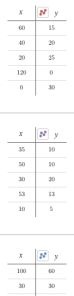
I then told them that Woodlawn school would donate $840 dollars for supplies.  I had them come up with scarf and afghan combinations that they could buy for $840.  I also had them come up with a combination that amounted less than $840 (in case we had unexpected expenses or wanted to buy snacks), and a combination that was too much money.
Screen Shot 2013-02-21 at 8.28.30 PM

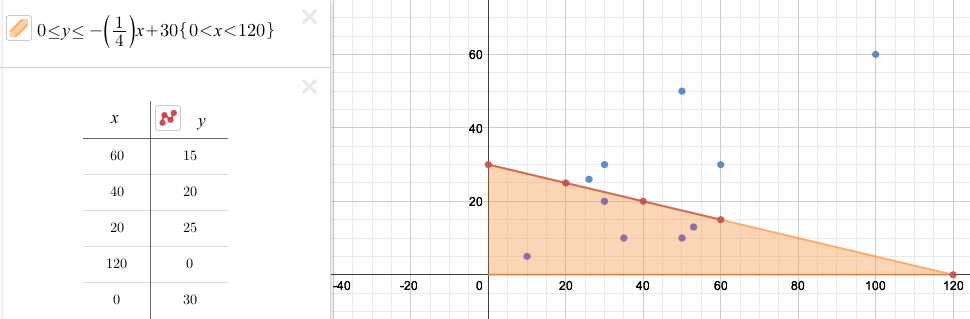
Once they had their combinations, we put them in three different tables on Desmos.com (my new favorite website!).  We made a table for combinations that equaled exactly $840, one for less than $840 and one for more than $840.  Desmos is an amazing tool as we were able to make each set of points a different color.

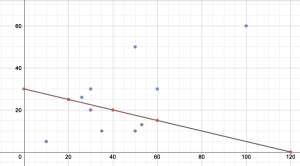
After we entered our numbers, I had the students tell me what they noticed and asked if they had any wonderings (thanks so much Max!).   Thanks to Desmo’s colors, it was easy to see that all of the combinations that equaled $840 created a straight line.  So, we connected this line.  After connecting the line, it was very obvious that combinations under $840 all fell under this line, and those above $840 were above the line.
Screen Shot 2013-02-21 at 8.28.15 PM


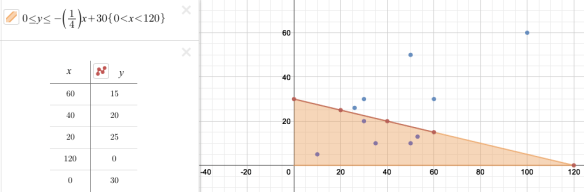
We wrote the equation of that line together and then I had them watch me while I changed the equals sign to the <= sign in Desmos.  There was an audible gasp in the room as the bottom filled in.  Students exclaimed, “Oh my goodness, EVERYTHING in the orange area works!” as it dawned on them what had happened.  They couldn’t wait to see how to do it themselves and really realized what was going on.
Screen Shot 2013-02-21 at 8.29.15 PM

Never before had “test points” seemed so obvious to them.  Test points were not just random points, they MEANT something, they told a story.  The next day, when we finally got to the actually inequality lesson, foldable, and then homework, the students really understood the need for a test point.  They also easily understood the horrific workbook word problem.  Honestly, even I still can’t believe how well this works.  It is truly, “math-a-magic”!

So please, if you can, begin at the end and save the math for last!

Thanks so much to Desmos.com for all of their help via Twitter!  They are an amazing, consumer friendly product and we use it daily in our class now.  I still can’t believe that it is free!
MathCounts in Hickory, NC

I’m at MathCounts in Hickory, NC today.  I brought 7 6th graders and 3 7th graders.  My team consists of four 6th graders.  None of these students are even in Algebra.  But, they have worked so hard and are so excited about coming today!  None of us could sleep last night.  I don’t know how they will do since they are so young.  These problems are tough for them.  They were all quite intimidated when they saw that everyone but them has a graphing calculator.  But, none of that matters.  They are fabulous, brilliant kids!  They are excited to be here and I am so excited for them!  Best of all, they requested that we continue math club even after MathCounts!  Win for math!

Our “Official” Lesson Plans for Observation

Click here to submit your MS Sunday Funday post!

#msSunFun

Next week:  How do you help students in your class that are behind in math?

Please share your “official” lesson plans that you used when being observed this week.

Differentiating Math Homework

Click here to submit your MS Sunday Funday post!

#msSunFun

Next week will be:  Post Your “Official” Lessons Plans That Were Used for Observation

We have blogged about Homework Policies before in MS Sunday Funday, but this week I wanted to focus on differentiated homework.  I found some great posts about homework in my Google Reader this week so I am adding these here as well!  Additionally, Sam Shah surveyed teachers about homework a couple of years back that I analyzed and summarized in this post.  Those results changed my thoughts about grading homework – and I’ve never looked back!  Thanks for great posts about homework.

Homework Choice Allows Differentiation and Encourages Creativity

Listen to me present this live at Global Math (recording will be up 2/6/13).

I have recently started offering “choice” homework assignments – and my students LOVE them.  Last week in a survey, many of them said that they loved working on the choice assignments and requested to do more of them.

IMG_4692

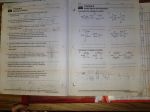
For the choice assignment, students can do traditional homework (workbook problems only) OR they can do half of the workbook problems and then create their own word problem (with solution) based on that concept.  They can write their problem on paper or create a Google Document and share it with me.

The next day, I have the students work each other’s problems in class.  The students like to share their fun problem.  Plus, they help each other solve their problems when they get stuck or have a question.  It is also great because sometimes they find mistakes in a problem and will help that person understand what they did wrong.  They love working each other problems and teaching (and helping) each other.  I walk around the room looking at their problems and helping as needed.

Choice assignments are automatically differentiated.  Students having trouble with a concept often chose to do the workbook problems so they can check their answers.  Most students who make up problems create ones that are similar to ones that we have done in class.  However, some students make up more difficult problems or go above and beyond with their creativity.

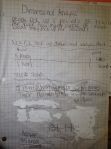
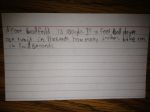
IMG_4702 IMG_4701 IMG_4722

They are having so much fun making up their own math word problems – and spending so much more time thinking about math.  Students usually dread working word problems but when they are creating their own and solving their friends problems they love them!  I love how excited they are about their math homework and that they have asked me if they can do more choice assignments in the future.  Another benefit for me is that I can use their problems in the future for subsequent classes.  My students are creating creative and engaging word problems for future students!

Here are some examples of the work they have created.

I’m Presenting “Choice Homework Assignments” on Global Math! LIVE – Tuesday, 02/05/13 at 9PM EST

Listen to the recorded presentation at Global Math (recording will be up 2/6/13).

The first Tuesday night of each month, math teachers present their favorite ideas and lessons at the Global Math presentations.  It is called “My Favorites” and has become my favorite presentations to watch on Global Math!  Usually 5 or 6 teachers share something that they LOVE (lesson, idea, activity).  I always come away learning so much from this one hour talk.

This Tuesday night is “My Favorites”, and I am presenting one of my new favorite things I have started doing in class, Homework Choice Assignments.  My student LOVE my new choice homework assignments.  They are working harder on homework and learning more as well.  Plus, Homework Choice Assignments automatically differentiate their homework assignments without me having to do it.  I can’t wait to share it with you tomorrow on Global Math!

To attend the meeting, all you have to do is click on the link below.  You can sign in with Twitter or Facebook, but you don’t have to sign in to watch the conference.  And, you don’t have to talk or even participate.  You can just watch/listen and come and go as you please.   You can also “reserve” your spot if you click on it now instead of waiting until tomorrow night.  To reserve your spot now or watch tomorrow, click on this link.   Global Math, “My Favorites” Tuesday, 02/05/13 at 9PM EST

This week the presenters are:

1. Jonathan Newman (@newmjh3)
2. Alisan Royster (@G8rAli)
3. Julie Reulbach (@jreulbach)
4. Matt Vaudrey (@MrVaudrey)