Rice Krispie Conic Sections

After seeing Rice Krispie Conic Sections on Shawn’s blog, I knew I had to make them for my class.  I’m so glad I did.  They were amazing.  They are actually very easy to make, and totally worth it.  We have been doing parabolas all year, but it was so cool to cut a conic and SEE a parabola inside!

Screen Shot 2015-02-25 at 10.13.13 PMTips for anyone who wants to make them.  I used snow cone cups that I got on Amazon.com.  I first looked at Target, but there were no snow cone cups to be found in January.  Once the treats were made and set, the snow cone paper just tore off very easily.

Screen Shot 2015-02-25 at 10.11.34 PMThe Rice Krispie Treat recipe is not on the Rice Krispies box, but on the marshmallow package.  It took a double recipe to fill 18 snow cone cups.  I only have one Alg 2 class, so this was fine.  But, if I had more students I would probably not fill the cups up as full, so a double recipe would fill more cups.

I gave each group of students two snow cone krispie treats (so we could make a full conic) and some plastic knives, and then we were off!  I first had them cut a circle off of the top.  Then we moved to ellipses and parabolas.  For the hyperbola, I had them stick their two cones together.  I was impressed at how well it went.  Sometimes you do an activity that sounds great, but doesn’t really give you the full effect.  The rice krispie cones turned out better than I even thought they would!  And of course, the best part about Rice Krispie Conic sections is that you get to eat them!  This was worth its weight in gold today during the LAST period of the day before 8 inches of snow was expected to fall!

Completing the Square with Algebra Tiles

I can’t remember when I learned how to “Complete the Square”.  However, I don’t know if I ever knew (or even thought about) why it was called completing the square.

I wanted my students to actually complete a square before they “completed the square”.  And, what better way to do this than with Algebra Tiles!  I have an entire class set that I bought for middle school.  I even have a magnetic set for the board.

My Algebra 2 students had never used Algebra Tiles before.  Introducing manipulatives to high school students isn’t always easy, they think they are “too old” to play with them.  One student even (loudly) made a comment at the beginning of class about how silly they were.  However, by the end of class he had changed his tune, and I even had two students ask to take a set home.

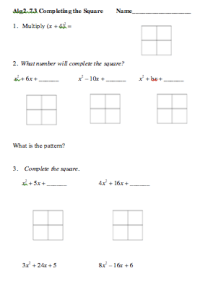
Screen Shot 2015-02-21 at 5.53.56 PM Screen Shot 2015-02-21 at 5.50.42 PM

I also made an INB graphic organizer that also leads them through completing the square. It includes steps on the back, but my students didn’t like that at all once they actually understood what they were doing.  Love that.

Screen Shot 2015-02-21 at 5.46.15 PM

Here are three videos that I made for my students on how to complete the square using the area model. 

Completing Two Squares to Make a Circle

Trying Conic Cards

I haven’t taught Conic Sections in many, many years.  But even though it has been many years, I still remember how much students disliked them.

After hearing Cindy Johnson speak so enthusiastically at TMC14 about her Conic Cards, I knew I wanted to try them.  Amy and Sarah had great success with the cards as well. So, I’m going all in.  If you have tried them and have any suggestions for me, please throw them in the comments.  I start Monday.  I can’t wait to try them!

I had read from other bloggers how much time it takes to makes these cards. I thought I understood, but really had no idea until I started printing them out. It took for-ev-er. I also laminated them and then cut them out while watching a movie with the family. It took me over two hours to cut them out, and I only made five sets. (I’m at a private school so I only have 20 kids per class). Thank goodness for snow days.

The entire time I printed, laminated, and cut each page I just kept thinking, “I cannot believe that Cindy CREATED all of these cards!” And I can’t even imagine how long it took her to make them! So, thank you Cindy for your great work, but especially for being willing to share them with all of us!  This is why I love the #MTBOS.

The entire set of Conic Cards including worksheets, a project, and even a test to go with them can be downloaded here.  There are even two levels of worksheets, a standard and an advanced set.

I also plan to make Rice Crispie treat conic sections that we can cut apart, IF I have the time (soccer!).  And no, I am not above bribing my HS students with food.  Whatever it takes…

Polynomial FUNctions – Multiplicity Roots Video

Polynomial End Behavior and Multiple Roots Video

Screen Shot 2018-05-11 at 10.00.57 PM


You just NEVER know where a math lesson is going to go once you bring in the “teenager” element.  After a few very random events in class I decided to make a video to help explain end behavior and multiple roots to my students.  Music included!

I was teaching multiple roots with the help of the fun terms “bounce” (double root) and “wiggle” (triple root) coined by Rachel.  (Thank you again Rachel for sharing your files).  So as I was talking about “bounce” and “wiggle” in class I MAY have said (sang?), “Wiggle, wiggle, wiggle” once…or twice.  I have a tendency to sing random song clip-its throughout class, so it just may have happened.  Towards the end of the lesson one of my students, Michael, raised his hand to share how he was thinking of it with the class to help everyone.  He then started taking about Bounce It with Juicy J and Wiggle with Jason Derulo.  EVERYONE in the room was like, “Oh yeah! I get it now.”  Well, everyone but me that is.  You know you are old when you cannot even understand what the teen people are saying.  At least I DID know the Wiggle song, but all of the J names completely threw me.

After class I shared all of the dance fun with my teaching partner Chris.  He talked about how he hi-lights what the roots look like at the graph when explaining multiplicities.  He said he even draws a little frame around the root so the picture inside the frame looks like a line, a parabola, or a cubic function.  I don’t think I’ve thought of roots visually this way, but when I shared it with my students they were like, “Duh, Mrs. Reulbach”.  How do I always miss obvious things?

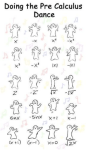
Screen Shot 2015-02-20 at 8.58.47 PMWe also did the “End Behavior” dance to High School Musical (my sophomores are obsessed with High School Musical – it’s adorable).  I threw in a lightening round of Simon Says End Behavior at the end but quickly had to cease all manic dancing when I noticed I was being observed from the door by several other teachers and one of our deans.  Luckily I don’t embarrass easily!  During all of the madness one of my students found an adorable picture of little ghosts doing math graph dances.  I had seen this with stick figures before, but never ghosts!  Adorable.  Thanks Kallie!

Maximizing Box Volume with Popcorn

IMG_2916Thanks to Fawn, my students actually cared about making the maximum sized box out of their 8.5″x10″ piece of graph paper.  If you don’t do this, you should!  It was very easy and great fun!  You will need to go and read Fawn’s popcorn post because she has all of the great lesson details.

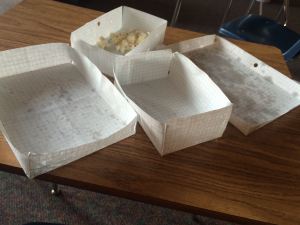
I went minimalist and only showed them a box I had made, and the squares I had cut out to make my box.  I gave them a ruler, scissors, tape and ONE piece of graph paper.  I told them they only got ONE piece of paper.  They worked well and carefully.  Most students chose to fold  the sides in instead of cutting just in case they messed up.  Love them.

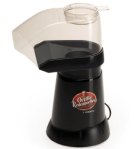
Screen Shot 2015-02-15 at 9.56.16 PMI recently bought an Orville Redenbacher air popper so I brought that in to make the popcorn.  Seriously, this is the best $22.49 I’ve spent in a long time even before I used it for a math lesson!  I even brought in butter.  One of the students took a picture of the air popper so she could buy one.  It was pretty cool with all of the popping going on right in the back of the room.  It smelled heavenly!

Once they made their box they measured it and entered the measurements and resulting volume on a Google Form.  Then I filled up their box with popcorn!  We ate while looking at the Google Form results and then I challenged them to find a general equation for an size cut.  Several students came up with it pretty quickly and then I had them graph it in Desmos to show them how their maximum volume was also on the graph.


IMG_2915

Polynomial Roots and End Behavior Card Sort

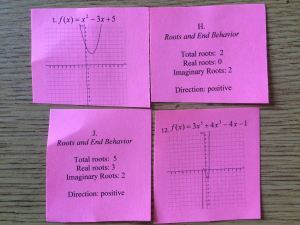
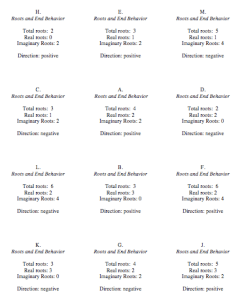
I really don’t know how people taught before the internet.  Luckily, I don’t have to!  I found some beautiful “end behavior” cards on the amazing Amy Gruen’s blog, “Square Root of Negative One Teach Math“.  I doubled the set, adding the number of roots (real and imaginary), as well as direction and wanted to share them back out.

IMG_2913

IMG_2914

I passed them out to review end behavior and roots, but I wish I would have had these as a discovery lesson to introduce the concepts.

The amazing Amy is some sort of card sort savant.  I also saw a Desmos card sort that I can’t wait to explore.

Polynomial Roots and End Behavior Cards (these are just the word cards, the graph cards that go with them can be found on Amy’s blog.)  Thanks Amy!

Screen Shot 2015-02-15 at 9.06.21 PM

Help Needed – Algebra 2 Factoring Review?

Help needed!  I have quickly learned (the hard way) this year that Algebra 2 students need mini “refresher courses” of Algebra 1 before plunging into more advanced material.  I gave my students a pretest and many of them also need a review on multiplying polynomials as well.  I plan to review quadratic factoring for 2-3 days in my Algebra 2 class before I jump into factoring polynomials.  Since this is a quick review of a section that takes at least a couple of weeks in Algebra 1, I would love some advice.

My review plan is this –

  • Day 1 – Eradicate FOIL – Multiply polynomials by using area method (boxes) and distributive property.  Factor GCF’s.
  • Day 2 – Factor a = 1 and special cases.
  • Day 3 – Factor a > 1.  Advice appreciated on methodology here.**

** What are your thoughts on factoring when a > 1 in Alg2 and above courses?  The factor by grouping method is a sure thing, but is so much better than “guess and check” (the way I learned and used forever) that it worth the time?  I don’t believe my students were taught this method in the past and I don’t know if teaching them now will a) take to long and b) totally confuse them since it is a more procedure heavy way of factoring.  Plus, in Alg2 + how often is factoring by grouping going to be useful?

For those of you who have been there before, I would love any advice (or anything you have created).

Thanks in advance!

Structured Group Work Webinar by Mimi Yang – Tonight on Global Math, EST 9:00pm

Join us tonight at Global Math to hear the fabulous Mimi Yang, writer of the blog, Until The  Next Stop, talk about structured group work.

I have been a huge fan of Mimi’s since I went back to teaching 5 years ago.  Her blog is smart and informative.  She is an expert at scaffolding lessons in a way that makes perfect sense to students.  My students love every lesson of hers that I try and always remember those concepts.  I can’t wait to hear how she structures group work.

Click here to attend the webinar tonight. 7 Oct: Structured Group Work.  I hope to see you there!

Function Transformation Discoveries using Desmos

Calling all teachers to help me make these better!

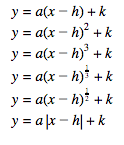
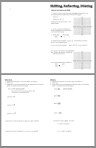
Screen Shot 2014-10-04 at 11.40.52 AMThis summer at Twitter Math Camp, Glenn (@gwaddellnvhs) and Jonathan (@rawrdimus) showed us how they lead students through all of the functions in Algebra 2.  Basically, they put all of the equations into (h,k) form.  Fortunately, the book I am using this year, “Discovering Advanced Algebra” does basically the same thing.  Since it is a “discovery” book, they have some good ideas that I have been able to modify and made into INB (Interactive Notebook) form.  Never fear, this just means it’s a worksheet that you fold in half.

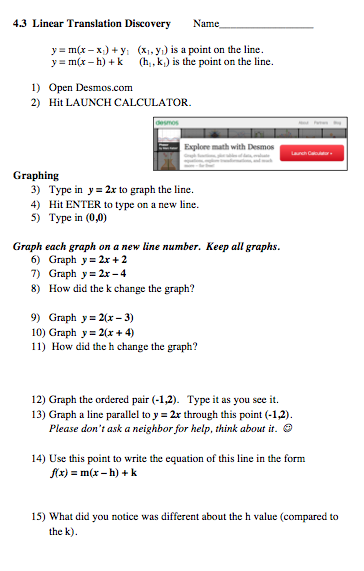
Screen Shot 2014-10-04 at 11.58.29 AMThe first discovery was also my students first introduction to graphing with Desmos on their own.  Of course they have seen me use Desmos multiple times by now since Desmos has all of those great example graphs in their side bar!

Here is how I progressed through discovery for linears, quadratics, square root, and absolute value.  The Box files with the word docs are at the end.

  • Horizontal and Vertical Shifts
    • Linear Equations (first time with Desmos)
    • Screen Shot 2014-10-04 at 12.15.08 PM
    • Quadratic Equations
    • Screen Shot 2014-10-04 at 12.14.30 PM
  • Reflections with the square root function
  • Dilations with the absolute value function – these last two are combined into one.  I would love any suggestions on this – before Monday.  I know, I’m asking for too much here! 🙂
  • Screen Shot 2014-10-04 at 12.11.32 PM

Also included is a “Transformations Parent Graph” foldable that I made to sum it up.  I kind of hate this one, and would love suggestions here for sure!  Should I add dilations?  Why is it so ugly?  What else do I need to add?  I need help here for sure.

Screen Shot 2014-10-04 at 12.10.56 PM

Algebra 2 Function Transformation Discoveries

Please note:  I did not make all of these discoveries from “scratch”.  I created some of them.  But some were inspired by the textbook I am using this year, “Discovering Advanced Algebra” and some were created by my amazing co-teacher.  I then adapted all of them for INB (Interactive Notebook) form.

Recursively Defined Sequence with Limits Investigation – Skittles Activity

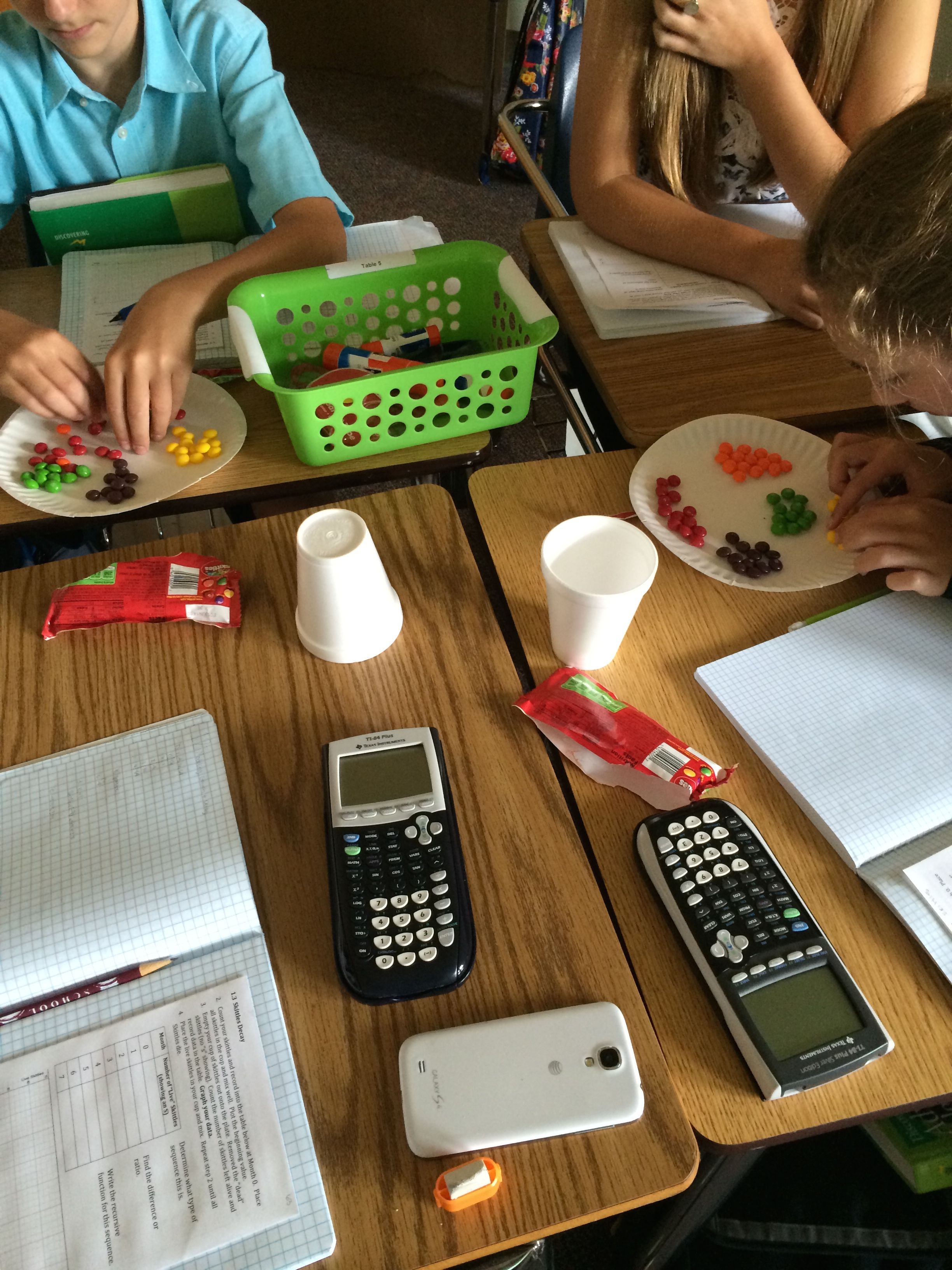
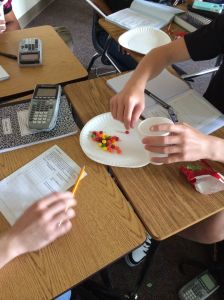
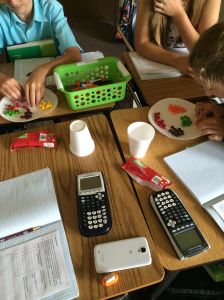
Yikes.  So the title is dreadful.  I need to work on that now that I will share my HS lessons!  Also, I only took two pictures of the action and they aren’t great.  As soon as I pulled out my phone, a student asked me, “Is this for your blog?”.  And then the subsequent comments were either, “Please don’t take my picture.” or “Please, take MY picture!”, and then posing for me.  So, this threw me a bit.  I don’t care if they know, as all my MS students at my last school knew (and begged me daily to take their pictures and blog about it).  I just wasn’t expecting it yet.  Again, it’s hard being new.
IMG_1628

First of all, I needed an entire 90 minute block period for this activity.  So, if you do not have a block period, I would set aside two days.  However, this activity is worth the investment!  I am using the book Discovering Advanced Algebra for my class, and this one activity covers decaying geometric sequences, decaying shifted geometric sequences with limits, and graphs of geometric sequences.

I got the idea from Sarah (thank you Sarah!) but needed to alter it because I wanted to define the function recursively, and I wanted to include limits.  I did not tackle growth, as I plan on teaching that through finances next week, so I only covered decay.
IMG_1629

Experiment 1 – Decaying Sequence:

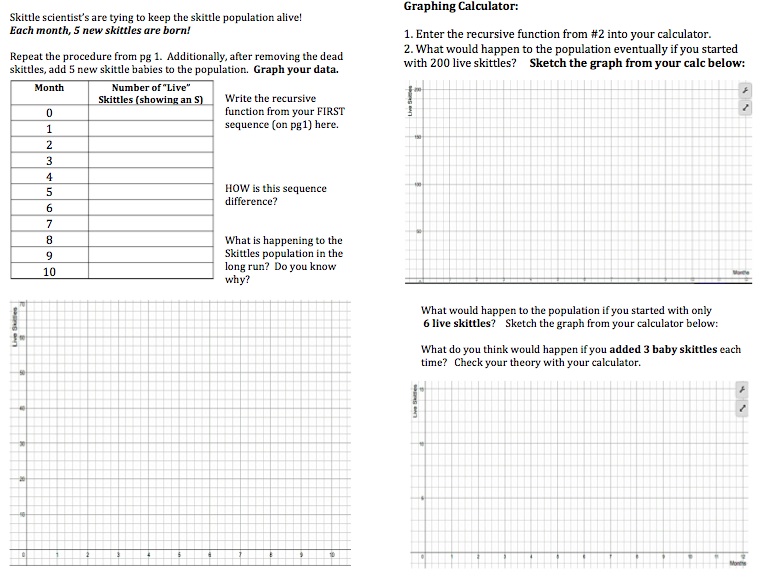
I gave each pair of students a package of Skittles, a plate, and a cup.  Most of the work we had done the previous day was with patterns that started at step 1, so I wanted to start with an existing value.  This is a good precursor for financial functions as well.  Thus, I had them count, record, and graph their initial Skittle population before we started “killing them off”.  They then put them in a cup, shook them up, and spilled them out on the plate.  We recorded the Skittles that had an S on them as “Live Skittles) and put the dead aside.  I had them count even Skittles with a partial S and told the kids, “They aren’t dead yet!  They are still hanging on!  They are only partially dead!”  You must be very clear about how to pour out and count the Skittles.  I do not have a document camera this year to show everyone what to do.  I had a couple of groups doing wacky things, like trying to rub the S off of the Skittles (in effect, actually killing them), counting only Skittles that were blank on both sides, or taking out the Skittles one by one instead of just dumping and counting.  As they repeated the procedure they recorded everything in a table and graphed each point.  ** Note to next year self:  Remind them to graph as they go along. **   We talked about the percentage of Skittles that were dying each time.  They noticed that it was a geometric sequence and that the ratio of each term was similar.  At this point, we talked about how to find a ratio that could best represent the experiment for any stage and averaged all of the ratios.  After each group found their common ratio, I had each group tell me their common ratio.  I wrote them all on the board and we found the common ratio for the entire class.  I should have emphasized that we needed ONE “common” ratio in order to define the function.  Again, next year.  Last, we defined the Skittle death sequence for the entire class.
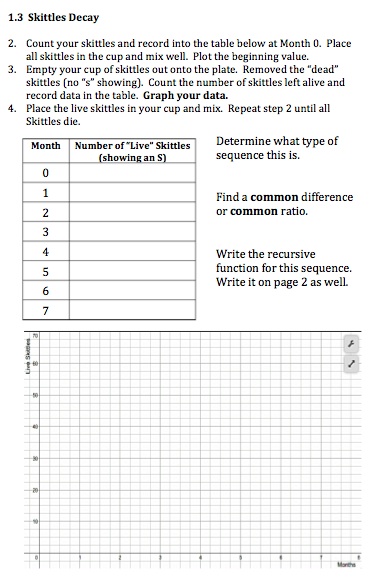
Screen Shot 2014-08-24 at 8.21.27 AM

Experiment 2 – Decaying Sequence with a Limit

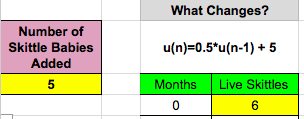
Once they defined their sequence, we started again.  But this time, we ADDED five Skittle babies every time we killed a bunch off.  I put WAY too many trials in this section and have shorted it for you.  However, the frustration did prove for some much needed teacher entertainment.  “Why won’t they all just DIE already?”,  “WHEN are they all going to die?”, and finally, “Oh my gosh, they are NEVER all going to die, ARE THEY Mrs. Reulbach?!?”  The Skittle population wasn’t the only thing that had reached it’s limit!  But we forged on and added our +5 to the function.

Graphing Calculator Investigation – Changing the initial number of Skittles.

I totally ran out of time for this stage because I had no idea it would take so long to kill, record, and graph Skittles.  I had started class off with an additional activity before I started with the Skittles.  (It was my FIRST block period ever and 90 minutes seemed like an eternity – especially if we finished early!  I have so much to learn.)  I asked them what would happen if we started with 200 Skittles.  I was pleasantly surprised that many students actually knew.  But, I acted like I didn’t believe them and made them enter their brand new shifted geometric sequence into their graphing calculators to prove it to me anyway.  The next step was to change the initial Skittle population to only SIX skittles and then watch the graph shift magically before their eyes.  But it was 3:00 and we were all at our limit.  So I will pick up here on Monday.  The last question asks what will happen if we change the number of skittle babies added each year so they can see what makes the limit actually change.
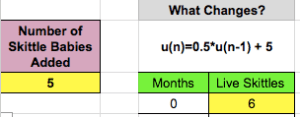
Screen Shot 2014-08-24 at 8.44.39 AM

They were really annoyed that the Skittles didn’t die in the second experiment AND it was the last block period after two days of block periods, on Friday no less.  So, I have no idea if they even liked this activity.  I don’t care if they loved it as long as they didn’t hate it and as long as they learned from it.  But since it’s the first week of school and I am totally new to HS students I have zero idea at this point.  I guess only time will tell!
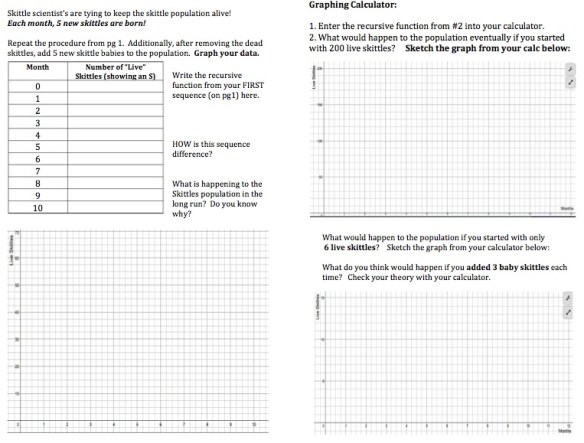
Screen Shot 2014-08-24 at 8.21.37 AM

Any thoughts and/or improvements would be extremely appreciated.  Love, the Newbie.

Important Notes:

  1. This takes the entire block period.
  2. SHOW them how to dump and count Live Skittles.  Do not put dead Skittles back into the cup.  Or, give them two cups!
  3. Remind them to graph as they go along.
  4. Emphasize that we need ONE “common” ratio in order to best define the function.

The Doc and PDF files are on Box here.  They are in landscape booklet style so students can fold it and tape it into their notebooks.