I would love to give my students a good end of year survey. Does anyone have one they like? If so, I would love to see it. If not, do you have ideas for questions that would be helpful on a student survey? I plan to make mine on a GDoc Form.
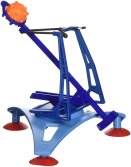
You should definitely shoot candy when you cover projectile motion in Algebra! I got this fun idea from Sean, who even had his students build their own catapults! He’s a rock star. Luckily, our math department already had some catapults that I was able to use. If you want to save time, the catapults were only $7.89 from Amazon and worked great! I used Starbursts instead of the included balls (candy for the win). But students did have to create a tape basket for the shooter since the Starbursts were smaller and were falling through. My students call this the Starburst Catapult activity and many said it was their favorite activity of the year.
This activity follows my projectile motion lesson, which will be very helpful for your students to do before Candy Catapult so they understand what the dilation should be and where it is coming from. After reading Mimi’s comment on Sean’s post I amended Sean’s instructional worksheet (Candy Catapult Worksheet) to have the students do all of the quadratics work with just the time. This makes it a projectile motion problem, and then they can use -4.9 meters/sec for the a.
Candy Catapult:
In groups of 3 or 4, instruct students to carefully read their handout.
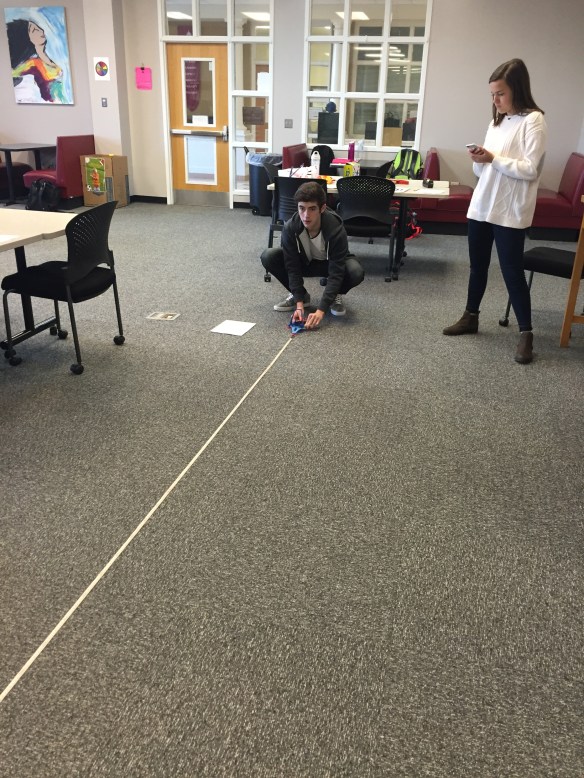
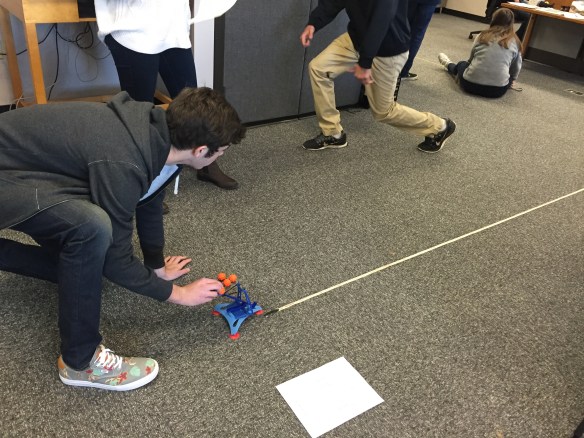
Students shoot the catapult from the floor and time how long it takes for the candy to hit the ground and the distance their candy travels. Students used their smartphones to time the flights. I tell them to practice and make sure they are getting accurate results. They do not get a target at this stage.
They use this data to create a quadratic equation of the candy’s flight (in factored form). We used -490 cm/sec as the dilation since we measured in cm.
They measure the height of a desk and use their equation and Desmos* to find out how long it will take their candy to hit the floor from the desk.
After they find the time the candy will be in flight, they use proportional reasoning to calculate where to place the target.
No one may shoot from the desk until all groups are finished, then we ALL gather around and watch each group shoot, one at a time.
*I made a Desmos Teacher Activity for students to record their data and then enter the equations that they created from their data. This was a great visual check for them to make sure their equations matched their data before moving on. The graphs also helped them find the numbers they needed when going from shooting from the floor to shooting from the desk.
I did this lesson with all four of my classes, and of course it got better as the day went on. I always feel sorry for my 1st period class. I started out having the groups do all of the work individually, even the final round. But there was really ZERO excitement in that and it just kind of, ended. By my last 2nd two classes of the day I had set up a true, “Final Challenge Round!!” where the entire class watched. I even played Jock Jams to get them all “pumped up”. Oh, the things I do to get high school students energized.
We did everything in an 85 minutes block class. However, I wish I had spend one additional class day after the activity to reflect and even challenge them with variations of the catapult problem to whiteboard with. I need to find giant catapult war related problems! (Or I’m watching way too much Game of Thrones lately). But really, wouldn’t that be the most fun!
Tips for Success:
MOST IMPORTANT!! Do the final round at the end, with everyone watching each other so they can root and especially heckle.
Play music during the finals. (I used a Spotify Jock Jams playlist.)
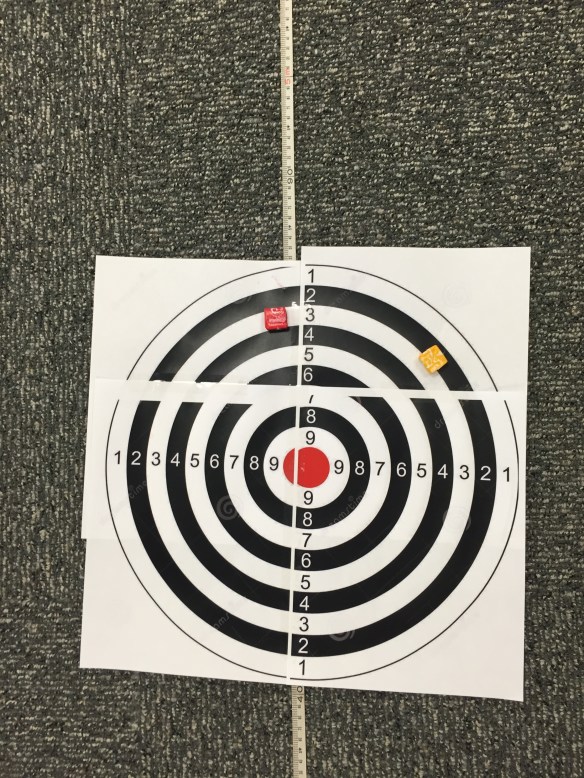
Print out a LARGE target! I found a picture online and used 4 sheets of paper.
Emphasize consistency, consistency, consistency.
Use centimeters to measure, and -490 cm/sec for the dilation.
Remind them to sure the are consistently measuring in cm, not flipping the tape over and ALSO measuring in inches. True story.
Bring prizes for winners
Spend an additional day reflecting, and even give additional problems to solve.
If you do this activity and create a reflection activity or additional problems I would love to see them! 🙂
I read about #MTBoS30 on Twitter yesterday. After blogging only about once a month (or even every other month) for the past year or so, I actually blogged three times in a row last week! I doubt I can blog something every day. We have AP exams this week so we are missing class days, and then we only have two weeks left until finals. But, I am going to try! I love and miss blogging and am happy to get back into the habit again. Plus, I absolutely adore Anne so I’m in for anything she starts!
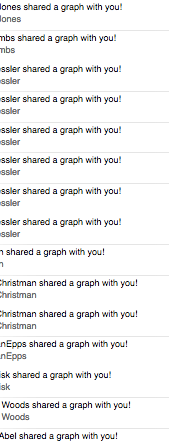
I am writing this blog as a Public Service Announcement. Or rather should I say, Prevent Stupidity Announcement. If you want to assign Desmos for homework but DON’T want your inbox to look like this (imagine about 150 more emails), then use Desmos Activity Builder.
This should have been obvious to me, but I’m never my best at the end of a long week (especially this close to May). Thankfully, the wonderful Dylan Kane is way ahead of me and made a “blank slate” template on Desmos Activity Builder! This is such an ingenious way to utilize Desmos and cut down on a teachers workload. Instead of searching through my Haiku inbox or 170 emails to see students work, I will now only have to look at ONE page on Desmos.
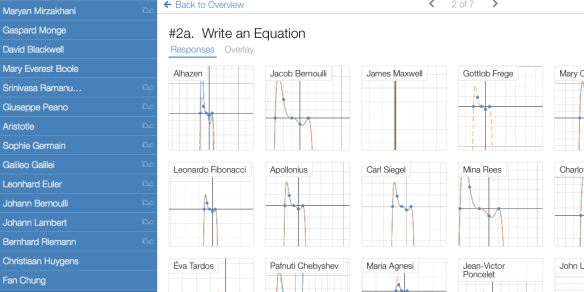
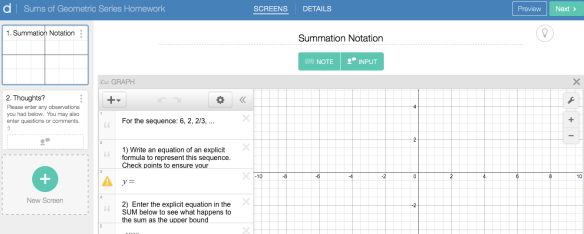
For those of you not familiar with Activity Builder, you can start with Dylan’s template, make an instruction page, and then have your students create all of their graphs in the same place. As a bonus, you don’t have to wait until they are finished and emailing you before you see what they have done. You can watch them working LIVE, and help them if needed. Your screen will have ALL student names and graphs on one page (also, love the new “fake names” option)!
I could not find a Desmos teacher activity exploration for series, so I made my own. Everything is better with Desmos!
This activity works best if students are already familiar with geometric sequences and series. They are really just exploring convergent and divergent. I instruct them to look up the words convergent and divergent in the dictionary. I thought knowing these definitions would help it make sense. I also included a geometric sequence and series link from Math Is Fun at the end.
Trigonometric identities – I adore them. They are like little challenging puzzles. But high school students don’t always share my ardor. I wanted them to understand what an identity actually was so I started the unit with Sam’s amazing Pythagorean Identities lesson.
The lesson was a little tough for my Algebra 2 class, so I helped them through the last two pages. The next day, I had them white board some basic trig identity problems. I usually just give them one side to simplify for starters. This helps with the whole, “OMG – it’s adding fractions – but with trig!!” scare. On the third day I put them in pairs to work on Shireen’s (Math Teacher Mambo) Trig Identity Match Up activity.
This activity was fantastic because all of the identities were the steps in the simplifying process! So even after they had matched them all up I had them put the cards in the correct order. What a great activity!
This is my first time teaching series. Thank goodness I have the amazing Sam Shah to give me his great ideas!
The fist bump problem is essentially the same as the famous “handshake problem“, but way better because of FIST BUMPS! You should read all about it on Sam’s blog because he not only describes it really well, he has a hilarious fist bump video short that my kids loved. Sam finds the best YouTube videos.
So after having them talk about how many fist bumps we would have in our class, I asked them how they could all fist bump each other most efficiently, then I actually had them act it out. Even in my last class of the day students were eager to get up and try out their fist bump efficiency strategy. I don’t know if you teach high school students but this is a BIG win. They never want to get up. like EVER. And, the last class even told me, “I heard we move in class today. Please don’t make us move.” Yet, they jumped up. I think it was because I had them come up with their own theories to test out instead of me telling them how to do it.
Sam timed his students fist bumps but I did not because I did this on a short day (55 minutes) instead of a block day. Ok, I did decide to time my last block because hey, it WAS the last class of the day and I was dying to time it. Plus, it was THE LAST CLASS OF THE DAY and even after begging me not to make them move when they first got to class, they happily jumped up to fist bump after working on the problem.
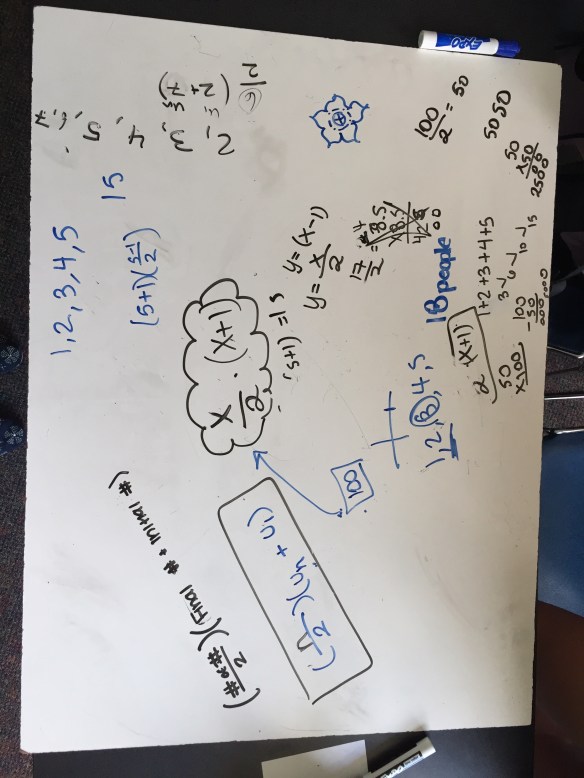
If you want your students to understand what is happening and even develop the partial sums for arithmetic question, you MUST give them time after the fist bumps to work. I took their suggestions about how to sum up a ton of numbers and then introduced them this method. I did not show them the video.
I tend to rush them, but it was Monday, so I let them work longer than usual. Wow, was I impressed. Almost all students were able to write a partial formula to describe what was happening. Several students actually developed the entire formula. I did not push them to use variables until their equation was very close, but many students jumped to variables right away.
I should have taken more pictures, but I was having way too much fun! I did get one picture of a white board from the last block. They figured out the formula and stayed after class to try to finish it. What a great day!
I have been giving hi-fives a ton this year so some students actually hi-fived me instead of fist bumping me when I went through the line. I love that.
I’m so excited to start trig again in Algebra 2! We have a week long trig blitz where we review the trig ratios, inverses, special right triangles, and law of sines and cosines. Some students needed more one on one review than others.
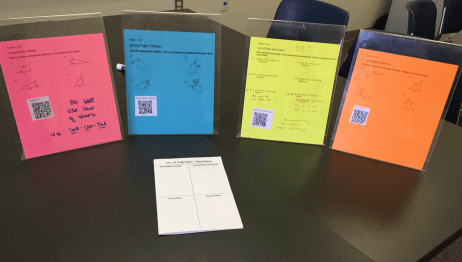
So I decided to do a station activity to review the week. I love station activities, as everyone can work at their own pace, check their answers as they work, and get one on one help from me when they need it. Plus, they get to work individually and with other students and move around. I created booklets for them to do the work for each station. My students make one sheets at the end of each unit, so I put a blank one sheet template on the front of the booklet. This way, they could take extra notes as they worked the problems. It was pretty much a perfect teaching day!
Since they have studied all of these topics previously in Geometry, I wanted to push them a bit. We did the ambiguous case (ASS) last year with the Law of Sines. However this year, after the pre-calc teacher told me about using the law of cosines with an ASS triangle, I pushed my students to try it! Some of them preferred the law of sines, but many saw the benefit to using the law of cosines.
This year I introduced the law of cosines as an alternate (and optional) challenge. But next year, I am going to have them all use the law of sines to find a missing side of a 2 triangle ASS in order to frustrate them enough to BEG for a better way. I will do this as a group activity on the large white boards so they can fuss with each other about how crazy the problem in, then I will sneak around to the groups and quietly suggest a better way. Oh, teaching math can be so much fun!
Here are the stations I used. I created QR codes that sent the students to the answer sheets. Then I taped the codes to each station so students could check their answers as they went along. And here is the booklet. I wish I could do this everyday.
Edited: I finally updated my Delta Math post. I love having a website that helps my students AND is so good that THEY ask me for it. It’s the best! Enjoy!
We are now into Week 2 of the Blogging Initiative, “My Favorite”! You should definitely check it out if you would like some blogging inspiration! It is only four posts and it’s not to late to join in.
My favorite for the week is Delta Math, a free online math practice program with problems ranging from middle school to pre-calculus. The amazing Mattie Baker presented Delta Math as one of his favorites at TMC15 last summer. You can watch his presentation at the bottom of this post.
I rarely use Delta Math for daily homework assignments. Instead, I use it to review those basic Algebra 1 skills that many students have either forgotten or did not master during their Algebra 1 year. I give these basic practice sets well in advance of the corresponding Algebra 2 topic that I will be covering in order to get them prepared. I assign one “Problem Set” of about 5 – 10 problems a week. I also give a variety of problem types in the problem sets. Students are able to rework each problem until they get it correct, meaning that they are able to receive full credit on their problem set each week with just effort.
The students can see fully worked out examples of each problem and even watch videos for some problem sets.
I love the explanations on Delta Math, as they usually use methods that I teach in class, like the “box method” for multiplying polynomials. They even color coded the diagonals!
Occasionally I will assign a Delta Math set for homework. For instance, they have some fantastic practice sets for graphs, such as the one for finding domain and range visually.
Delta Math gives you amazing student data. You can see which problems students missed and even their incorrect answers. If I see many students struggling on a set, then I will usually reassign that set in the coming weeks. You can even see how long students took on EACH problem!
How I Use Delta Math:
I assign about 10 review problems per week, due every Tuesday at 8:00 AM.*
I usually require 1-2 of each kind of problem, with a “1 off” designation. This means that they can miss one problem without penalty, but if they miss more than one in a row, they go back to zero.
I assign Algebra 1 problems well in advance of the corresponding Algebra 2 topic.
I assign problems on a spiraling basis where problems increase in difficulty each week. I am staring rational functions in about a month, so next week I will start assigning them basic fraction problems. Next, I will assign them fraction problems with x in them,…
I hold help sessions the day before their problem sets are due for my students that struggle recalling their Algebra 1 skills.
*This biggest drawback is that students forget to do their Delta Math since it is an online program and only assigned and checked once a week. Moving the due date from Monday to Tuesday helped tremendously with this. I also love the Tuesday due date as opposed to Friday as some students wait until the last day to complete it and they are usually pretty wiped out by Thursday night. I use Remind to remind them and mention it in class.
Bonus! Delta Math now has a Delta Math Plus, where students can watch videos for each topic. There is a fee for Delta Math Plus.
Optional Summer Assignment:
Another way I use Delta Math is that I give all rising Algebra 2 students at our school an optional summer assignment on Algebra 1 topics in order to help them refresh their basic skills. I assign just one question per topic, but students can do as many questions as they like.
My students really love Delta Math! Here is some of what they said in my last course survey.
Having Delta Math for homework helped me a lot because it showed me how to do the problems so that when I did a problem similar to the previous, I would know how to do it with a lot more confidence.
Start doing more Delta Math.
Do More Delta Maths.
Do Delta Math – It helps a lot!
Do the Delta Math (this will definitely help)!!
Delta Math was very helpful.
Please give more Delta Math assignments.
I think continuing to assign Delta Math would be wise.
2015 was a tough year for me, as I was at a new school, teaching all new classes in a different division! I did not have much time to blog. But now it’s 2016, and the new blogging initiative is almost here!! With the new year comes a new resolution for my blog…
I, Julie Reulbach at iSpeakMath, resolve to blog in 2016 in order to open my classroom up and share my thoughts with other teachers. I hope to accomplish this goal by participating in the January Blogging Initiation hosted by Explore MTBoS.
You, too, can still join in on this exciting adventure! All you have to do is dust off your blog and get ready for the first prompt to arrive January 10th!
We matched new bloggers up with mentors during the month of December. However if you would still like to mentor anyone (or get help) please check out the spreadsheet. This is a self-directed spreadsheet, so be sure to pick a mentor or someone to help when you sign up!
Complex numbers are amazingly fun to teach in Algebra 2 because it is the first time students have ever seen them. It turns many of their previous “no solutions” into answers, how exciting is that? It also enables them to understand the majority of math jokes and memes!
I start my students off by letting them read about who uses complex numbers (because they always ask and I find this saves time), and then I let them read the Math Forum’s John and Betty’s Journey Into Complex Numbers.
Then, I show them this…
We have been studying patterns since the first day of school. Patterns are part of the beauty of mathematics. And the math they currently know does not let this pattern continue.
Enter complex numbers.
Some of them don’t buy it at first, but then I ask them, “Can you SEE zero cookies?” “Can you SEE -5 dollars?” Hmmmm…..
After the fun stuff comes the real work. And that is where the foldable comes in. I saw this awesome circular diagram idea for powers of i on Bonnie’s blog, Teaching On The East Side. I also used her great answer scramble idea (see below)!
I use graphing a + bi to motivate why the heck we can’t leave i the denominator and must use the complex conjugate to simplify. Fun times!
After the foldable we needed a break before getting more practice so we played this Kahoot. I liked it because every slide has a fun math joke or meme involving complex numbers!
Finally, for the practice worksheet I made a Holiday Scramble! Where the answers are all on the board, but mixed up so you have to find them. This is great for the students that do NOT like to even see the hint of an answer before starting a problem, but do want to check their answers after they are finished.
 I got this fun idea from





 My favorite for the week is
 I love the explanations on Delta Math, as they usually use methods that I teach in class, like the “box method” for multiplying polynomials. They even color coded the diagonals!


 I Speak Math