Quadratic Frames – Totally Nguyening

If you teach middle school math or Algebra 1 and you are not reading Fawn’s blog, then you should.  I get all of my ideas and inspiration from her!

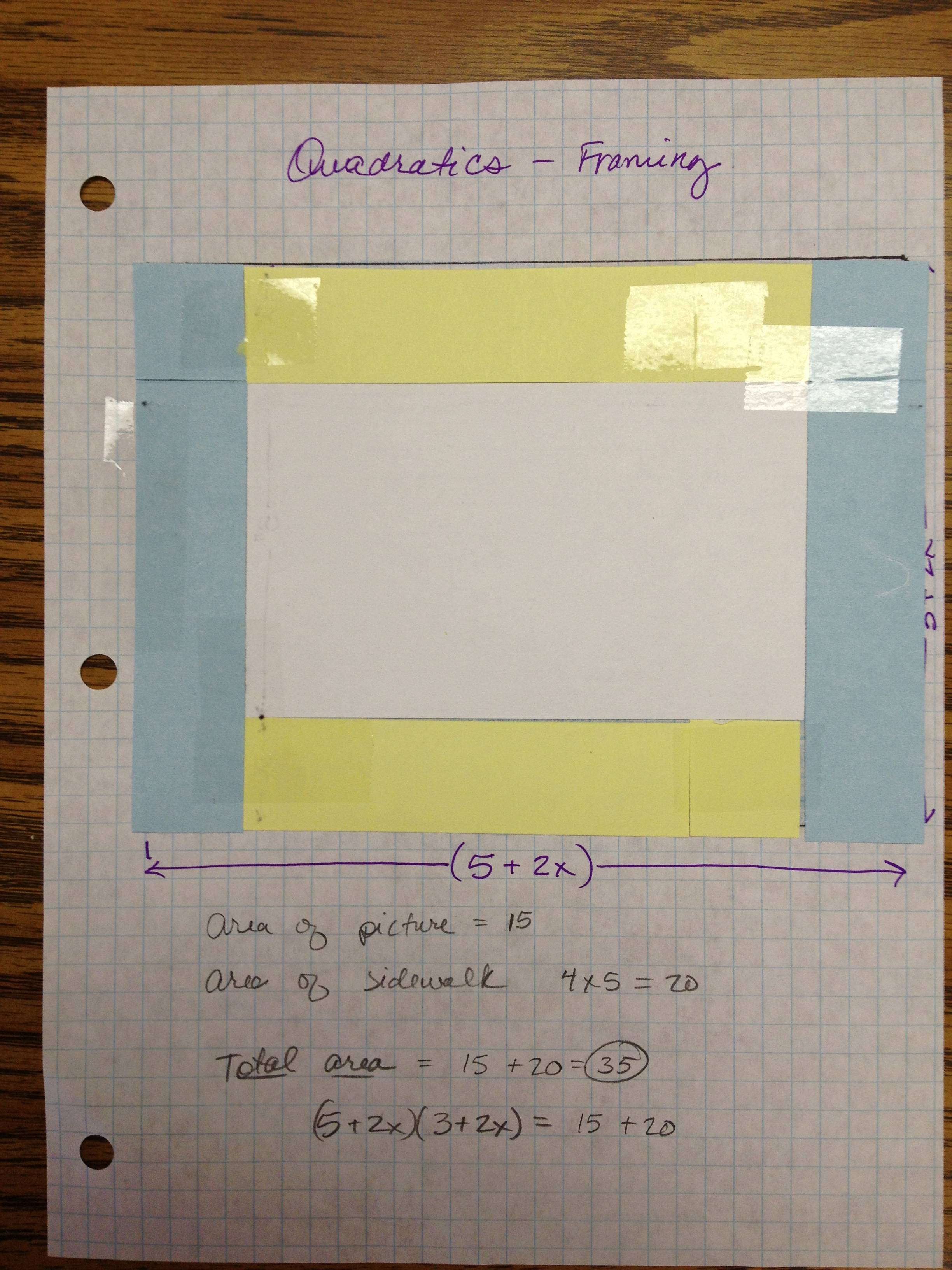
She posted a great activity about Quadratics and framing.  Please go read her post for instructions.  I wanted to post how I modified her activity for Pre-Algebra (using simple factoring instead of the quadratic formula).  I followed her instructions exactly, and modified four things.

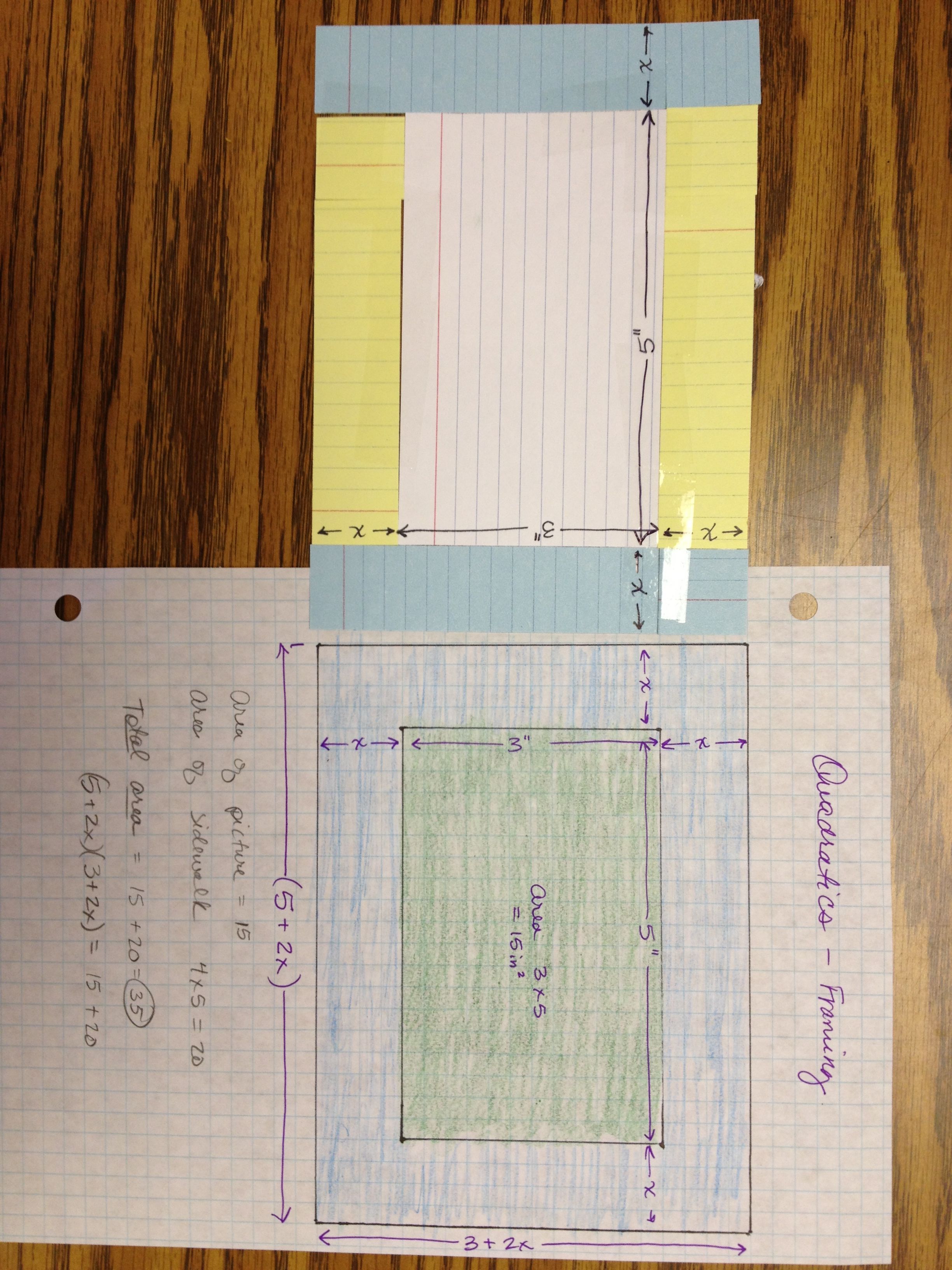
  1. I teach Pre-Algebra so I made the problem easier for my students so that the numbers would be easily factorable and not need the quadratic formula.  As a result, my students were more easily able to discover the frame dimensions (sadly, they did not beg).  It did take most of them quite a while however and they appreciated when I finally showed them the math.
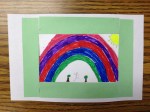
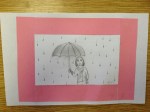
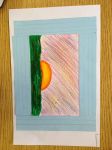
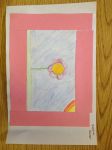
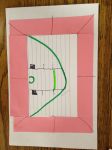
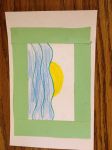
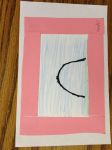
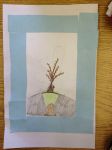
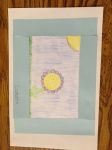
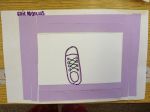
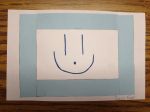
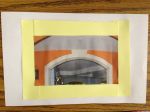
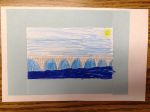
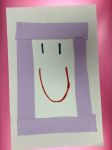
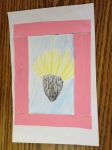
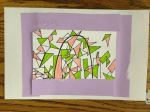
  2. I had my students draw their own picture on a 3×5 index card.  They could also take a picture and bring it in.  This way I didn’t have to find a picture for them, or print it and make copies, or cut it out.  (Yes, I’m lazy and they love being creative so it was win-win.)
  3. I used index cards so I wouldn’t have to cut up a bunch of paper to the perfect size.  Really Fawn, you are a saint.  I had my students draw the picture on 3×5 index cards, then I used 4×6 index cards for the frame.  I cut them down to 4×5 to make the border an even 1″ (see #1).
  4. I had them post the finish product on a half sheet of paper.  This way they could glue down the picture and the frame instead of using tape.  I am always short on tape.  Also, on the back of the picture is where we all “did the math”.

I am posting mainly to say THANK YOU for Fawn, and to share my students creations!  I am really into notebooks so I also included an idea for adding the work to the students notebook.

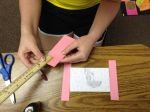
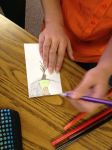
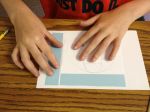
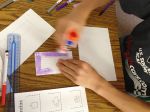
The Process:
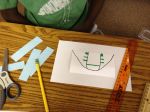
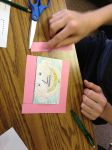
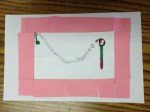
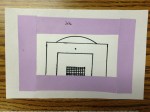
The finished product:
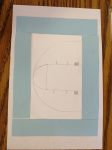
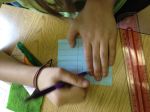
On the back of their picture, we did the math.
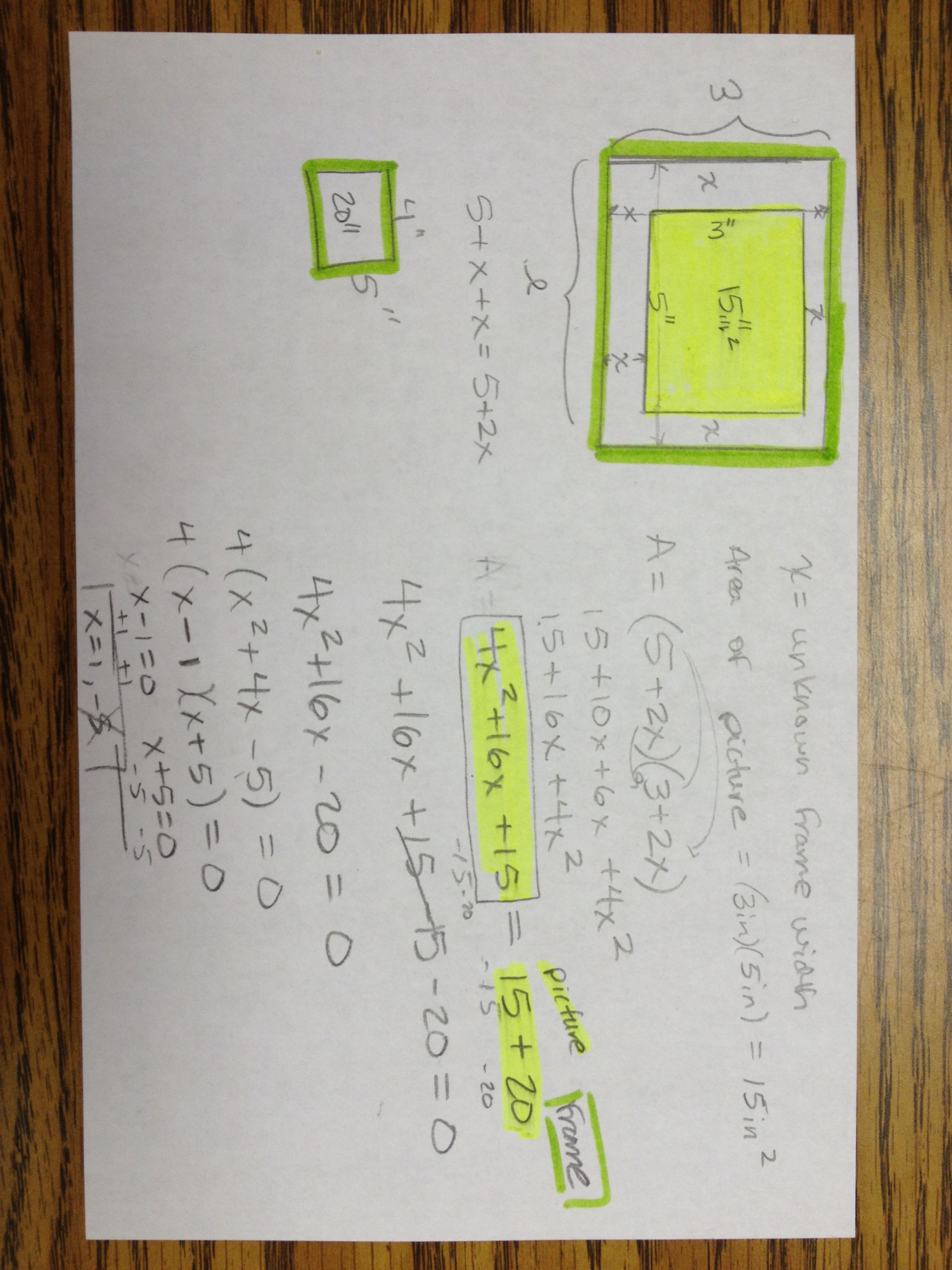
IMG_5027

The Notebook Entry:

Notebook Entry

It's like a foldable!

It’s like a foldable!

Blog About Differentiation

Last night Kate gave a great Global Math talk about differentiation in math class.  If you weren’t able to watch it last night, it was recorded and you can see it here.
Tina and I are going to encourage our readers to blog about differentiation, and then post them on both of our blogs.  So, if you would like to blog about differentiation, your post will be featured on both my blog for MS Sunday Funday and Tina’s for #matheme.
To Submit your post on differentiation to both blogs:
1)  Tweet your link to Tina.  Include #matheme in your tweet.
2)  Click here to submit your post to MS Sunday Funday.  (I will post them next Sunday, May 12th.)
Happy Blogging!

Geometry – Google Forms To Pre-Assess

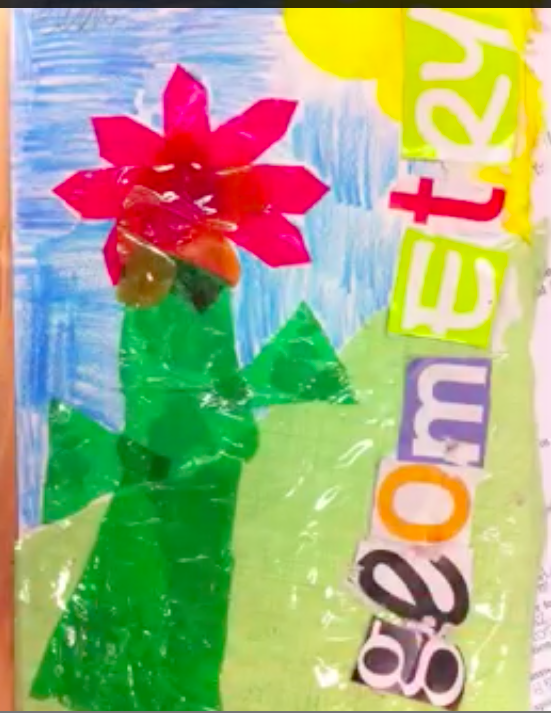
Screen Shot 2013-04-22 at 8.26.20 AMIt’s time for Geometry in 6th grade once again.  I love this time of year because Geometry is so much fun!  Each year, I have my student create Geometry Booklets.  They are half sized booklets that we make from folding a small stack of 8.5″x11″ copy paper in half.  The booklets are a quick way to review past topics without spending days reteaching the topics or taking notes.  Each Geometry lesson I teach goes into the booklet and then they make a wonderful Cubism cover in Art Class.  Taking notes in the booklets are a change from their usual math notebooks.  Change is good in the last weeks of the year to keep the student’s interest up during “Spring fever”.

Every year I jump into the Geometry books, but this year, I wanted to know what they remembered from 5th grade (as I have students from multiple elementary schools) before I started teaching.  After their last test I gave them a Google Survey asking them if they knew certain geometry definitions.  I had them answer yes if they were certain that they knew the definition, and no if they did not know if (or even if they weren’t sure).  The form looked like this.

Screen Shot 2013-04-22 at 8.19.47 AM

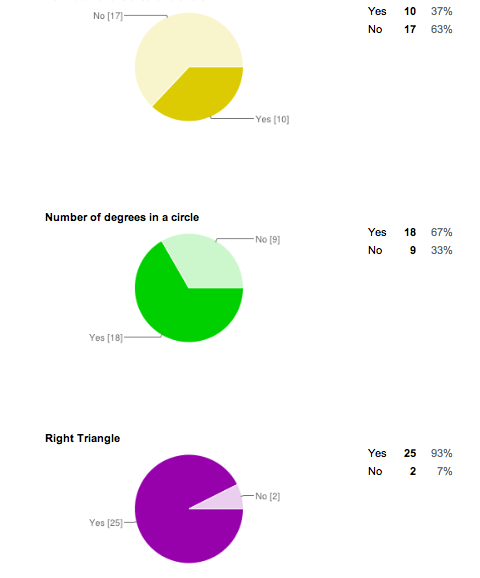
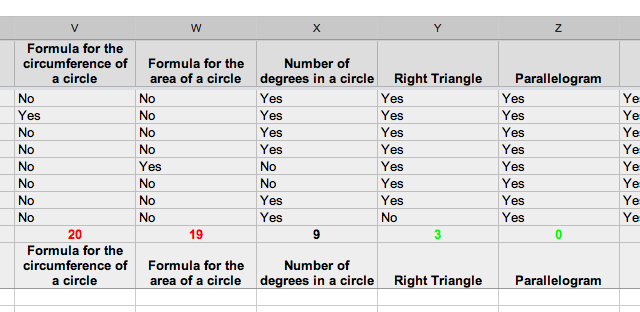
Screen Shot 2013-04-22 at 8.36.49 AMGoogle forms will display the results in pretty pie charts like this.  However, I prefer spreadsheet summaries, so I tallied up my own results.  I counted the results with a CountIf in Google Forms and then conditionally formatted with color to show me at a glance what I really needed to focus on.  The results looked like this.  The red 20 means that 20 of my 32 students did not know the formula for the circumference of a circle.  The green 0 for parallelogram means that all of my students know what a parallelogram is.

Screen Shot 2013-04-22 at 8.19.23 AM

I was surprised that so many students did not remember the area formulas (I had similar results for the areas of triangles and rectangles).  I thought many more students would have remembered the area formulas from 5th grade.  This shows me I will not only need to focus on the area formulas, but more frequently reinforce if I want my students to really learn and then remember these formulas.  Area is such an important topic throughout all “areas” of mathematics.  🙂

MS Sunday Funday – What Would You Like To Blog About?

What are you interested in blogging (or learning) about?  Please fill out the form below to help generate ideas for future Sunday Funday blog posts!  I would love to include High School in addition to Middle School bloggers.  There are many topic overlaps so this is a great idea  (thanks Reilly)!

I’ve had some new ideas lately.  One of the things I would like to explore is posting our creative lessons around a topic or even a software program.  For instance, one week we could post lessons where we used Desmos , Geogebra, or another favorite software.  One week we could all post how we teach solving one-step equations (or any other topic).  We could post about success we have had using lessons currently available on the internet, like from Dan Meyer’s 3-acts or Mathalicious.

We could also take on challenges, like creating our own 3-acts or creating a new lesson where we used Desmos.  We could all create a Virtual Filing Cabinet like Sam’s on our own blogs one week.

Following in the Global Math Format, the first Sunday of each month could be where we post a list of our most recent “Favorites”, whether it be new things we have tried and loved in our classroom or even a collection of blog posts we have enjoyed reading the past month.

I feel that as a “team” we could create some amazing resources.  If you like any of these ideas or have new ones, fill out the form and/or throw them in the comments section.  Happy Sunday!

Julie

Teaching Your Students How to Study for a Math Assessment

#msSunFun

Click here to submit your MS Sunday Funday post!

So, we are back from spring break – at least in body if not in spirit!  April is the most difficult time of year for me to blog.  It is not that I don’t have great ideas or don’t want to blog.  It is that my mind is STILL on spring break.  After a week of vacation, having to go back to work full time is a shock to my system.  At the end of each day I’m exhausted.  I don’t even want to open my computer up when I come home – and I usually don’t.  I even missed Desmos presentation at Global Math last Tuesday night.  I’m a huge Desmo’s fan so this was a tragedy for me.  I didn’t realize that it was Tuesday night until 9:45 and by then it was too late.  Thankfully, it’s recorded (you can watch the Desmo’s presentation on Global Math here), but it’s not the same for me!  Part of the Global Math magic is interacting with the other attendees and especially the presenter.

If you have a post for this week – please add it.  Right now, there is just the two of us.  🙂  And, in spring break style, I am extending this post for another week.  It’s such an important topic and I’d love to hear as many ideas as possible!  Thanks as ALWAYS to Mary for being our most consistent Sunday Funday blogger!

How To Review Past Math Topics

Click here to submit your MS Sunday Funday post!

#msSunFun

Next week:  Spring Break!  The next MSSunFun will be on April 13th and we will blog about how you teach students to study for math tests.  Happy Spring Break!  🙂

SOS – Math Review

Screen Shot 2013-03-23 at 7.53.50 PM

This tweet was favorited, retweeted, and/or responded to at least 20 times after I posted it last night.  Teachers everywhere feel this.  I couldn’t decide if all of the attention made me feel slightly better, or worse.

So, the math review topic could not have come at a better time for me.  For some crazy reason, I decided to grade tests on a Friday night.  It was a “round up” type of test covering important topics from pre-algebra this year; evaluating algebraic expression (involving order of operations), exponents, exponent rules, combining like terms, and multi-step equation solving.  The good news is my students have finally learned to use parenthesis when substituting values for variables and can solve equations LIKE MAD.  The bad news?  They are apparently mystified by the order of operations, especially within the vicinity of any sort of exponent rule problem.  I felt so defeated after grading those tests.  I failed.  After my dog used me as a trampoline in the middle of the night, I could not go back to sleep thinking about it.  I do so much to help them learn math, but what am I helping them do to remember it?  I have failed.

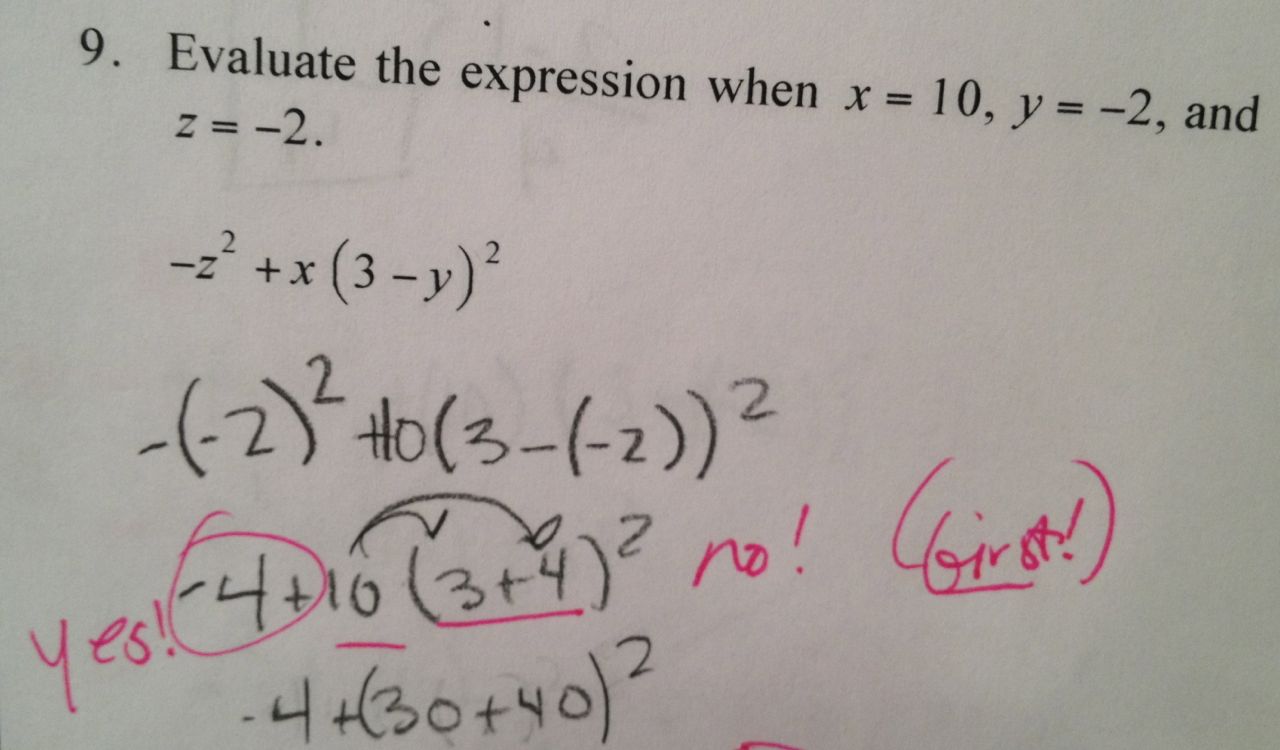
The most common math mistake that I encountered was:

MathMistake

Students had order of operations issues and just wanted to distribute things.  Michael, here come.

What happened?  First, I HATE PEMDAS.  This starts early, and students are already brainwashed by 6th grade when I get them.  I teach my students GEMS instead of PEMDAS but all of the GEMS in the world can’t seem to fix this.  I hate PEMDAS because students see parenthesis and go into “I must do that first” mode, even when there is only ONE number inside the parenthesis.  Just because it is in parenthesis, one number, for example (2), does NOT a group make.  I must frequently emphasize this, because very few students made this error when there was just one number in the parenthesis.  But, this knowledge did not transfer when they had two numbers.  The distributive property trumped all.  They do love to distribute.  They also distributed the exponent to both numbers inside the parenthesis.  I have no idea why they would do this, because I don’t even teach them the power to a power exponent rule.  I have them expand any set of parenthesis with an exponent.  They do love the distributive property, but we-e have never, ever, ever, distributed an exponent.  Sigh.  I failed.

This year things are worse than before because our classes are shorter than last  year.  I have replaced my daily warm-up review with “Make a new page in your notebook and update your TOC”.  It’s been awesome for our INB, but obviously tragic for the Order of Operations.  So, starting Monday, I am going to have one problem of the day for both classes posted on the board.  It will look like a variation of this.  Evaluate  -3x^2 – 2x + 5 when x = -2.  I’ll throw in fractions, decimals, and any other basic, easily forgettable concept.  This should help them quickly practice evaluating algebraic expressions, exponents, and the order of operations, EVERYDAY.  And we will go over it, together, everyday.

I will NOT go down, without a fight.

What are YOU doing to review past math topics?  What are YOU doing to help them remember what they have learned?

Oreo Cookie Math – Double Stuf Steals the Show

When I saw Dan’s post on Oreo cookies I knew this was meant JUST FOR ME. It was especially interesting because Chris Danielson in part 1 2 and 3, and Chris Lusto in part 1 and 2 also investigated it. I had to jump into the fun. I mean, WHO doesn’t love Oreos?

I have math club once a week and always bring them treats to eat. I’m not below bribery. So, when I saw Dan’s post I thought, “Awesome! I can feed Math Club AND make the food about math at the same time!” #Nguyen for sure.

Woodlawn Math Club

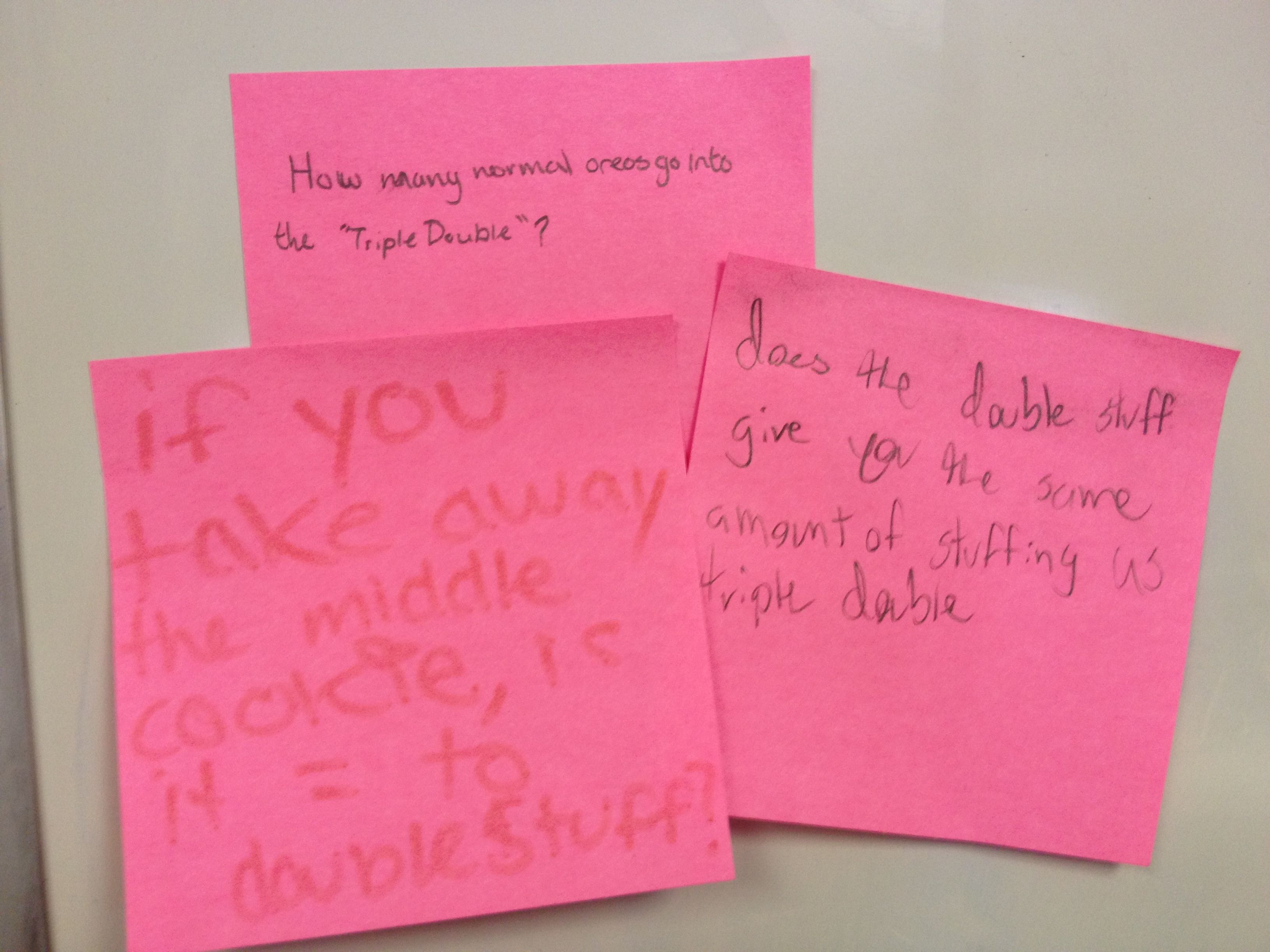
I pulled the four 4 packages of Oreo cookies I had bought to the “Oohs and ahhs!” of my math club. My 16 kids did the math in their heads instantly, calculating how many Oreos each of them were going to get to eat today. I opened the packages and pulled one out from each, original, double stuffed, chocolate, and triple stuffed. (Side note: I was very disappointed I couldn’t find a mega-stuffed package at the grocery store because I KNEW they would have gone nuts over that.) I then lined the cookies up next to each other. “Any Questions?” I asked as I handed them each a post-it note.

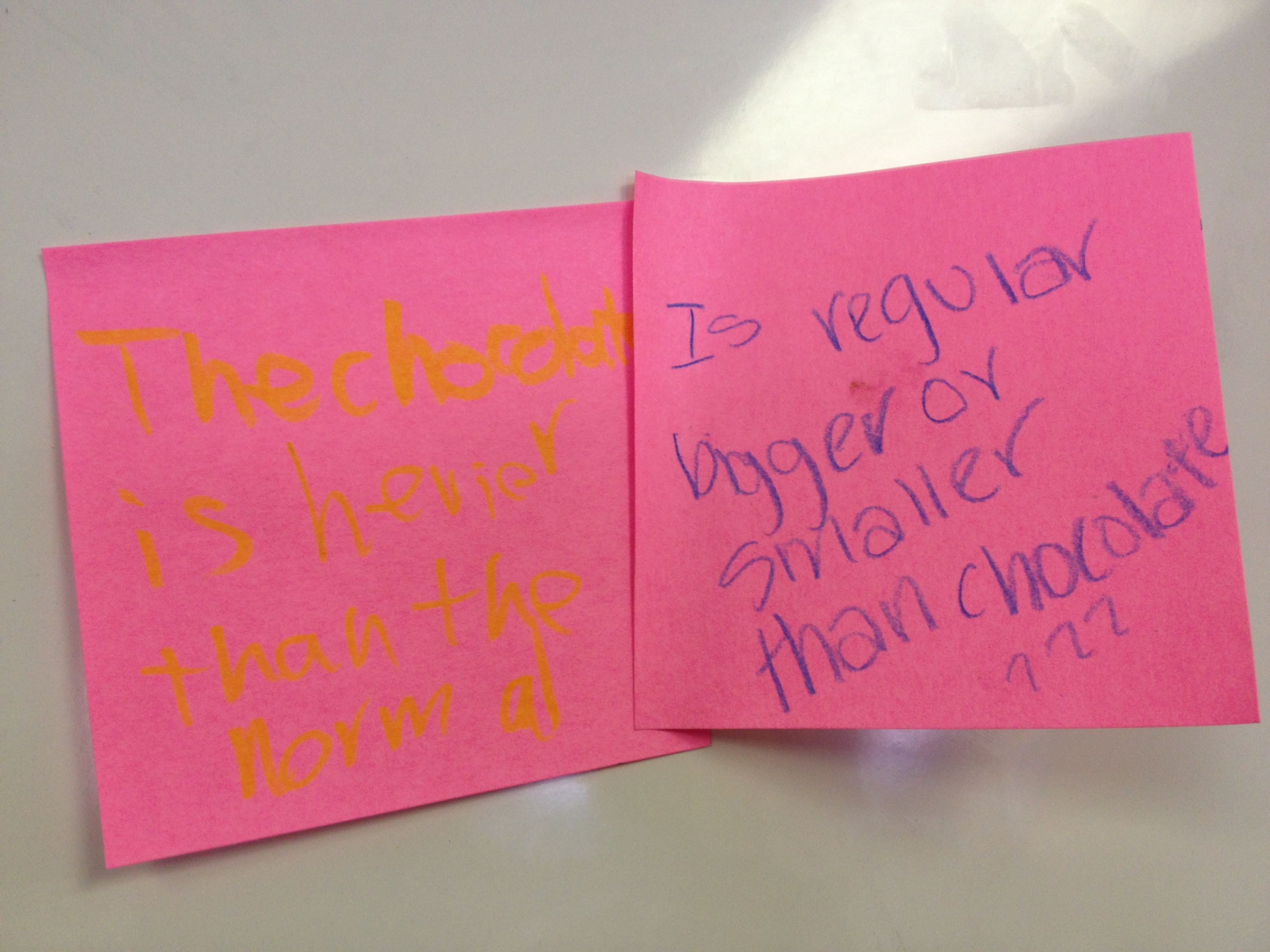
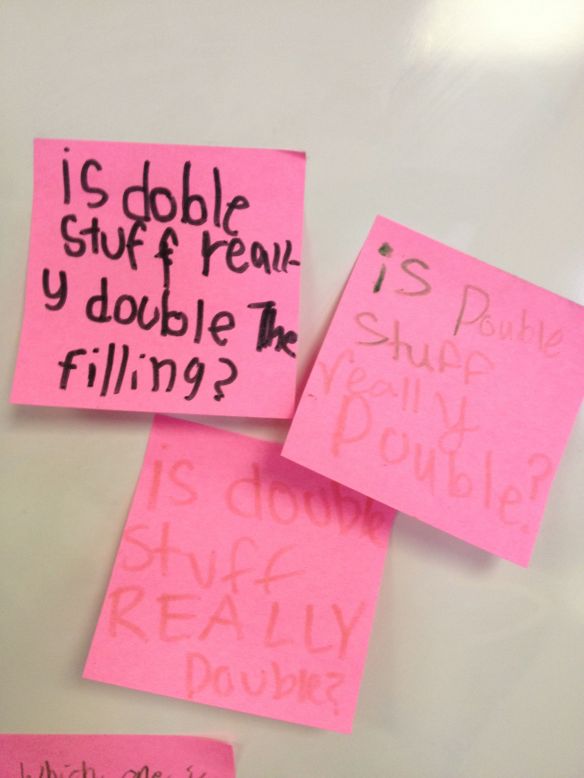
Excitement buzzed through the room as they posted their questions up on the board and then we sorted them.
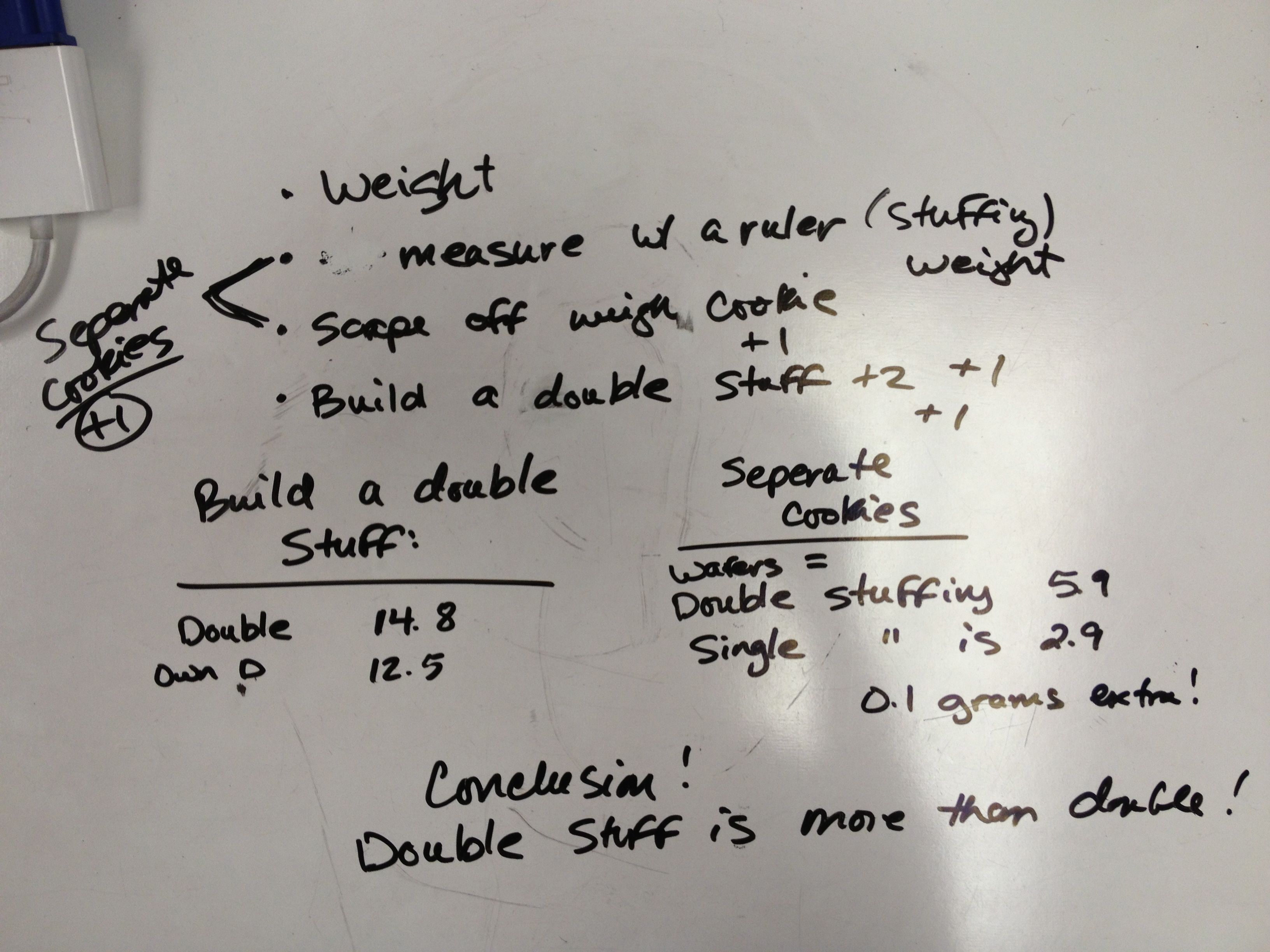
IMG_4905 IMG_4914IMG_4911 IMG_4913After talking through all of the questions they decided to work on “Is double stuf REALLY double the stuffing?” I offered to let different groups work on different questions but double stuffing won out! Then, they brainstormed how we could find the answer to our question. Here is what they came up with.

IMG_4899They then decided to break up into teams. Even though there were four teams, it ended up being girls vs. boys. The girls decided to weigh the wafers and the stuffing and the boys decided to build a double stuffed Oreos from the stuffing of two single stuffed Oreos.

The room was a bustle of activity as the students went to work. I was the “official” weigher so I could ensure all of the results were consistent for a good comparison. All groups decided to weigh and measure several cookies (or cookie parts) so that we could get more accurate results. I was very busy with all of the weighing so unfortunately I do not have pictures of this stage. But I promise, it was fun, messy, and mathy!

After they were all finished they shared their results with each other. It was great because all four groups came to the same conclusion. Based on weight, double stuffed Oreos are MORE than double stuffing compared to regular Oreos!

IMG_4901

In the end I videoed their conclusions, one representative from the girls side and one from the boys. Unfortunately, my iPhone went wonky and did not record the boys conclusions. this was tragic as they had made their own mega-stuffed Oreo and even had an Oreo dance! Ah, technology!

Thanks so much to the MathTwitterBlogoSphere for making my job so easy! I don’t even have to come up with the ideas – they come to me in my Twitter Feed and GReader (RIP – sigh).

** Edited to say Double Stuf – one f.  Seriously, who knew that?

“Infusing Math Class with Google Docs” Slideshow

It’s always great fun presenting at Global Math!  If you want to actually hear the entire presentation (and all of the great questions that went with it), go to Global Math.

If you would like anything else, please let me know in the comments.

This presentation contains many examples of my Google documents as well as student work.

I explained how to use the different Google Document software platforms for project work and collaboration in the mathematics classroom.  I shared technology based projects that encourage students to be creative and allow students to differentiate their own learning.  I showed how you can use these student generated projects as curriculum (and even homework) for future students.

Finally, I talked about formulas and the amazing ImportRange function that allows you to import data from many spreadsheets into one!   This is great for organizing Concept scores.

I’m Presenting Online at Global Math, Infusing Math Class with Google Documents, this Tuesday!

Come and see how Google Documents can transform your mathematics class and inspire your students!  This Tuesday at 9PM EST I’ve got the entire hour to teach you all about how I use Google Documents almost every day in my math classroom.  Click here to pre-register or just show up on Tuesday night at 9pm and enter the conference.  I love the Global Math format as everyone can “chat” and ask questions while I am presenting.

This session is for teachers that are new to Google Documents as well as experienced users.  I will be showcasing many examples of my Google documents as well as student work.

I will explain how to use the different Google Document software platforms for project work and collaboration in the mathematics classroom.  I will share my technology based projects that encourage students to be creative and allow students to differentiate their own learning.  I will also show how you can use these student generated projects as curriculum (and even homework) for future students.

Screen Shot 2013-03-18 at 12.28.57 AM