It’s back to school time!!
Here is a compilation of posts that will hopefully help with all of your “Back To School” planning. I thought that putting them all in one place would be helpful. Happy planning and welcome back to school!
It’s back to school time!!
Here is a compilation of posts that will hopefully help with all of your “Back To School” planning. I thought that putting them all in one place would be helpful. Happy planning and welcome back to school!
I’m teaching high school now, but here are the lessons that I miss the very most. These are my “Must Do” lessons. I have a few friends who will teach middle school math (or Algebra 1) for the first time this year. Thanks to Jami for the inspiration for organizing these lessons. It’s been a walk down memory lane for me. I really miss middle school.
These lessons really kicked ass. Not only did I love teaching them, but students had a blast. Best of all, these are the lessons that students learned the most from. They were totally engaged and the ideas stuck. Of course my number one lesson of all time is Barbie Bungee. And, I just realized that I never blogged about some of my all time favorite lessons! Goals!
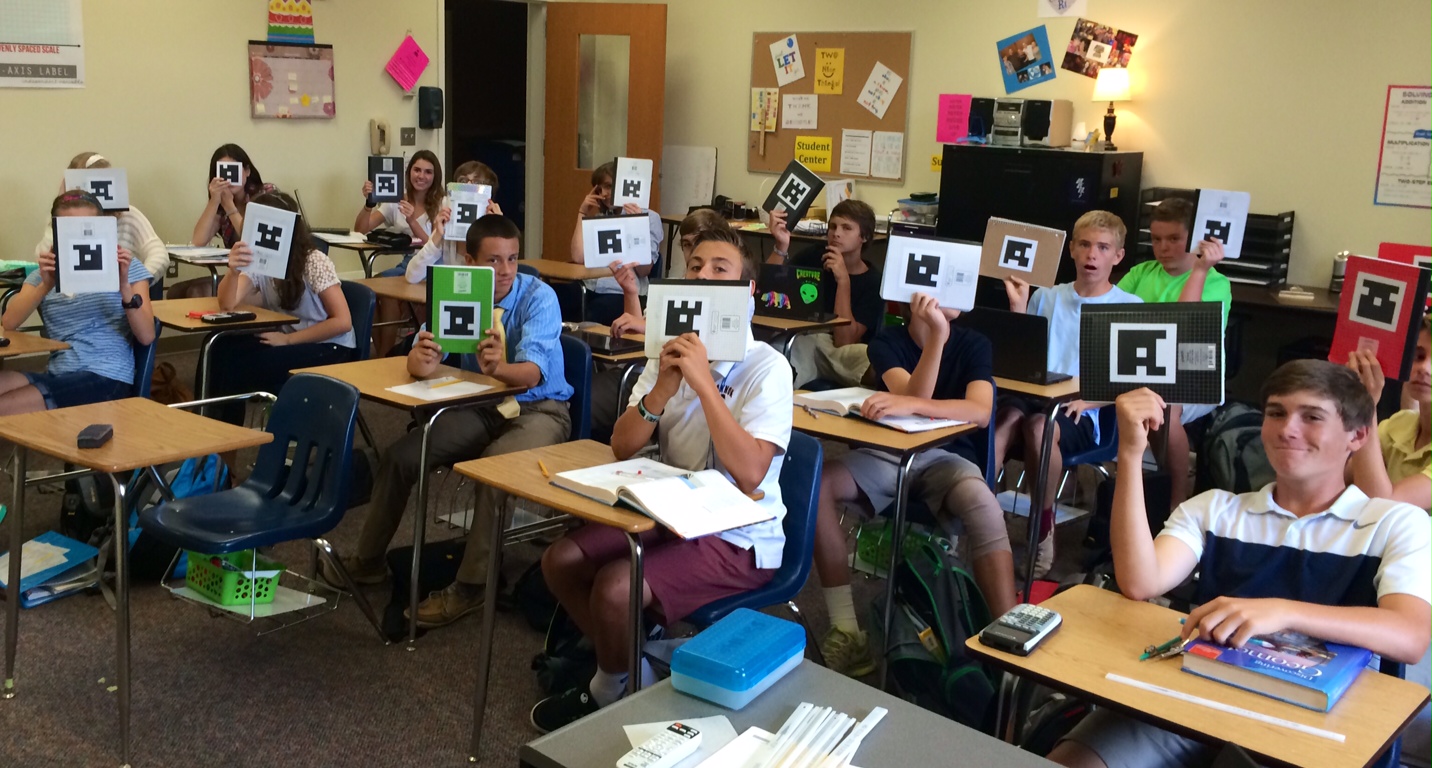
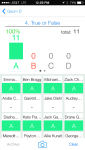
If you want 100% of your students engaged and asking you to do an activity, you need to try Plickers.
The amazing Pam Wilson introduced us to them at Twitter Math Camp. We were ALL amazed and impressed!
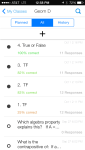
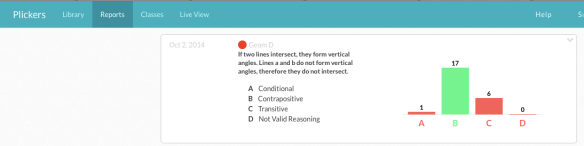
A Plicker is a “paper clicker” with a bar code that the students hold up and then you scan with any smartphone or iPad. Only one device needed, no batteries required! The students can pick A, B, C, D or True/False. The data immediately shows up on your phone AND on their website as a bar graph. I assigned my students a number, so I can even see who missed the question as I am scanning the room.
From your computer, you can project their responses onto your overhead. It only shows the correct responses in the “Live View”.

It also stores the data on their website so you have a record of correct and incorrect answers. I know you think that I must be lying, but I am not. These things are AMAZING.
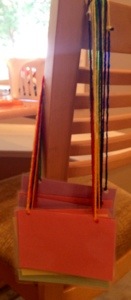
I decided to affix my students Plickers to the back of their INB with clear contact paper. That way, they should always have them handy during class, and hopefully they won’t get destroyed! I oriented them all differently (either A, B, C, or D facing up) on their notebooks so they couldn’t see how other students were holding up their notebooks to get a hint. It’s so much fun for the students and for me!
I have been using it as a warm-up, to asses prior knowledge or expose them to a new topic that we will begin that day. I think it would also be a great “Pre-Assessment” or “Exit Ticket” tool.
You can see below how other teachers are using them in class as well. If you have an idea about how Plickers could be used, please put it in the comments. Also, if you have blogged about Plickers, please post your link in the comments so that we can all get great new ideas!
I teach 6th and 7th grade math so I get my students for two years in a row. The beginning of 7th grade year is a review of their entire 6th grade year. It’s fabulous because I get to go pretty fast through the material and only focus on what they need. I don’t usually need to teach the entire lesson again and they did the discovery activity the year before. This leaves plenty of time to practice, practice, practice!
This year I’ve had much more fun than ever before with in class practice thanks to the great math teachers at TMC12. This summer I learned all about their favorite things, many of which included fun ways to practice.
I have found that practice is more effective when I put kids in groups or with a partner and either play games or do a fun activity. I never, ever just give them a worksheet to work on.
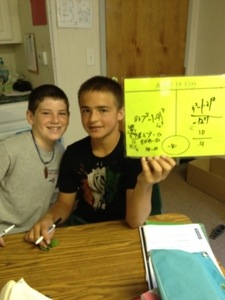
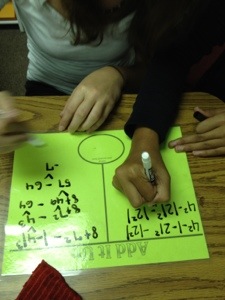
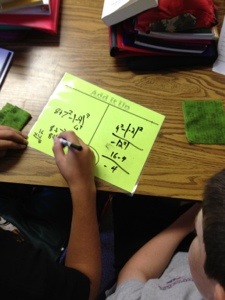
Right now my favorite activity is Rachel’s math “placemats”. I made a dry erase template for the activity and called it “Add It Up”. All you need to play is a worksheet and a template. You can use any worksheet that you have. To play, two or four students work on individual problems and then add the sum up and write it in the middle. I check the sum. If it’s correct, they move on. If it is incorrect, they don’t know which problem is incorrect. I usually tell them to work each others problem.
This is a great way to differentiate. I usually have the students work with students that work at the same “pace” as they do so one student doesn’t get frustrated. Everyone can thus work at their own pace. Quicker students move from the easier problems at the beginning to the work difficult ones. And, I put incredibly difficult problems at the end. It’s the one day when I can really challenge my highly gifted students. I can also take time to sit with my students that need more help and do some re-teaching.
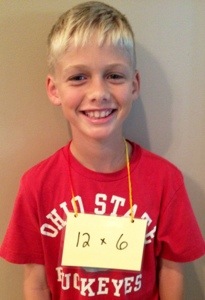
I loved new blogger Bruce’s post “My Name is 6 x 7” where each student wears a multiplication fact (say 12 x 6) on a name tag. Then, everyone calls that person 72 for the whole time they are wearing their multiplication name tag. As soon as I read this, I knew I had to try it with my 6th graders! Most of them are still having trouble with 9’s and 12’s facts. My problem is they are only in math for 1 hour a day, so for this to be effective, they would need to wear their facts for a few days in a row in my class. Since I didn’t want to use up 32 name tags a day (labels can get expensive), I came up with a dry-erase nametag solution.
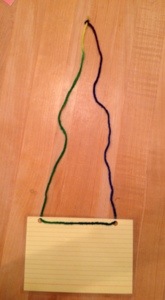
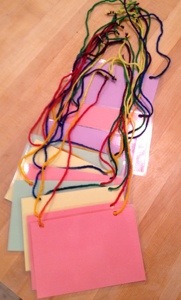
Nora gave me the great idea in a comment on my Math Stations post about making necklaces out of index cards. I laminated index cards, punched two holes in them, and then put string in them to make dry-erase index card necklaces. When the students come in, they can write their fact on their necklace and wear it. Whenever they speak, they must introduce themselves (ie – 12×6 would be called 72! And whenever anyone speaks to them, they must call them by their multiplication name (72).
These necklaces are so cool that I am trying to think of other fun ways to use them! Bruce said a teacher in his building puts longer problems on them. I am thinking:
That’s all I have for now. But if you have a brilliant idea (and I’m sure that you do!), please leave it in the comments!
Last year I transitioned from regular notebooks to spiral bound graph paper notebooks.
I LOVE graph paper notebooks for two main reasons. First and foremost, I never have to pass out graph paper. We make many tables, charts, and graphs in my class so having their notebook BE graph paper is just divine. Additionally, I teach 6th grade and many of them still have giant handwriting and/or their work is all over the place. With the graph paper notebooks, I can strongly encourage them to put one number in each square. This helps in almost every mathematical procedure that they do. Numbers are small, neat, and all lined up. Beautiful.
I also do a modified version of the INB (Interactive Notebook). I didn’t do very well with the Left Hand Page OR the Table of Contents last year, but thanks to Megan I am motivated and planning to be much better this year!
Most teachers like to use the composition books for the Interactive Notebook. They DO have these graph paper composition notebooks! But, I would have to buy them all myself and have the students reimburse me. My parents have a hard enough time finding the graph spiral bound notebooks and I don’t want to stress them out further. Whatever you do, don’t let them use the notebooks with the glued in pages (not the composition books). The pages of the notebooks with the glued in pages start falling out, in mass, after about 2 weeks of use. This is a nightmare.
Notebook Tips:
Read more Middle School Math Sunday Funday Posts!
Hi! Be sure to follow me on Twitter for more updates! I am @jreulbach. 🙂
Welcome to a collaboration of posts by amazing middle school math teachers!
This week’s theme is First Day / First Week Activities. Next week, the theme will be sharing how you have your students set up their math class notebooks. This can be interactive notebooks or traditional notebooks.
To submit a blog, click on this link.
** Brand new blogger!